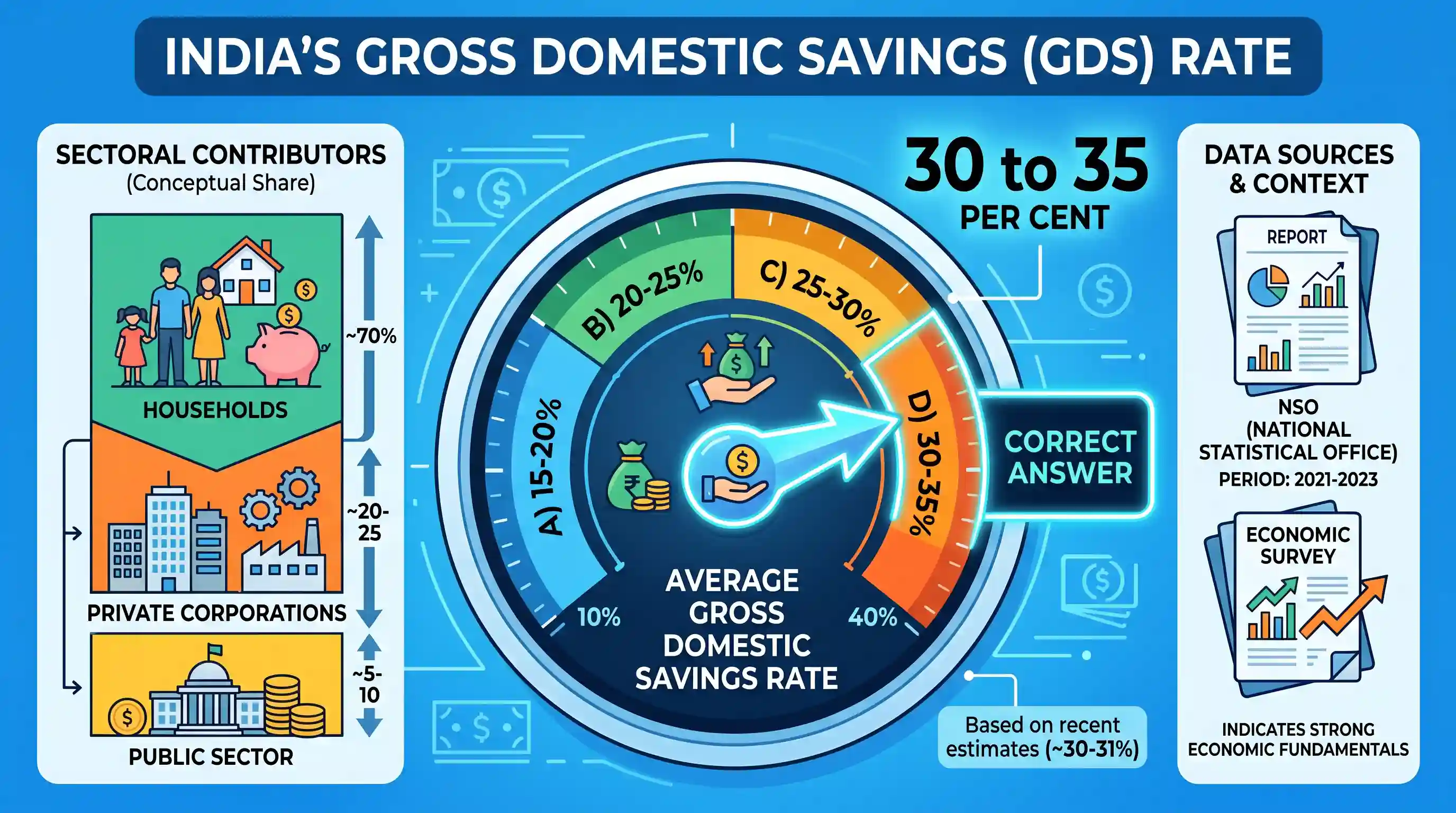
The average rate of domestic savings (gross) for the Indian economy is currently estimated to be in the range of

- A15 to 20 per cent
- B20 to 25 per centCorrect
- C25 to 30 per cent
- D30 to 35 per cent
Explanation
The correct option is B because the Gross Domestic Savings rate in India has been hovering around 30 percent in recent years. Specifically, according to the National Statistical Office and the Economic Survey, the savings rate for the period 2021 to 2023 was recorded between 30 and 31 percent. In the context of UPSC examinations, this range typically falls within the 30 to 35 percent bracket, making it the most accurate representation of the current economic data. The savings are primarily driven by the household sector, followed by private corporations and the public sector.
Related questions
More UPSC Prelims practice from the same subject and topic.
- Prelims 1997GS1economy
Human Development Index comprises literacy rates, life expectancy at birth and
- Prelims 1997GS1economy
In India, inflation is measured by the
- Prelims 1997GS1economy
National Income is the
- Prelims 1997GS1economy
The average monthly income of a person in a certain family of 5 is Rs. 1000. What will be the monthly average income of a person in the same family if the income of one person increased by Rs. 12,000 …
- Prelims 1997GS1economy
The following table shows the per cent change in the number of sales (in rupees) at different retail stores in a given neighbourhood market in the period 1993 to 1995: Retail Store Percent Change 1993…
- Prelims 1997GS1economy
The economic and monetary union of 15 European Countries is proposed to be made by 1999. But the currencies of two countries, Franc, have already the same value and circulate freely in both the countr…