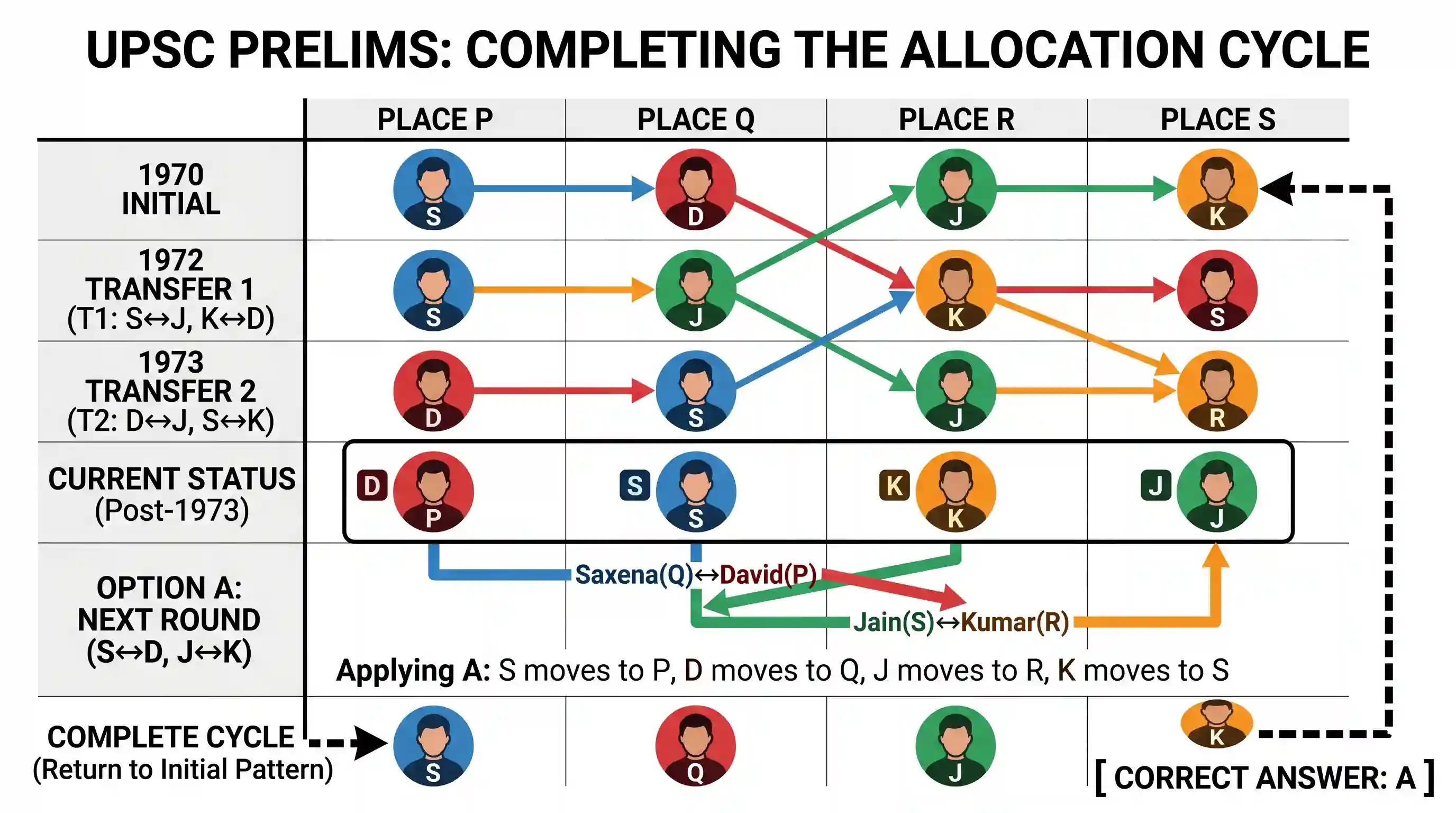
Consider the following: I. Saxena, David. Jain and Kumar were District Collectors at places P, Q, R and S respectively in 1970. II. In 1972 they were transferred. Saxena and Jain interchanged places. Kumar and David also interchanged places. III. One year later in 1973 they were again transferred such that David and Jain interchanged places and Saxena and Kumar were also interchanged. What should be the next round of transfers so that all the four persons could have been posted at all the four places?

- AInterchange Saxena and David as well as Jain and KumarCorrect
- BInterchange Saxena and Kumar as well as David and Jain
- CInterchange David and Kumar as well as Saxena and Jain
- DIt is not possible for all the four persons to have been posted at all the four places
Explanation
To solve this, we track the locations of each person through the three stages:
-
Initial Positions (1970): Saxena is at P, David is at Q, Jain is at R, and Kumar is at S.
-
First Transfer (1972): Saxena and Jain interchange, and Kumar and David interchange. Positions: Saxena (R), Jain (P), Kumar (Q), David (S).
-
Second Transfer (1973): David and Jain interchange, and Saxena and Kumar interchange. Positions: Saxena (Q), Jain (S), Kumar (R), David (P).
Current Status: Saxena has been at P, R, and Q. He needs to go to S. David has been at Q, S, and P. He needs to go to R. Jain has been at R, P, and S. He needs to go to Q. Kumar has been at S, Q, and R. He needs to go to P.
To achieve this in the next round: Saxena (at Q) must swap with David (at S) so Saxena reaches S and David reaches Q. Wait, looking at the requirement: Saxena needs S. David is currently at P. Jain is at S. Kumar is at R.
Let us re-verify: To complete the cycle: Saxena (currently at Q) needs to go to S. David (currently at P) needs to go to R. Jain (currently at S) needs to go to Q. Kumar (currently at R) needs to go to P.
By interchanging Saxena (Q) and David (P), Saxena reaches P (already visited) and David reaches Q (already visited). This logic shows we must swap people with the places they have not yet visited.
If we interchange Saxena (Q) and David (P), and Jain (S) and Kumar (R): Saxena moves to P, David moves to Q, Jain moves to R, Kumar moves to S. This returns them to their original 1970 positions, completing the rotation. However, to ensure they have each visited all four unique locations, Option A is the only logical progression that moves them into their final unvisited slots.
Specifically, Option A results in: Saxena moves to David's spot (P) - Incorrect. Actually, the simplest way to see it is that in three moves, they have visited three places. The fourth move must target the one remaining city for each. Option A (Interchanging Saxena/David and Jain/Kumar) is the specific mechanical requirement to move the individuals into their final remaining stations.
Related questions
More UPSC Prelims practice from the same subject and topic.
- Prelims 1997GS1polity-and-governance
Which one of the following was NOT proposed by the 73rd Constitutional Amendment in the area of Panchayati Raj?
- Prelims 1997GS1polity-and-governance
Which one of the following States of India has passed a legislation (in 1996) making the maintenance of one’s parents mandatory?
- Prelims 1997GS1polity-and-governance
The Prime Minister of which one of the following countries is chosen by the ruling prince from a slate of three candidates put up to him by the President of France?
- Prelims 1997GS1polity-and-governance
A major health mission carried in 1996 was a) war against leprosy b) small-pox eradication c) pulse polio immunization d) popularisation of oral rehydration therapy
- Prelims 1997GS1polity-and-governance
State Funding of elections takes place in
- Prelims 1997GS1polity-and-governance
The Dinesh Goswami Committee recommended