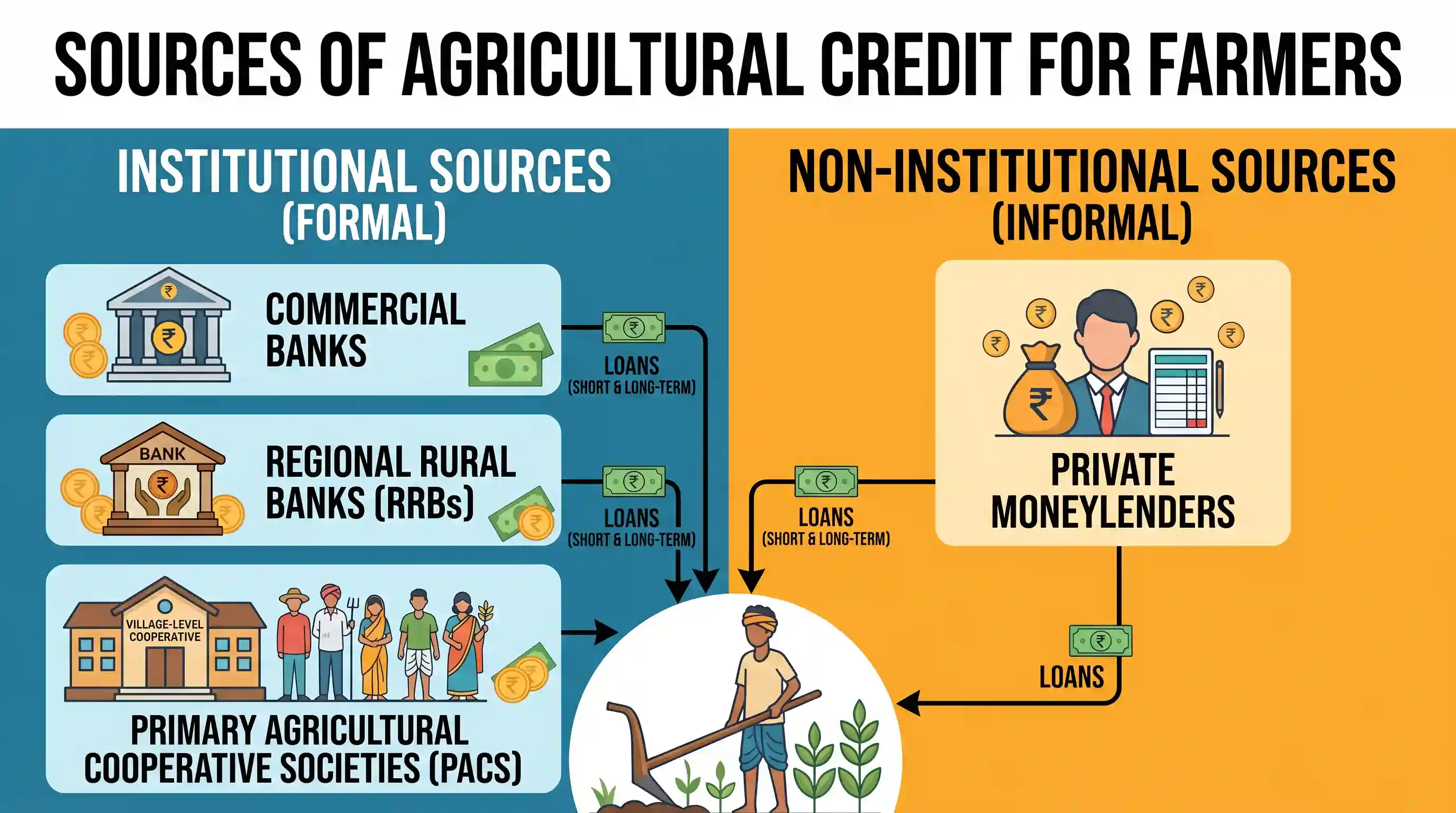
The farmers are provided credit from a number of sources for their short and long- term needs. The main sources of credit to the farmers include

- Athe Primary Agricultural Cooperative Societies, commercial banks, RRBs and private moneylendersCorrect
- Bthe NABARD, RBI, commercial banks and private moneylenders
- Cthe District Central Cooperative Banks (DCCB), the lead banks, IRDP and JRY
- Dthe Large-scale Multi-purpose Adivasis Programme, DCCB, IFFCO and commercial banks
Explanation
The correct answer is A because it accurately represents both institutional and non-institutional sources of agricultural credit.
Primary Agricultural Cooperative Societies, Commercial Banks, and Regional Rural Banks (RRBs) are the primary institutional agencies that provide short-term and long-term loans directly to farmers. Private moneylenders, while non-institutional, remain a significant source of credit in the rural economy.
Option B is incorrect because NABARD and RBI are regulatory and refinancing bodies that do not provide direct credit to farmers. Option C includes government schemes like IRDP and JRY which are poverty alleviation and employment programs, not direct credit sources. Option D includes IFFCO, which is a cooperative federation for fertilizers rather than a credit-providing financial institution.
Related questions
More UPSC Prelims practice from the same subject and topic.
- Prelims 1999GS1economy
Persons below the poverty line in India are classified as such based on whether
- Prelims 1999GS1economy
Consider the following statements: Regional disparities in India are high and have been rising in recent years because I. there is persistent investment over time only in select locales. II. some area…
- Prelims 1999GS1economy
Consider the following statements: Industrial development in India, to an extent, is constrained by I. lack of adequate entrepreneurship and leadership in business. II. lack of savings to invest. III.…
- Prelims 1999GS1economy
The Employment Assurance Scheme envisages financial assistance to rural areas for guaranteeing employment to at least
- Prelims 1999GS1economy
Consider the following statements: Small-scale industries are, in most cases, not as efficient and competitive as the large-scale ones. Yet the Government provides preferential treatment and reservati…
- Prelims 1999GS1economy
Trans chart is the