“India has the largest population of the Asian X. Today, there are just about 20,000 to 25,000 X in their natural habitat spreading across the evergreen forests, dry thorn forests, swamps and grasslands. Their prime habitats are, however, the moist deciduous forests. The X population in India ranges from Northwest India where they are found in the forest divisions of Dehradun, Bijnor and Nainital districts of UP to the Western Ghats in the states of Karnataka and Kerala and in Tamil Nadu. In Central India, their population is distributed in southern Bihar and Orissa. In the East, they are seen in North Bengal, Assam and a few other states.” The animal ‘X’ referred to in this quotation is

- ALion
- BElephantCorrect
- CTiger
- DOne horned rhinoceros
Explanation
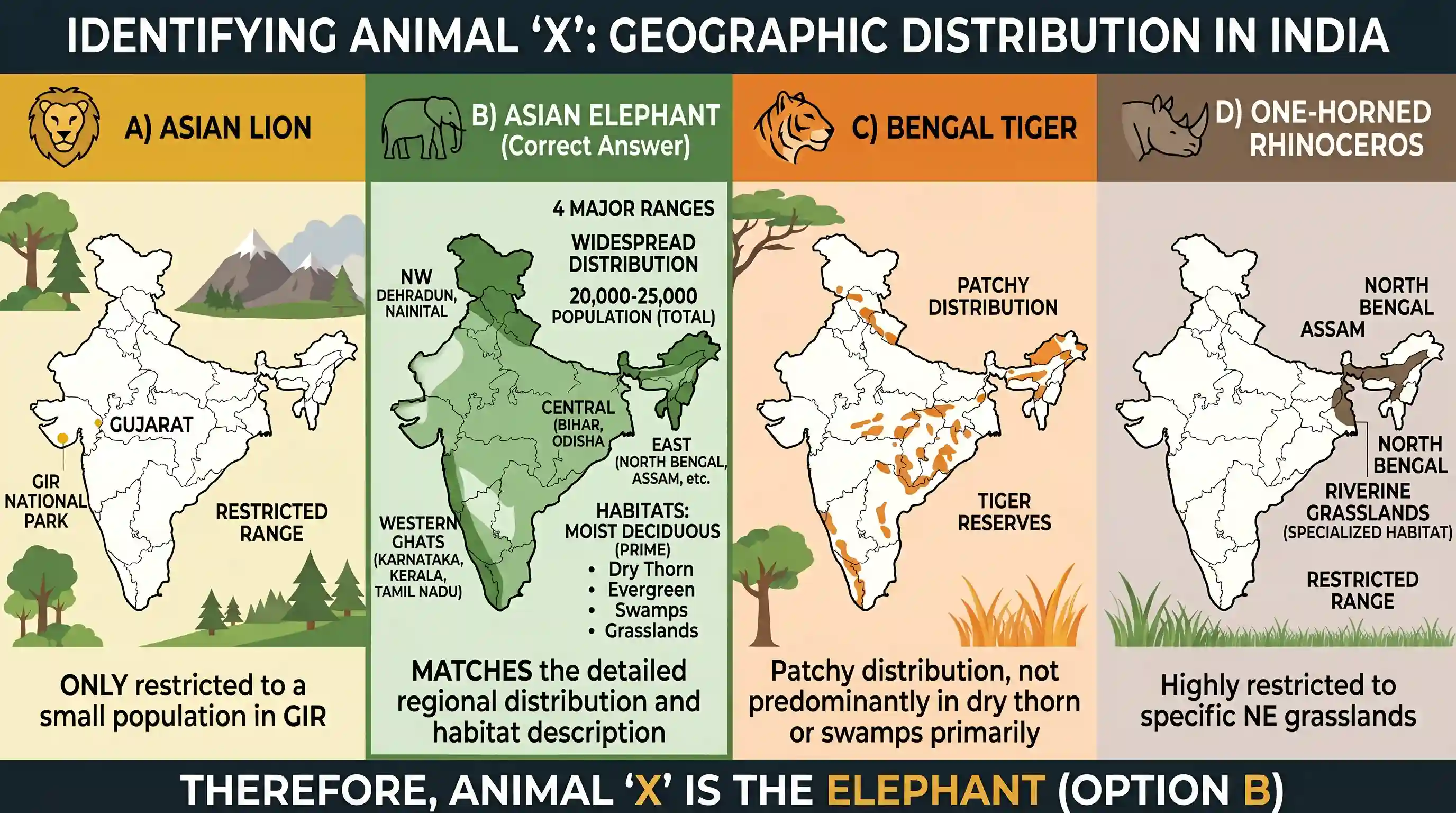
The animal X is the Elephant. The description fits the Asian Elephant for the following reasons:
-
Habitat Range: Elephants occupy a diverse range of habitats mentioned, including the foothills of the Himalayas in Uttarakhand and UP, the Western Ghats, and the northeastern states.
-
Specific Ecosystems: While they can live in dry forests and grasslands, their primary habitat is the moist deciduous forest, which is characteristic of the elephant populations in South and Central India.
-
Population Distribution: The geographic spread described matches the four major elephant ranges in India: North, South, Central, and Northeast.
-
Exclusions: Lions are restricted only to the Gir National Park in Gujarat. Tigers do not have their largest population in dry thorn forests or swamps primarily. One-horned rhinoceroses are limited almost exclusively to the riverine grasslands of Assam and West Bengal, lacking the broad distribution across the Western Ghats or Central India described in the text.
Related questions
More UPSC Prelims practice from the same subject and topic.
- Prelims 1999GS1geography
The minimum land area recommended for forest cover to maintain proper ecological balance in India is
- Prelims 1999GS1geography
The first marine sanctuary in India, having within its bound’s coral reefs, Mollusca, dolphins, tortoises and various kinds of sea birds, has been established in
- Prelims 1999GS1geography
Which one of the following legislations does not deal with the protection of environment?
- Prelims 1999GS1geography
Which one of the following agricultural practices is eco-friendly?
- Prelims 1999GS1geography
Which one of the following is a useful functional association between fungi and the roots of higher plants?
- Prelims 1999GS1geography
If it is 10.00 a.m. I.S.T., then what would be the local time at Shillong on 92°E longitude?