Consider the following statements: Glass can be etched or scratched by I. diamond. II. hydrofluoric acid. III. aquilegia. IV. cone, sulphuric acid. Which of these statements are correct?

- AI and IV
- BII and III
- CI and IICorrect
- DII and IV
Explanation
The correct option is C because of the following reasons:
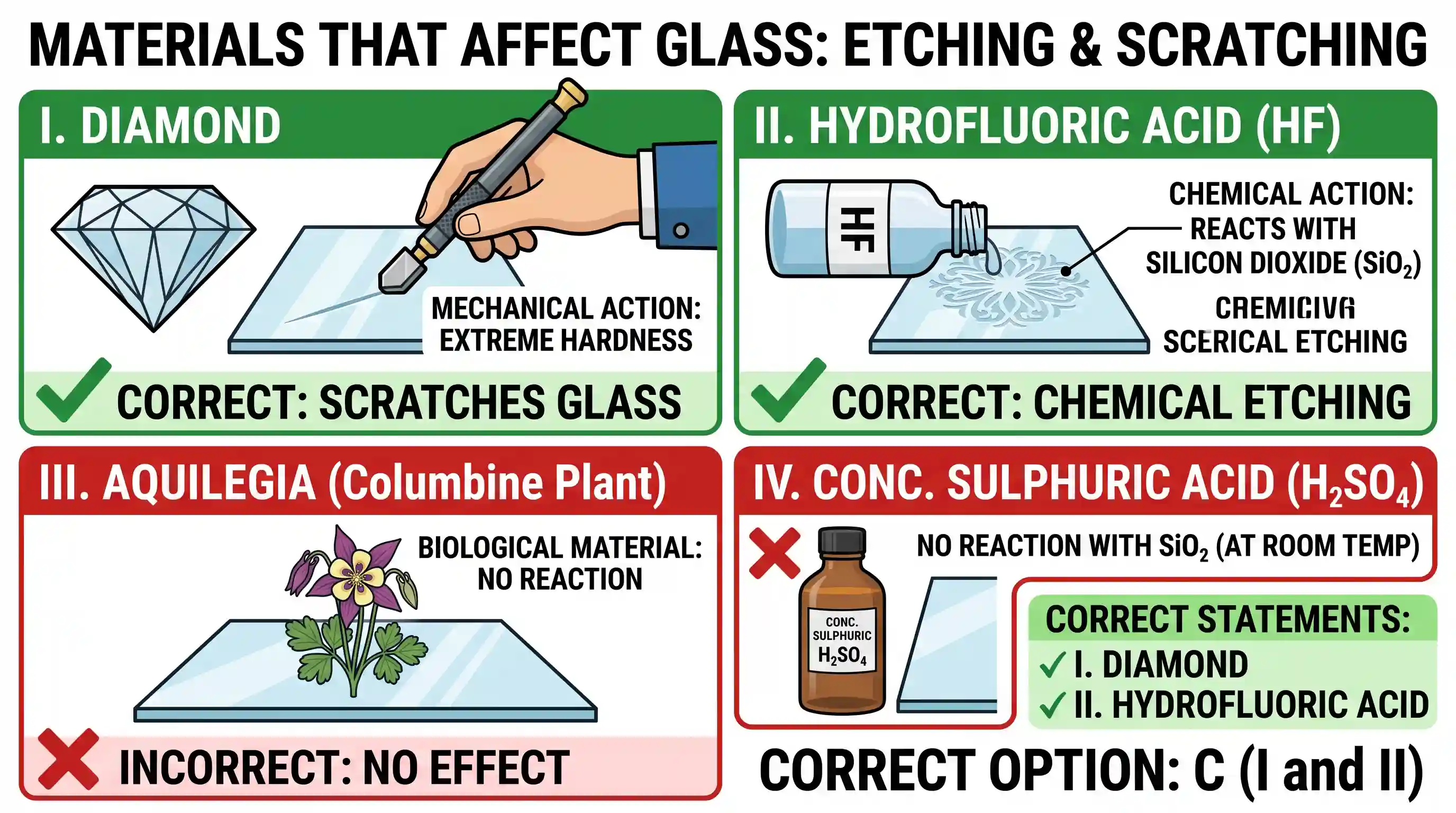
Statement I is correct because diamond is the hardest natural substance known. Due to its extreme hardness, it can easily scratch the surface of glass, which is why it is commonly used in industrial glass cutters.
Statement II is correct because hydrofluoric acid is one of the few acids that can chemically react with silicon dioxide, the main component of glass. This chemical reaction dissolves the glass surface, a process known as etching.
Statement III is incorrect because aquilegia is a genus of flowering plants, commonly known as columbine, and has no properties that can etch or scratch glass.
Statement IV is incorrect because concentrated sulphuric acid does not react with silicon dioxide at room temperature and therefore cannot etch glass.
Since only statements I and II are accurate, option C is the right answer.
Related questions
More UPSC Prelims practice from the same subject and topic.
- Prelims 1999GS1science-and-technology
Match List I (Naturally occurring substances) with List II (Elements) and select the correct answer using the codes given below the Lists: List I List II I. Diamond A) Calcium II. Marble B) Silicon II…
- Prelims 1999GS1science-and-technology
Consider the following statements regarding a motor car battery: I. The voltage is usually 12 V. II. Electrolyte used is hydrochloric acid. III. Electrodes are lead and copper. IV. Capacity is express…
- Prelims 1999GS1science-and-technology
Assertion (A): Information technology is fast becoming a very important field of activity in India. Reason (R): Software is one of the major exports of the country and India has a very strong base in …
- Prelims 1999GS1science-and-technology
In eye donation, which one of the following parts of donor’s eye is utilised?
- Prelims 1999GS1science-and-technology
Consider the following statement: An ordinary light bulb has a rather short life because the I. filament wire is not uniform. II. bulb cannot be evacuated completely. III. wires supporting the filamen…
- Prelims 1999GS1science-and-technology
Match the hormones in List I with items in List II and select the correct answer using the codes given below the Lists: List I I. Adrenaline II. Estrogen III. Insulin IV. Pheromones List II A) Anger, …