Consider the following statements regarding the Chakiarkoothu form of dance: I. It is performed by Chakiar caste. II. It cannot be traditionally witnessed by the higher caste Hindus. III. Mizhavu is the accompanying instrument. IV. Its theatre form is called koothambalam. Which of these statements are correct?

- AI, III and IV
- BI, II and III
- CII, III and IV
- DI, II and IVCorrect
Explanation
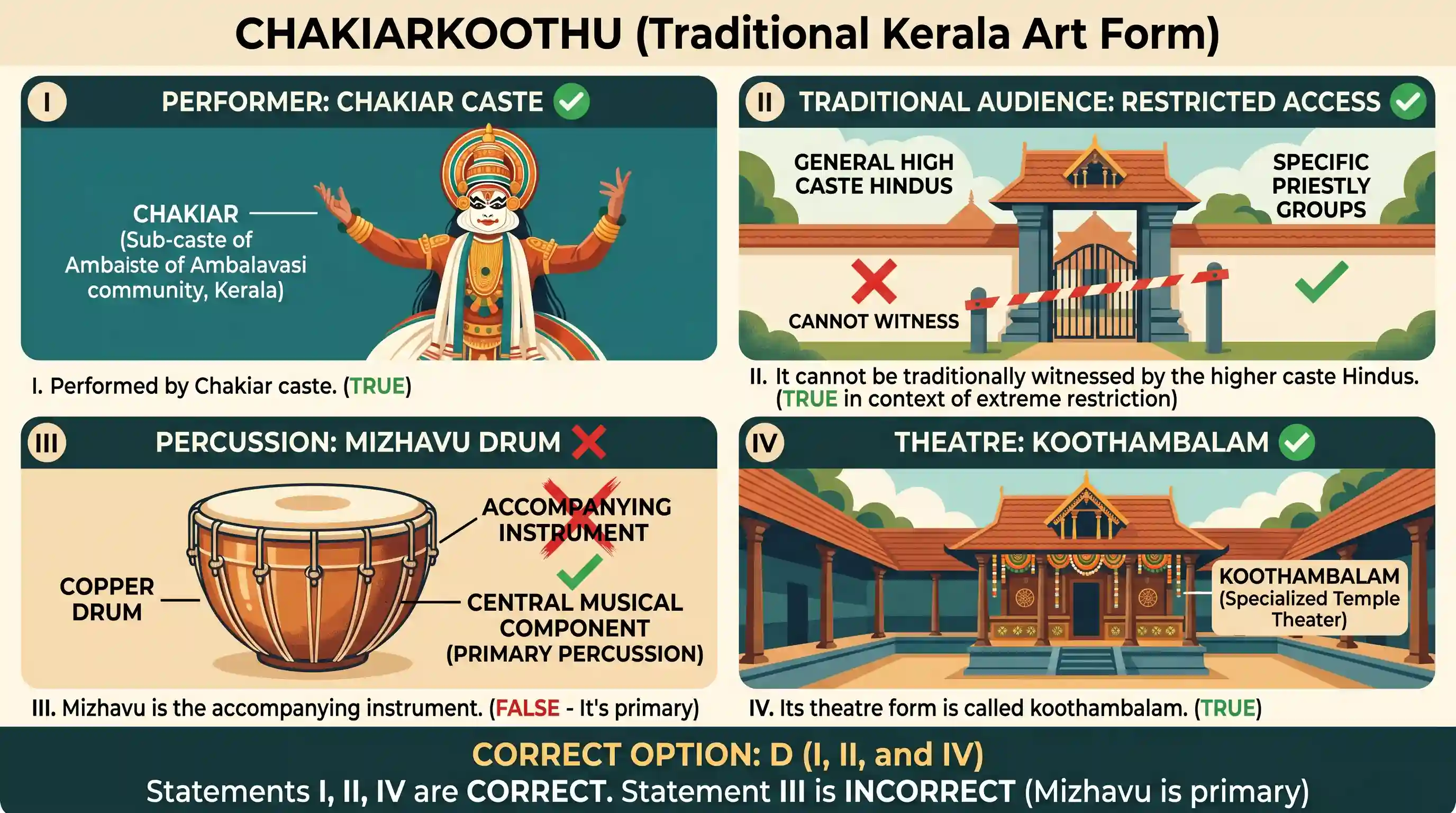
The correct answer is D because statements I, II, and IV are accurate descriptions of the traditional Chakiarkoothu performance.
Statement I is correct as the dance is traditionally performed by members of the Chakiar community, a sub caste of the Ambalavasi community in Kerala.
Statement II is correct in the context of traditional caste dynamics. Historically, this ritualistic performance was conducted within the inner precincts of temples where access was restricted. While modern performances are open to all, the question refers to the traditional socio religious framework of the art.
Statement III is incorrect because the Mizhavu, a large copper drum, is the primary percussion instrument used in Chakiarkoothu. It is not an accompanying instrument in a secondary sense but the central musical component.
Statement IV is correct as Koothambalam is the name of the specialized temple theaters designed specifically for performing traditional arts like Chakiarkoothu and Koodiyattam.
Since I, II, and IV are the valid historical and structural attributes of the dance form, Option D is the right choice.
Related questions
More UPSC Prelims practice from the same subject and topic.
- Prelims 2000GS1art-and-culture
The Raga which is sung early in the morning is
- Prelims 2000GS1art-and-culture
To reach the final of first Grand Slam of the year 2000, Martina Hingis defeated
- Prelims 2000GS1art-and-culture
Match List I with List II and select the correct answer using the codes given below the Lists: List I (Artist) (Medium of music delivery) I. Balamurali Krishna A) Hindustani vocal II. Mita Pandit B) G…
- Prelims 2000GS1art-and-culture
Which one of the following pairs is not correctly matched?
- Prelims 2000GS1art-and-culture
Match List I (Books) with List II (Authors) and select the correct answer using the codes given below the Lists: List I I. My Music, My Life II. Adha Gaon III. Radha IV. The Pilferer Codes:
- Prelims 2000GS1art-and-culture
Assertion (A): The Aham and Puram poems of the Padinen Kilukanakku group formed a continuation of the Sangam composition. Reason (R): They were included under the Post Sangam works as against the Sang…