Consider the following statements: Hard water is not suitable for I. drinking. II. washing clothes with soap. III. use in boilers. IV. irrigating crops. Which of these statements are correct?

- AI and III
- BII and III
- CI, II and IV
- DI, II, III and IVCorrect
Explanation
Hard water contains high concentrations of dissolved minerals, primarily calcium and magnesium, which make it unsuitable for various purposes as explained below:
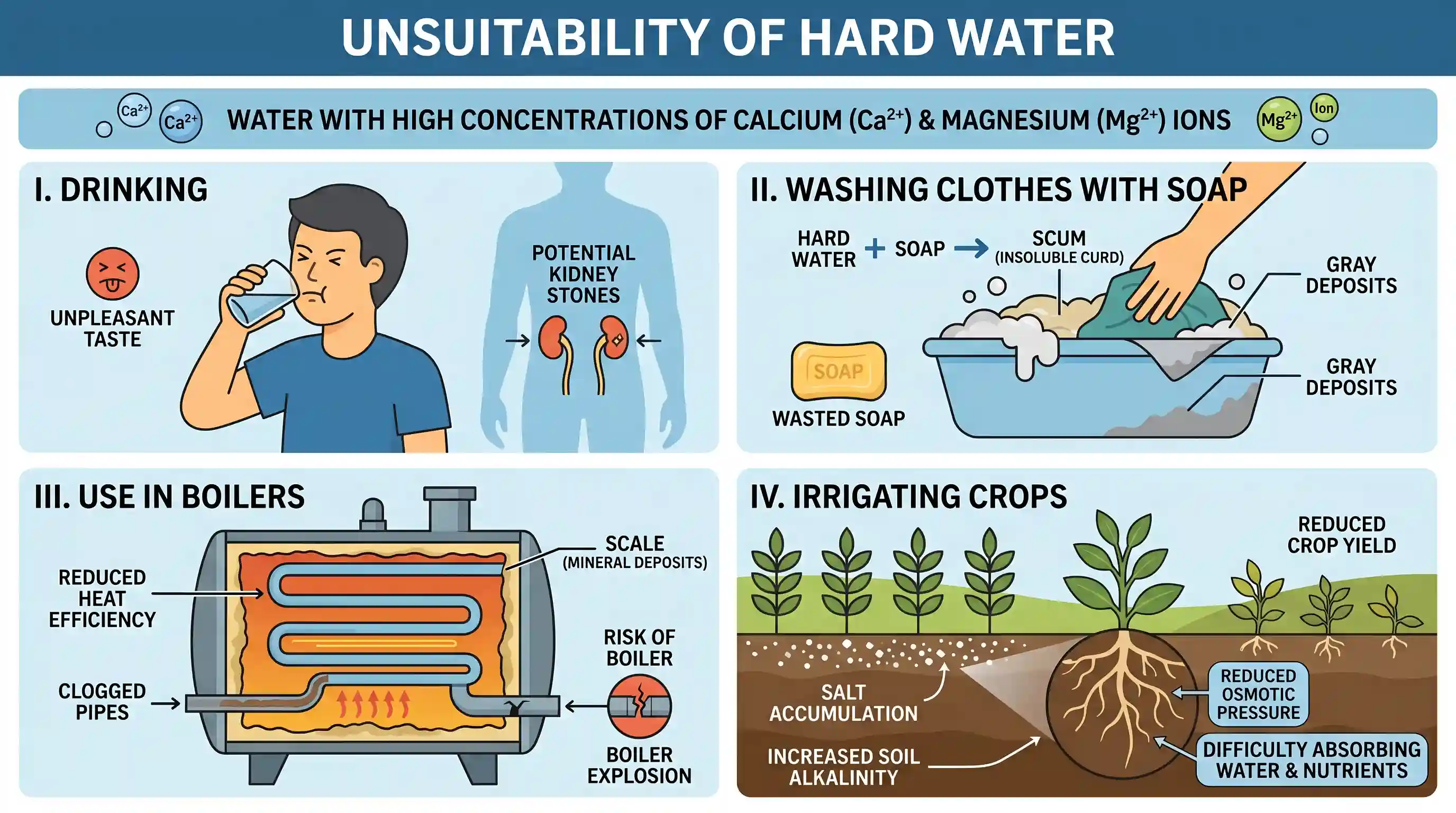
First, for drinking, while not necessarily a health risk in small amounts, hard water can lead to digestive issues over time and is often rejected due to its unpleasant taste and potential to cause kidney stones.
Second, for washing clothes, the minerals in hard water react with soap to form an insoluble curd or scum. This prevents the soap from lathering effectively, wastes cleaning agents, and leaves a gray deposits on fabrics.
Third, for use in boilers, heating hard water causes minerals to precipitate and form a hard layer called scale. This scale acts as an insulator, reducing heating efficiency, clogging pipes, and potentially leading to boiler explosions.
Fourth, for irrigating crops, the high salt and mineral content can increase soil alkalinity and lead to salt accumulation. This affects the osmotic balance of plants, making it harder for them to absorb water and nutrients, which ultimately reduces crop yield.
Since hard water is unsuitable for all four activities mentioned, option D is the correct answer.
Related questions
More UPSC Prelims practice from the same subject and topic.
- Prelims 2000GS1science-and-technology
Match List I with List II and select the correct answer using the codes given below the Lists: List I I. German Silver II. Solder III. Bleaching Powder IV. Hypo List II
- Prelims 2000GS1science-and-technology
Which one of the following materials is very hard and very ductile?
- Prelims 2000GS1science-and-technology
Aluminium surfaces are often 'anodized'. This means the deposition of a layer of a) chromium oxide b) aluminium oxide c) nickel oxide d) zinc oxide
- Prelims 2000GS1science-and-technology
A small pouch containing silica gel is often found in bottles of medicine in tablet or powder form because silica gel
- Prelims 2000GS1science-and-technology
Assertion (A): Large cold storage plants use ammonia as refrigerant while domestic refrigerators use chlorofluorocarbons. Reason (R): Ammonia can be liquified at ambient temperatures at low pressures.
- Prelims 2000GS1science-and-technology
A rectangular piece of iron sheet measuring 50 cm by 100 cm is rolled into a cylinder of height 50 cm. If the cost of painting the cylinder is Rs. 50 per square metre, then what will be the cost of pa…