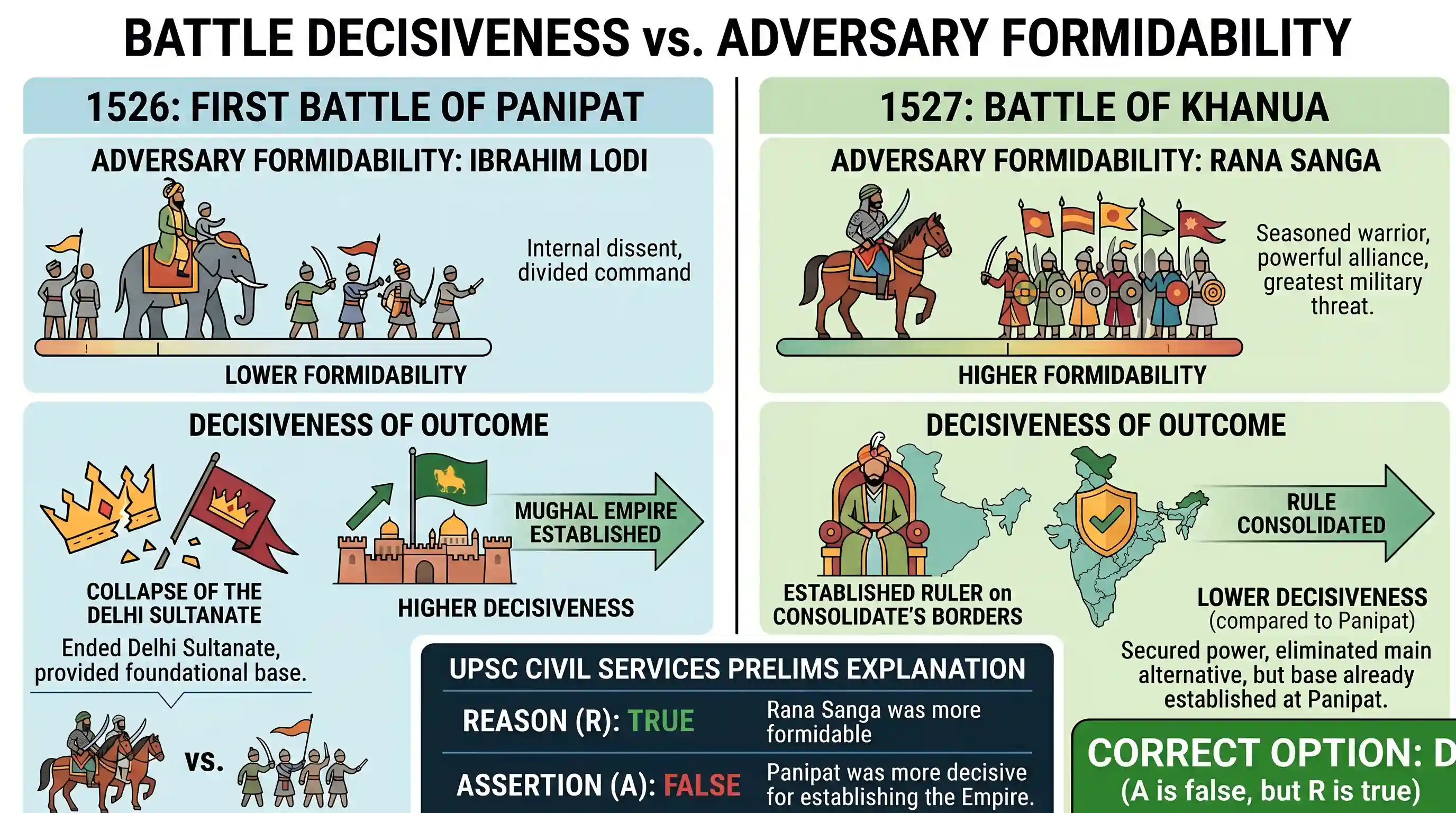
Assertion (A): The Battle of Khanua was certainly more decisive and significant than the First Battle of Panipat. Reason (R): Rana Sanga, the Rajput hero, was certainly a more formidable adversary than Ibrahim Lodi.

- ABoth A and R are individually true, and R is the correct explanation of A
- BBoth A and R are individually true, but R is NOT a correct explanation of A
- CA is true, but R is false
- DA is false, but R is trueCorrect
Explanation
The correct answer is D because the Assertion is false while the Reason is true.
The First Battle of Panipat 1526 is considered more decisive and significant than the Battle of Khanua 1527. Panipat resulted in the death of Ibrahim Lodi, the collapse of the Delhi Sultanate, and the formal establishment of the Mughal Empire in India. While Khanua was important for consolidating Baburs power, it was the victory at Panipat that provided him the throne and a base in India.
The Reason is true because Rana Sanga was a more formidable adversary than Ibrahim Lodi. Rana Sanga was a seasoned warrior who led a powerful confederacy of Rajput kings and commanded a much larger and more disciplined military force than the Sultan of Delhi. Baburs own memoirs indicate that he viewed the Rajputs under Sanga as a greater threat to his survival in India than the Lodi dynasty.
Related questions
More UPSC Prelims practice from the same subject and topic.
- Prelims 2001GS1history
The shaded area in the above map shows the empire of
- Prelims 2001GS1history
The Mongols under Genghis Khan invaded India during the reign of
- Prelims 2001GS1history
Which among the following ports was called Babul Makka (Gate of Makka) during the Mughal Period?
- Prelims 2001GS1history
Which of the following pairs is correctly matched?
- Prelims 2001GS1history
Who among the following organised the famous Chittagong armoury raid?
- Prelims 2001GS1history
A London branch of the All-India Muslim League was established in 1908 under the presidency of