Consider the following taxes: I. Corporation tax II. Customs duty III. Wealth tax IV. Excise duty Which of these is/are indirect taxes?

- AI only
- BII and IVCorrect
- CI and III
- DII and III
Explanation
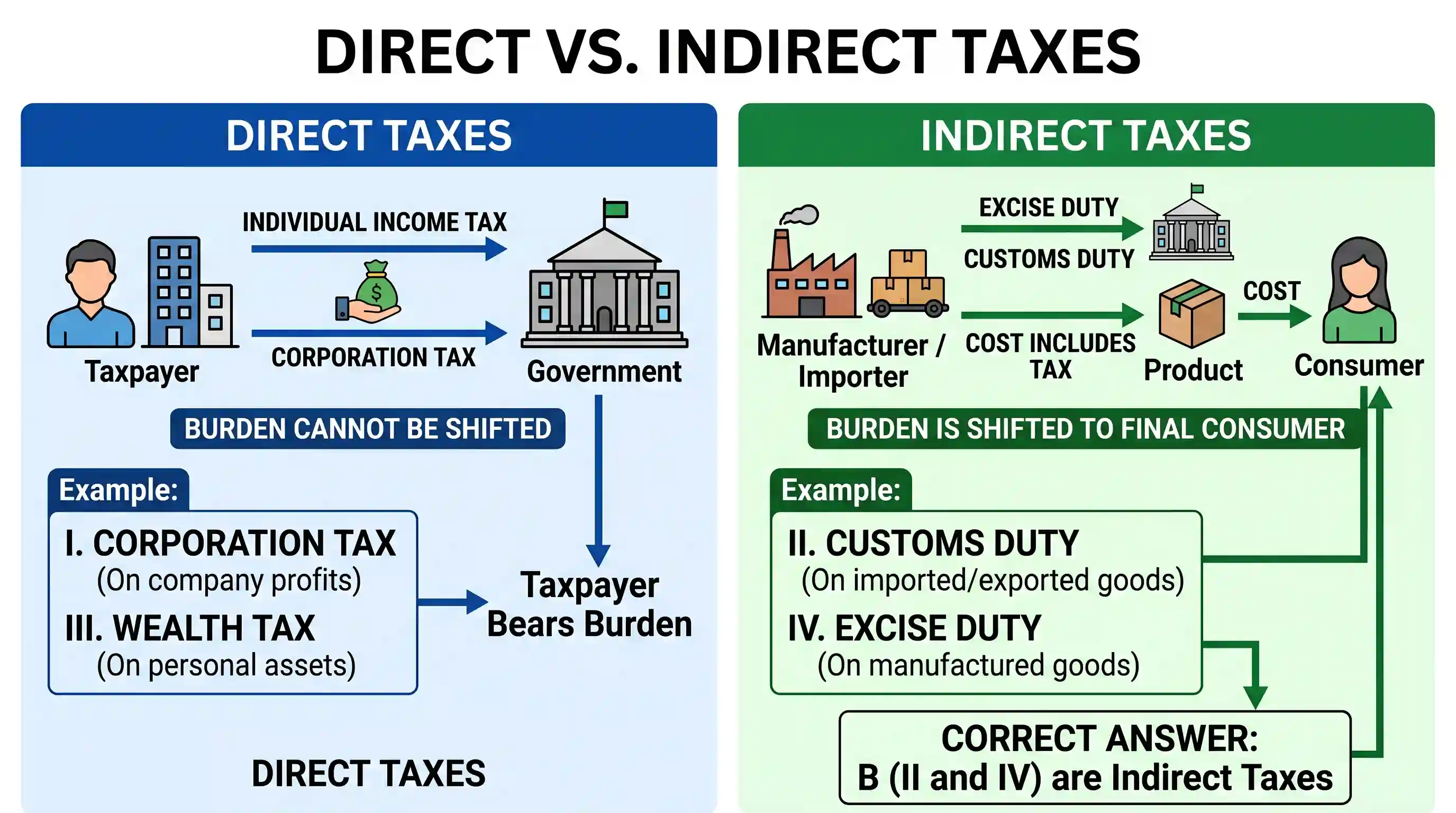
The correct answer is B because indirect taxes are those where the burden of payment can be shifted from the taxpayer to the final consumer.
Customs duty and Excise duty are indirect taxes. Customs duty is levied on goods imported into or exported out of the country, while Excise duty is levied on the manufacture of goods within the country. In both cases, the manufacturer or importer pays the tax to the government but recovers it from the buyer by adding it to the price of the product.
Corporation tax and Wealth tax are direct taxes. Corporation tax is paid directly by companies on their profits, and Wealth tax was paid by individuals on their personal assets. In direct taxes, the person who pays the tax to the government also bears the final economic burden, meaning the tax cannot be shifted to others.
Related questions
More UPSC Prelims practice from the same subject and topic.
- Prelims 2001GS1economy
Consider the following: I. Market borrowing II. Treasury bills III. Special securities issued to RBI Which of these is/are component(s) of internal debt?
- Prelims 2001GS1economy
Match List I with List II and select the correct answer using the codes given below the Lists: List I List II (Term) (Explanation) I. Fiscal deficit A) Excess of Total Expenditure over Total Receipts …
- Prelims 2001GS1economy
The Union Budget, 2000 awarded a Tax Holiday for the North-eastern Region to promote industrialisation for
- Prelims 2001GS1economy
Which of the following committees examined and suggested Financial Sector Reforms?
- Prelims 2001GS1economy
The new series of Wholesale Price Index (WPI) released by the Government of India is with reference to the base prices of
- Prelims 2001GS1economy
The theme of the World Development Report, 2001 is