Two wires have their lengths, diameters and resistivities, all in the ratio of 1: 2. If the resistance of the thinner wire is 10 ohms, the resistance of the thicker wire is

- A10 ohmsCorrect
- B5 ohms
- C20 ohms
- D40 ohms
Explanation
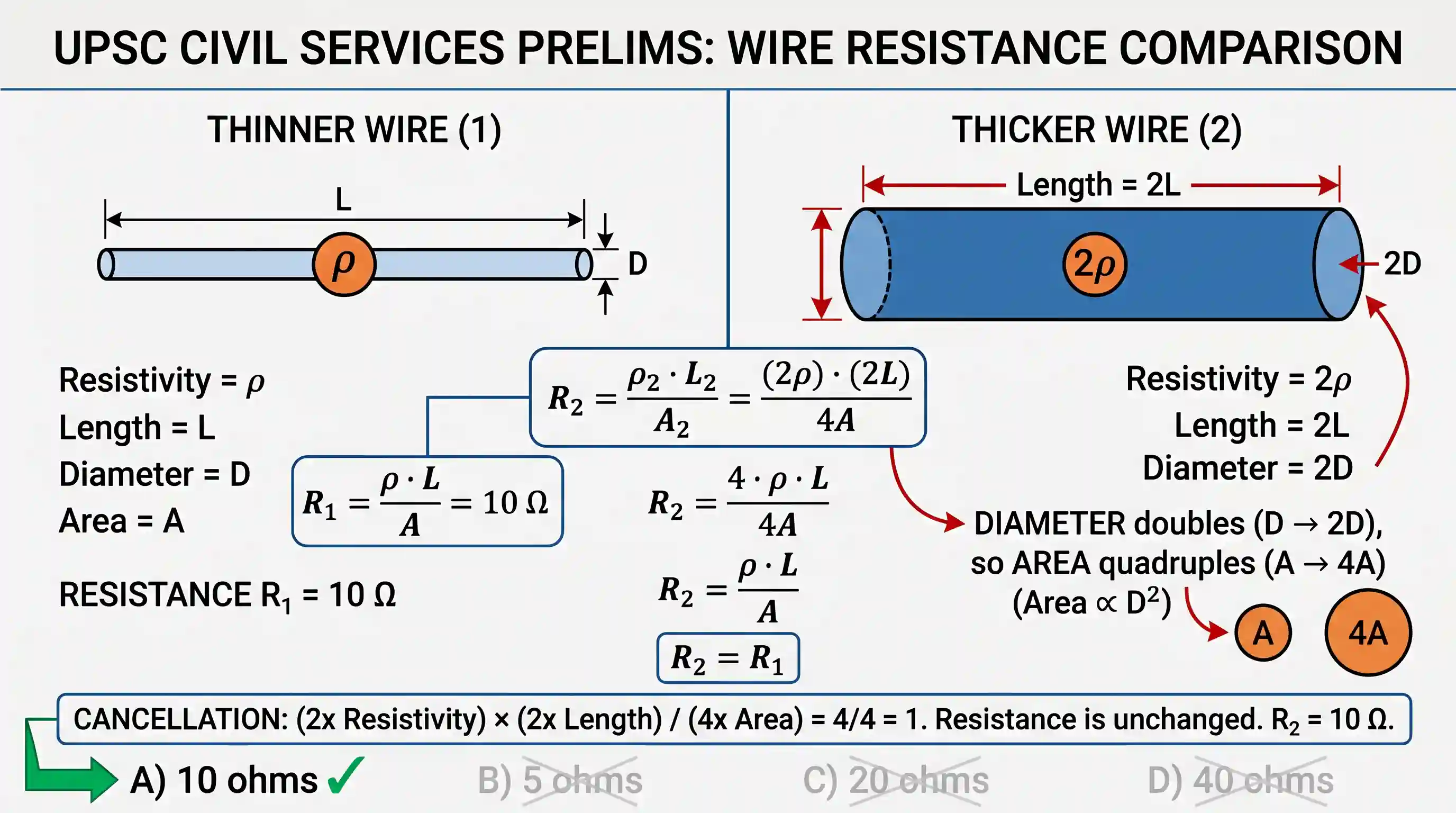
The resistance of a wire is determined by the formula: Resistance equals Resistivity multiplied by Length divided by Area. The Area is proportional to the square of the Diameter.
Let the properties of the thinner wire be Length (L1), Diameter (D1), and Resistivity (R1). Let the properties of the thicker wire be Length (L2), Diameter (D2), and Resistivity (R2).
The ratio is given as 1 to 2. Therefore: L2 is 2 times L1. D2 is 2 times D1 (making the Area 4 times larger because Area depends on the square of the diameter). R2 is 2 times R1.
Using the formula for the thicker wire: Resistance equals (2 times Resistivity) multiplied by (2 times Length) divided by (4 times Area). This simplifies to (4 divided by 4) times the original resistance.
The calculation shows that the resistance remains the same if the ratio applied to length and resistivity is balanced by the square of the diameter ratio. However, in this specific problem, let us look at the values: Resistance of thick wire = (Resistivity 1 x 2) x (Length 1 x 2) / (Area 1 x 4). The factors 2 x 2 in the numerator and 4 in the denominator cancel each other out (4/4 = 1).
Therefore, the resistance of the thicker wire is the same as the thinner wire, which is 10 ohms.
Related questions
More UPSC Prelims practice from the same subject and topic.
- Prelims 2001GS1science-and-technology
The theme of Indian Science Congress, 2001 was
- Prelims 2001GS1science-and-technology
Match List I with List II and select the correct answer using the codes given below the Lists: List I List II (Institute) (Location) I. Central Institute of Medicinal and Aromatic Plants A) Chandigarh…
- Prelims 2001GS1science-and-technology
Assertion (A): A stick is dipped in water in a slanting position. If observed sideways, the stick appears short and bent at the surface of water. Reason (R): The light coming from the stick undergoes …
- Prelims 2001GS1science-and-technology
When light waves pass from air to glass, the variables affected are
- Prelims 2001GS1science-and-technology
When water is heated from 0°C to 10°C, its volume
- Prelims 2001GS1science-and-technology
Match List I with List II and select the correct answer using the codes given below the Lists: List I (Characteristic) List II (Particle) I. Zero mass A) Positron II. Fractional charge B) Neutrino III…