The American multinational company, Monsanto has produced an insect resistant cotton variety that is undergoing field-trails in India. A toxin gene from which ONE of the following bacteria has been transferred to this transgenic cotton?

- ABacillus subtilis
- BBacillus thurigiensisCorrect
- CBacillus amyloliquifanciens
- DBacillus globlii
Explanation
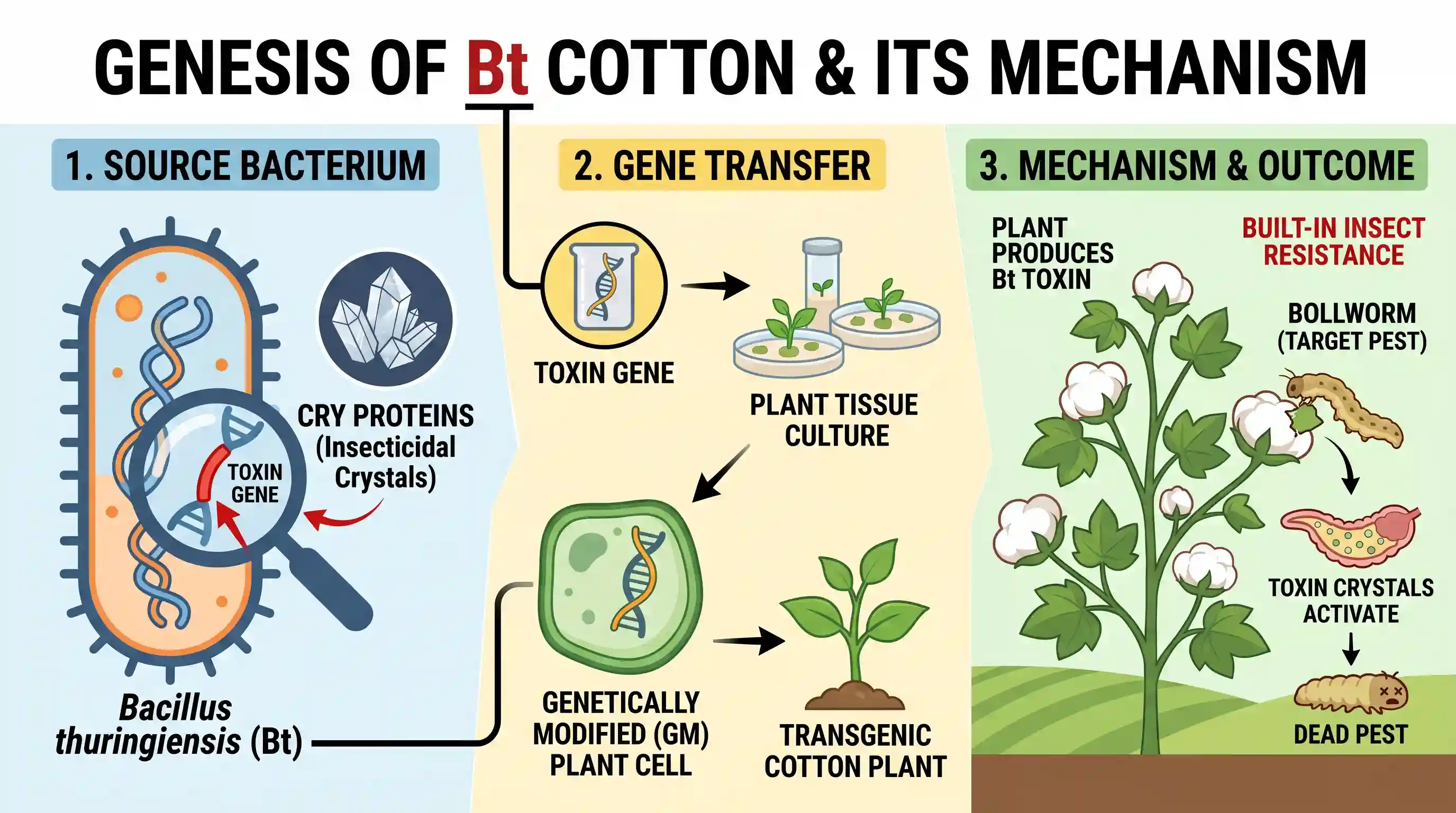
The correct answer is B, Bacillus thuringiensis.
The insect resistant cotton variety, commonly known as Bt cotton, is created by genetically engineering the plant with a toxin gene from the soil bacterium Bacillus thuringiensis. This bacterium naturally produces crystal proteins that are toxic to specific types of pests, such as bollworms. When these genes are transferred to the cotton plant, the plant begins to produce its own pesticide, which provides built in protection against insect attacks and reduces the need for chemical sprays.
Related questions
More UPSC Prelims practice from the same subject and topic.
- Prelims 2001GS1science-and-technology
Assertion (A): Scientists can cut apart and paste together DNA molecules at will, regardless of the source of the molecules. Reason (R): DNA fragments can be manipulated using restriction endonuclease…
- Prelims 2001GS1science-and-technology
Which of the following features of DNA makes in uniquely suited to store and transmit genetic information from generation to generation?
- Prelims 2001GS1science-and-technology
Match List I with List II and select the correct answer using the codes given below the Lists: List I List II (Achievement in genetics) (Scientists) I. Discovery of transdiction and Conjugation in bac…
- Prelims 2001GS1science-and-technology
Consider the following organisations: I. Atomic Minerals Directorate for Research and Exploration II. Heavy Water Board III. Indian Rare Earths Limited IV. Uranium Corporation of India Which of these …
- Prelims 2001GS1science-and-technology
Who amongst the following was the Chairman of ISRO when INSAT3B was launched?
- Prelims 2001GS1science-and-technology
The theme of Indian Science Congress, 2001 was