Consider the following financial institution of India: 1. Industrial Finance Corporation of India (IFCI) 2. Industrial Credit and Investment Corporation of India (ICICI) 3. Industrial Development Bank of India (IDBI) 4. National Bank for Agriculture and Rural Development (NABARD) The correct chronological sequence of the establishment of these institutions is

- A1, 2, 3, 4Correct
- B2, 3, 4, 1
- C3, 4, 1, 2
- D4, 1, 2, 3
Explanation
The correct chronological sequence is based on the establishment years of these financial institutions.
-
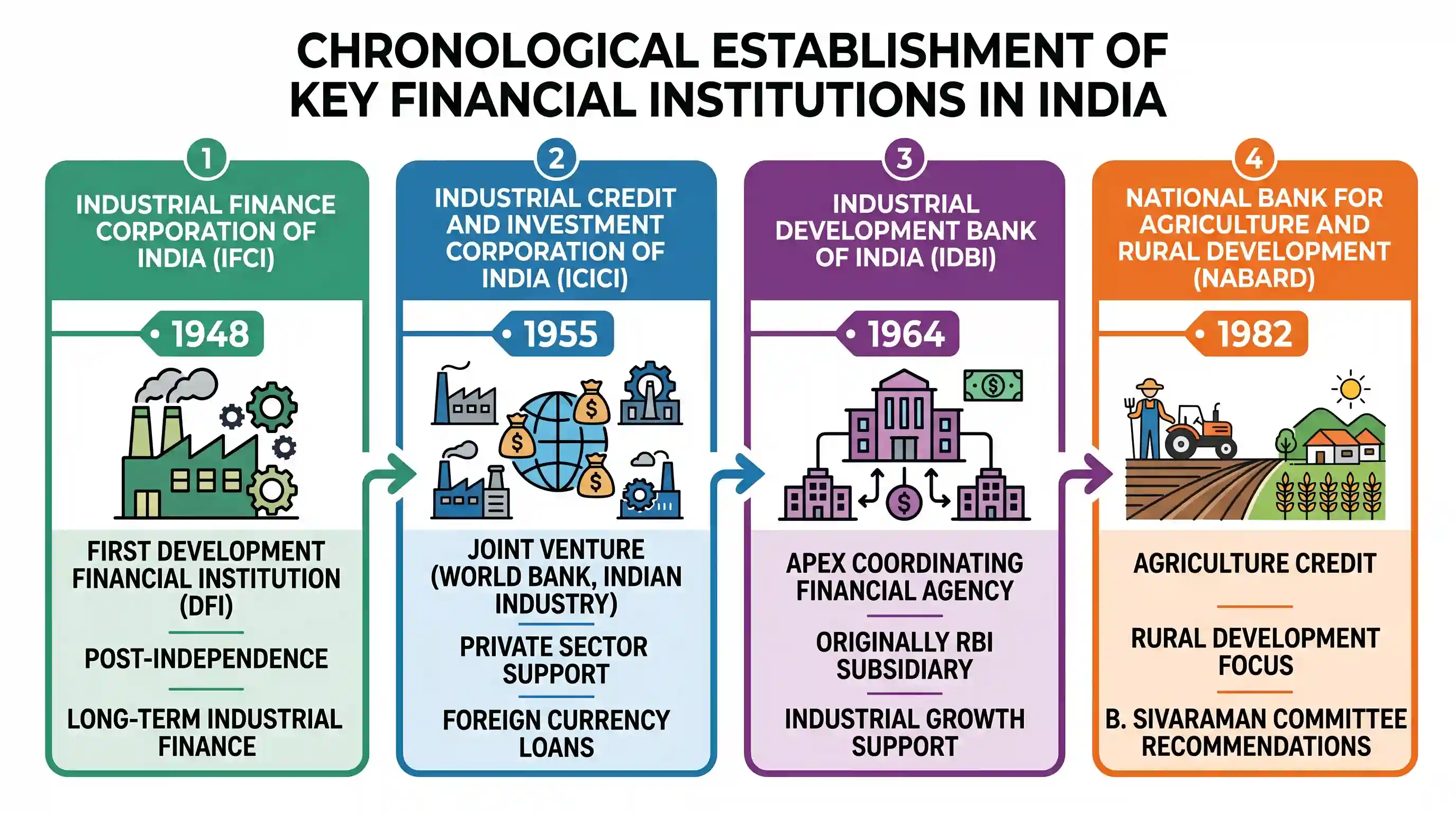
Industrial Finance Corporation of India (IFCI): Established in 1948, it was the first development financial institution created by the Government of India after independence to provide long term finance to the industrial sector.
-
Industrial Credit and Investment Corporation of India (ICICI): Established in 1955 as a joint venture involving the World Bank and representatives of Indian industry to provide foreign currency loans and support private industry.
-
Industrial Development Bank of India (IDBI): Established in 1964 under an Act of Parliament as a wholly owned subsidiary of the Reserve Bank of India, later becoming an autonomous corporation to coordinate the activities of other financial institutions.
-
National Bank for Agriculture and Rural Development (NABARD): Established in 1982 based on the recommendations of the B. Sivaraman Committee to focus specifically on credit for agriculture and rural development.
Therefore, the chronological order is 1948, 1955, 1964, and 1982, which corresponds to the sequence 1, 2, 3, 4. Option A is correct.
Related questions
More UPSC Prelims practice from the same subject and topic.
- Prelims 2002GS1economy
Among the following major stock exchanges of India, the exchange which recorded highest turnover during the year 2001-01 is
- Prelims 2002GS1economy
Consider the following: 1. Currency with the public 2. Demand deposits with banks 3. Time deposits with banks Which of these are included in Broad Money (M3) in India?
- Prelims 2002GS1economy
A trader fixed the price of an article in such a way that by giving a rebate of 10% on the price fixed he made a profit of 15%. If the cost of the article is Rs 72, the price fixed on it is
- Prelims 2002GS1economy
“World Development Report” is an annual publication of
- Prelims 2002GS1economy
Consider the following statements: The Draft Electricity Bill, 2001 seeks to replace 1. Indian Electricity Act, 1910 2. Electricity (Supply) Act, 1948 3. Electricity Regulatory Commission Act, 1998 4.…
- Prelims 2002GS1economy
India has the maximum volume of foreign trade with