Assume that the moon takes exactly 30 days to complete the cycle and also assume that it rises in the East exactly at 6.48 p.m. on the first day. On the fourth day, at what time will it rise?

- A8.24 p.m.
- B9.12 p.m.Correct
- C10.00 p.m.
- D11.48 p.m.
Explanation
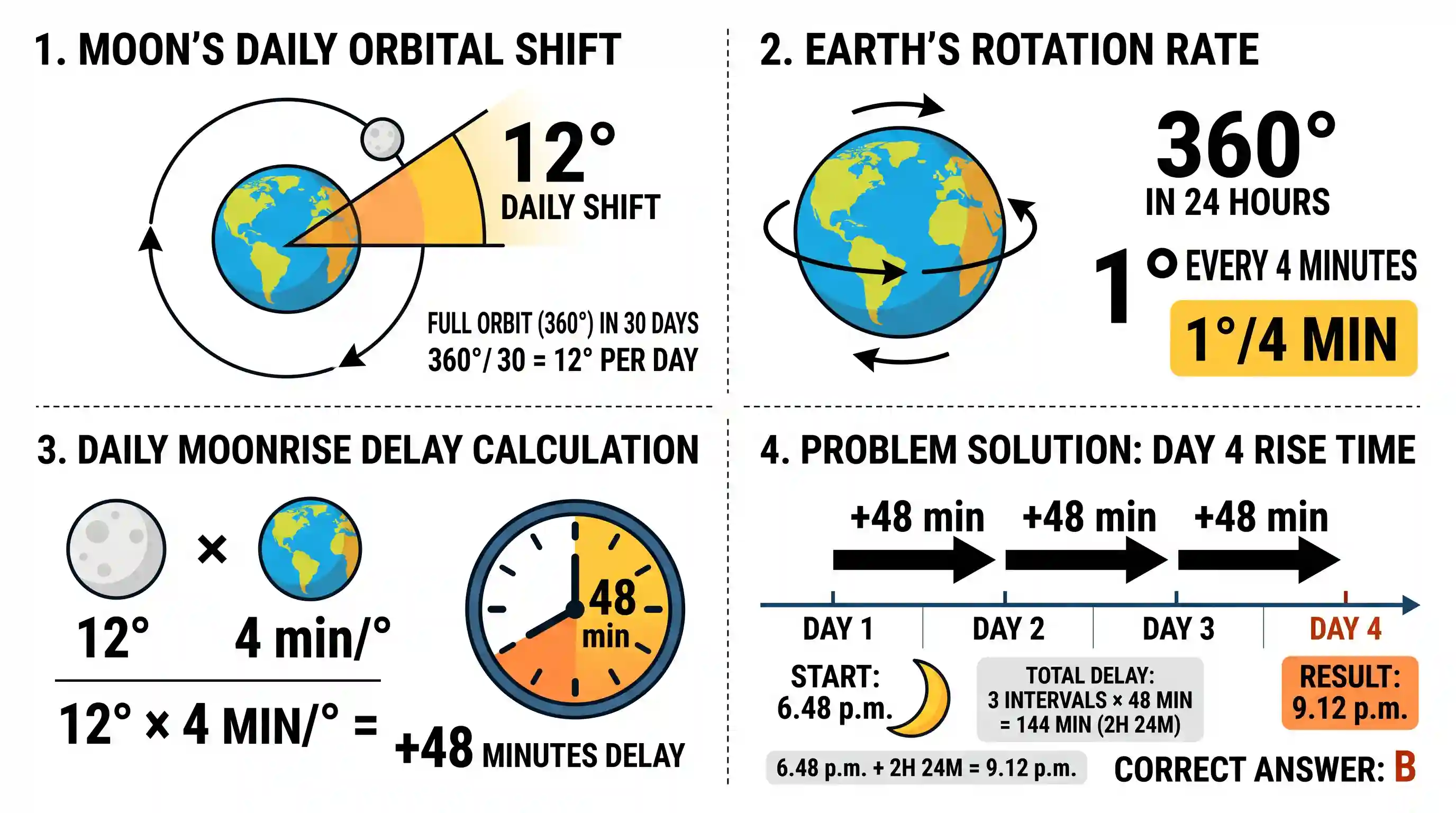
To find the moonrise time on the fourth day, we first calculate the daily delay in the moonrise.
A full circle of 360 degrees is covered in 24 hours. Since the moon takes 30 days to complete its cycle, it shifts by 12 degrees each day (360 divided by 30).
Because the Earth rotates 360 degrees in 24 hours, it rotates at a rate of 1 degree every 4 minutes. Therefore, a shift of 12 degrees results in a daily delay of 48 minutes (12 multiplied by 4).
On the first day, the moon rises at 6.48 p.m. On the second day, it rises 48 minutes later. On the third day, it rises 96 minutes later. On the fourth day, it rises 144 minutes later (48 minutes multiplied by 3 intervals).
144 minutes is equal to 2 hours and 24 minutes. Adding 2 hours and 24 minutes to 6.48 p.m. gives 9.12 p.m.
Thus, option B is correct.
Related questions
More UPSC Prelims practice from the same subject and topic.
- Prelims 2002GS1geography
Which one of the following statements is correct with reference to our solar system?
- Prelims 2002GS1geography
A bus is moving with a speed of 30 km/hr ahead of a car with a speed of 50 km/hr. How many kilometres apart are they if it takes 15 minutes for the car to catch up with the bus?
- Prelims 2002GS1geography
The world’s highest ground based telescopic observatory is located in
- Prelims 2002GS1geography
With reference to India, which one the following statements is correct?
- Prelims 2002GS1geography
Consider the following climatic and geographical phenomena: 1. Condensation 2. High temperature and humidity 3. Orography 4. Vertical wind Thunder Cloud development is due to which of these phenomena?
- Prelims 2002GS1geography
Among living organisms, which one of the following is the most responsible factor for bringing about the origin of a new species?