A country is said to be in debt trap if

- Ait has to abide by the conditionalities imposed by the International Monetary Fund
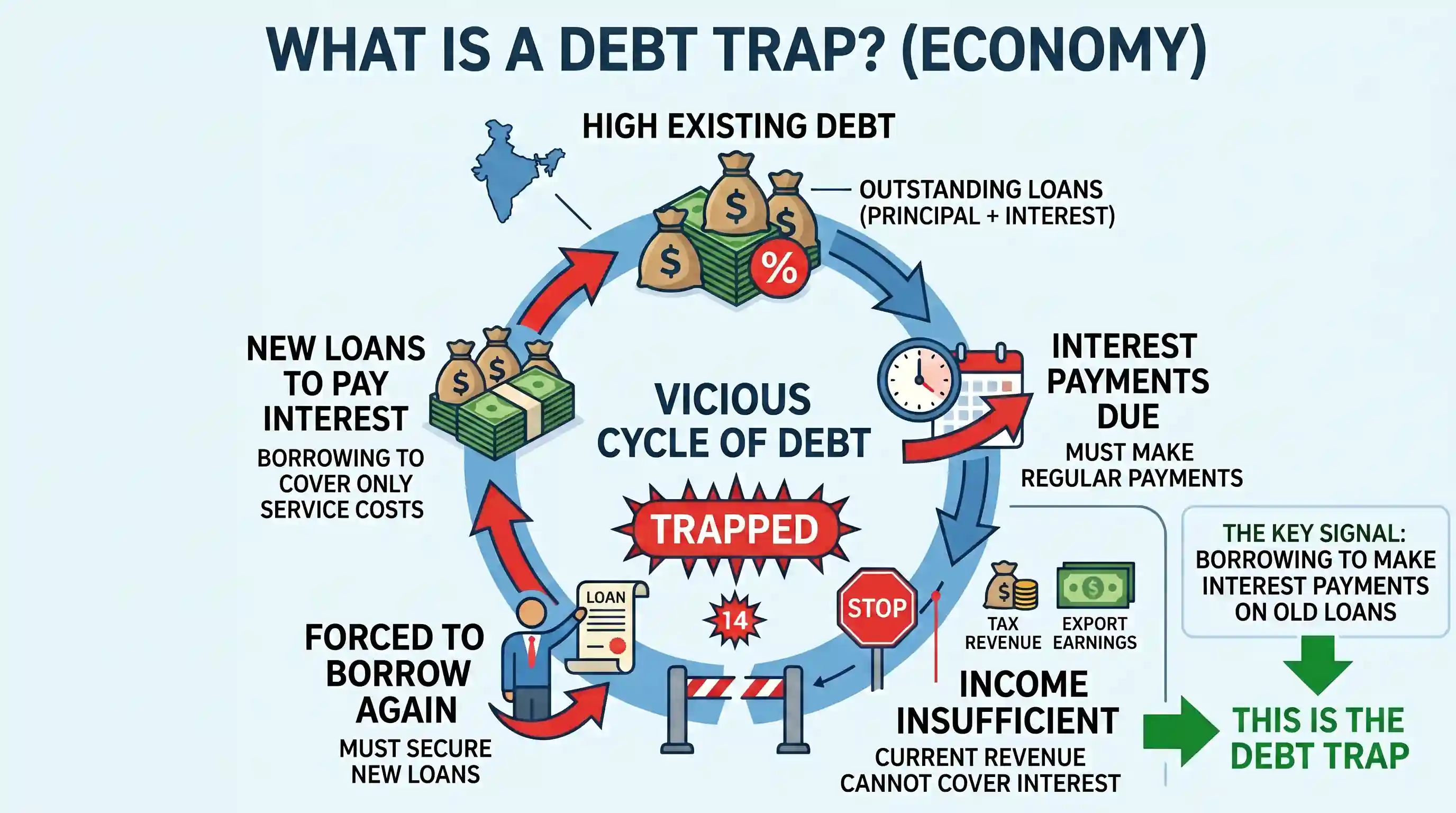
- Bit has to borrow to make interest payments to on outstanding loansCorrect
- Cit has been refused loans or aid by creditors abroad
- Dthe World Bank charges a very high rate of interest on outstanding as well as new loans
Explanation
The correct option is B because a debt trap occurs when a countrys debt levels become so high that its current revenue is insufficient to cover even the interest payments on existing loans. To prevent default, the country is forced to borrow more money just to pay off the interest, rather than the principal amount. This creates a vicious cycle where the total debt continues to grow indefinitely, making it nearly impossible to escape the repayment burden. This situation is the fundamental definition of being trapped in debt.
Related questions
More UPSC Prelims practice from the same subject and topic.
- Prelims 2002GS1economy
A trader fixed the price of an article in such a way that by giving a rebate of 10% on the price fixed he made a profit of 15%. If the cost of the article is Rs 72, the price fixed on it is
- Prelims 2002GS1economy
“World Development Report” is an annual publication of
- Prelims 2002GS1economy
Which reference to the Wholesale Price Index (WPI), consider the following statements: 1. The new WPI series with base 1993-94 = 100 became effective from April 1998 2. In the new WPI series, became e…
- Prelims 2002GS1economy
In a company 60% of the employees are men. Of these 40% are drawing more than Rs 50,000 per year. If 36% of the total employees of the company draw more than Rs 50,000 per year, what is the percentage…
- Prelims 2002GS1economy
Amit started a business by investing Rs. 30,000. Rahul joined the business after some time and invested Rs. 20,000. At the end of the year, profit was divided in the ratio of 2:1. After how many month…
- Prelims 2002GS1economy
Consider the following statements: The Draft Electricity Bill, 2001 seeks to replace 1. Indian Electricity Act, 1910 2. Electricity (Supply) Act, 1948 3. Electricity Regulatory Commission Act, 1998 4.…