Which one of the following statements is correct?

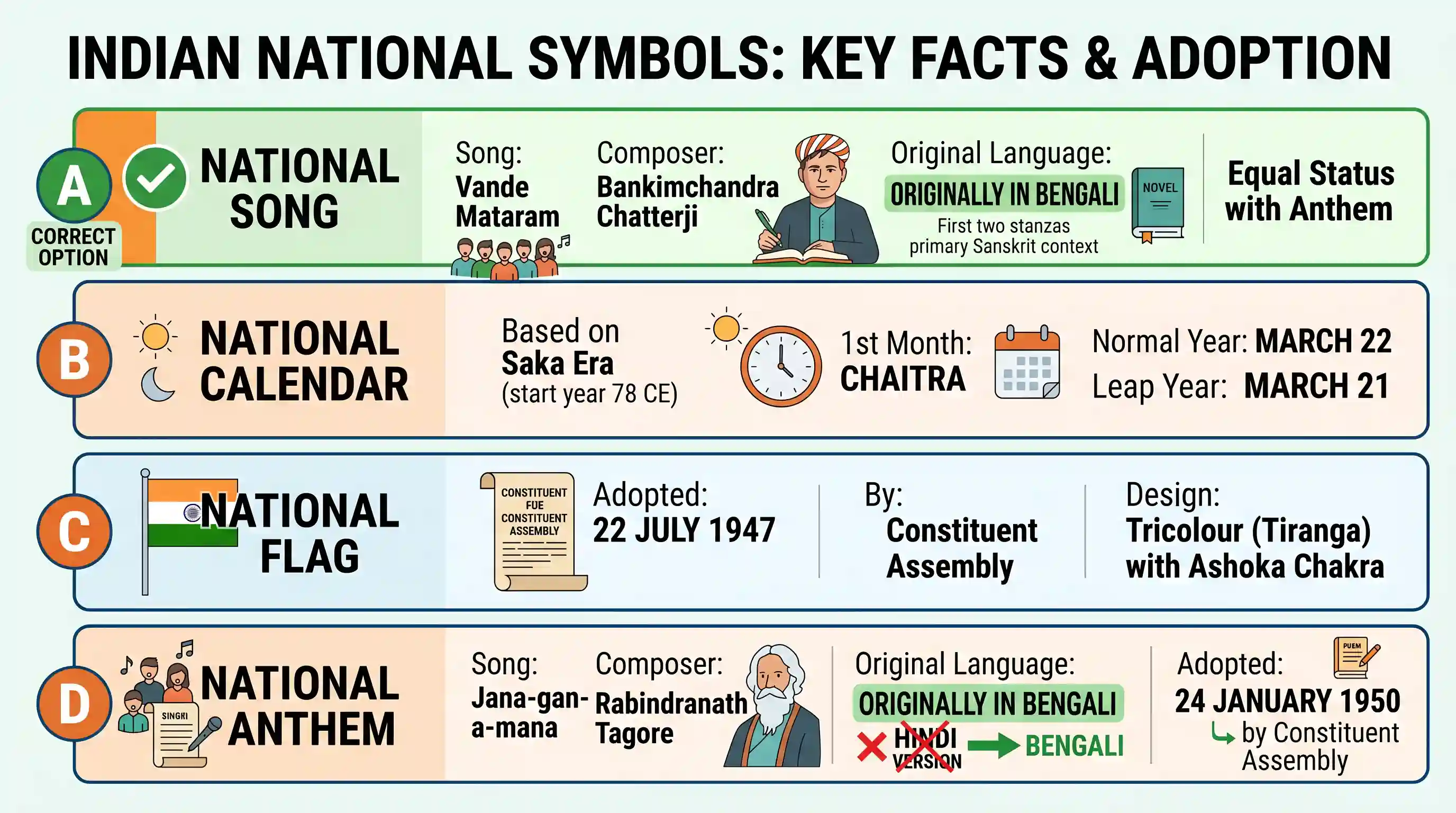
- AThe National Song Vande Mataram was composed by Bankimchandra Chatterji originally in BengaliCorrect
- BThe National Calendar of India based on Saka era has its 1st Chaitra on 22nd March normally and 21st March in a leap year
- CThe design of the National Flag of India was adopted by the Constituent Assembly on 22nd July 1947
- DThe song 'Jana-gana-mana', composed originally in Bengali by Rabindranath Tagore was adopted in its Hindi version by the Constituent Assembly on 24th January 1950 as the National Anthem of India
Explanation
The question asks to identify the single correct statement among the given options.
Let's analyze each statement:
A) The National Song Vande Mataram was composed by Bankimchandra Chatterji originally in Bengali
- Vande Mataram is indeed the National Song of India.
- It was composed by Bankimchandra Chatterji.
- The song was part of his Bengali novel 'Anandamath', published in 1882. While the first two stanzas (which constitute the National Song) are primarily in Sanskrit, the full poem and its literary context are Bengali. Therefore, stating it was "originally in Bengali" in terms of its composition and publication context is widely accepted as correct.
- This statement is correct.
B) The National Calendar of India based on Saka era has its 1st Chaitra on 22nd March normally and 21st March in a leap year
- The Indian National Calendar, adopted on March 22, 1957, is indeed based on the Saka era.
- Its first month, Chaitra, consistently begins on March 22 in a normal year and on March 21 in a leap year, aligning with the Gregorian calendar.
- This statement is factually correct.
C) The design of the National Flag of India was adopted by the Constituent Assembly on 22nd July 1947
- The design of the National Flag of India was indeed adopted by the Constituent Assembly on 22nd July 1947, a few weeks before India's independence.
- This statement is factually correct.
D) The song 'Jana-gana-mana', composed originally in Bengali by Rabindranath Tagore was adopted in its Hindi version by the Constituent Assembly on 24th January 1950 as the National Anthem of India
- 'Jana-gana-mana' was composed by Rabindranath Tagore originally in Bengali.
- It was adopted as the National Anthem by the Constituent Assembly on 24th January 1950.
- However, it was adopted in its original Bengali version (with some musical arrangements), not "in its Hindi version". The lyrics are in Sanskritized Bengali.
- Therefore, the phrase "in its Hindi version" makes this statement incorrect.
Conclusion: Statement D is definitively incorrect. Statements A, B, and C are all factually correct based on general knowledge and official sources. However, in UPSC Prelims, questions usually have only one correct answer. If we strictly adhere to the provided answer 'A' as the sole correct option, it implies that B and C must contain some subtle inaccuracy or be considered "less correct" than A. Given the straightforward nature of facts in B and C, it is highly probable that the question itself is flawed by having multiple correct options.
However, if forced to choose A as the unique correct answer, the statement "The National Song Vande Mataram was composed by Bankimchandra Chatterji originally in Bengali" is a widely accepted and concise description of its origin.
The final answer is A
Related questions
More UPSC Prelims practice from the same subject and topic.
- Prelims 2003GS1polity-and-governance
Which one of the following High Courts has the Territorial Jurisdiction over Andaman and Nicobar Islands?
- Prelims 2003GS1polity-and-governance
Consider the following statements: 1. While members of the Rajya Sabha are associated with Committees on Public Accounts and Public Undertakings, Members of Committee on Estimates are drawn entirely f…
- Prelims 2003GS1polity-and-governance
As per Indian Protocol, who among the following ranks highest in the order of precedence?
- Prelims 2003GS1polity-and-governance
Which one of the following statements is correct?
- Prelims 2003GS1polity-and-governance
Which one of the following Articles of the Indian Constitution provides that ‘It shall be the duty of the Union to protect every State against external aggression and internal disturbance’?
- Prelims 2003GS1polity-and-governance
Which one of the following statements is correct with reference to FEMA in India?