Which one of the following Bills must be passed by each House of the Indian Parliament separately, by special majority?

- AOrdinary Bill
- BMoney Bill
- CFinance Bill
- DConstitution Amendment BillCorrect
Explanation
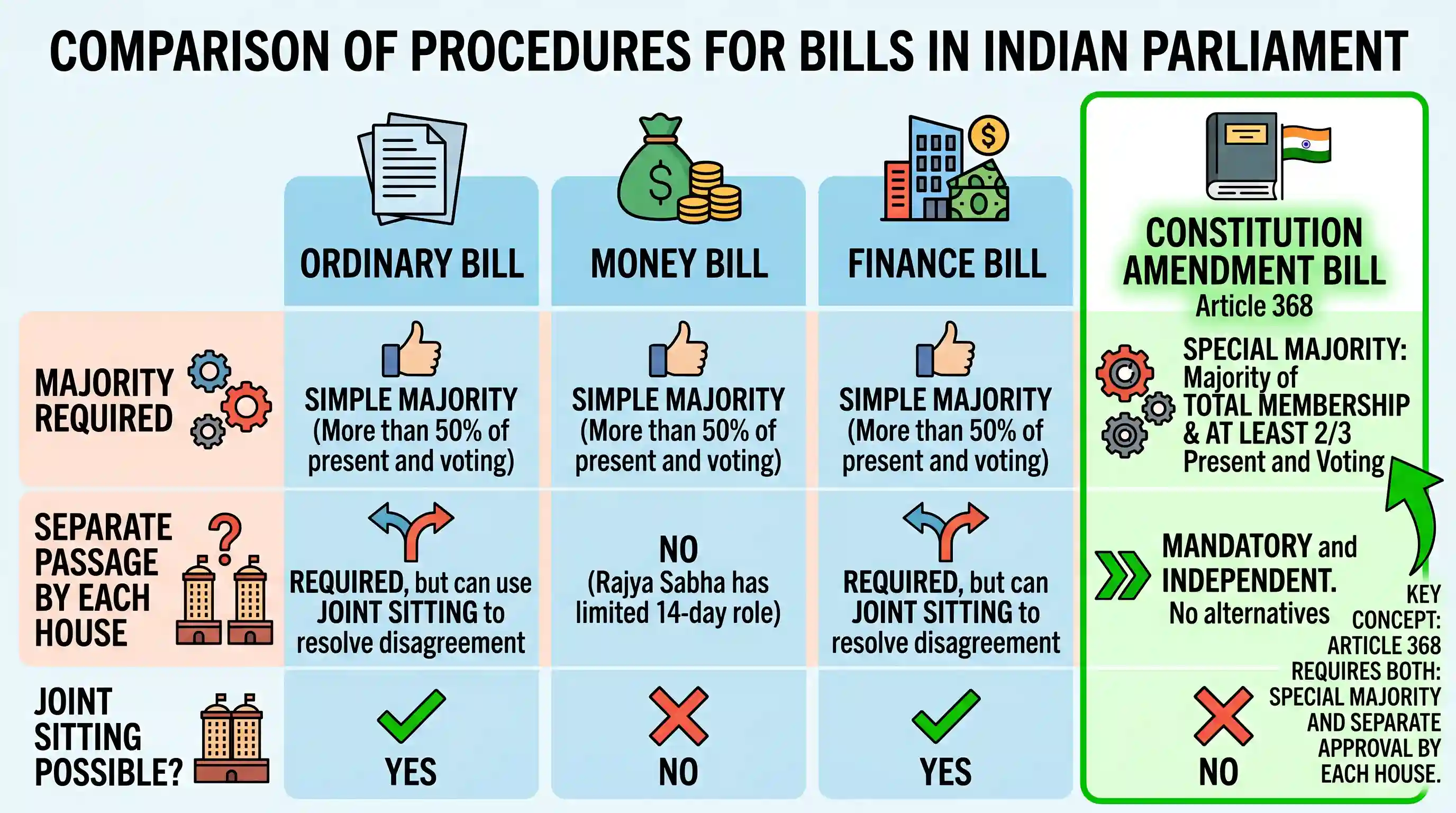
The correct answer is D because the Constitution Amendment Bill is governed by Article 368 of the Indian Constitution. This article specifically requires that the bill must be passed in each House of Parliament by a special majority, which is a majority of the total membership of the House and a majority of not less than two-thirds of the members present and voting.
Unlike Ordinary Bills, there is no provision for a joint sitting of both Houses if there is a disagreement. Therefore, each House must pass the bill independently with the required special majority.
In contrast, Ordinary Bills and Finance Bills require only a simple majority and allow for a joint sitting. Money Bills can only be introduced in the Lok Sabha, and the Rajya Sabha has very limited powers over them, meaning they do not require a separate special majority from both Houses.
Related questions
More UPSC Prelims practice from the same subject and topic.
- Prelims 2003GS1polity-and-governance
The power to enlarge the jurisdiction of the Supreme Court of India with respect to any matter included in the Union List of Legislative Powers rests with
- Prelims 2003GS1polity-and-governance
Match List I (Item in the Indian Constitution) with List II (Country from which it was derived) and select the correct answer using the codes given below the list. List I List II (Item in the India Co…
- Prelims 2003GS1polity-and-governance
Under which Article of the Indian Constitution did the President give his assent to the ordinance on electoral reforms when it was sent back to him by the Union Cabinet without making any changes (in …
- Prelims 2003GS1polity-and-governance
Which of the following Constitutional Amendments are related to raising the number of Members of Lok Sabha to be: elected from the States?
- Prelims 2003GS1polity-and-governance
Which one of the following schedules of the Indian Constitution lists the names of states and specifies their territories?
- Prelims 2003GS1polity-and-governance
The Ninth Schedule to the Indian Constitution was added by