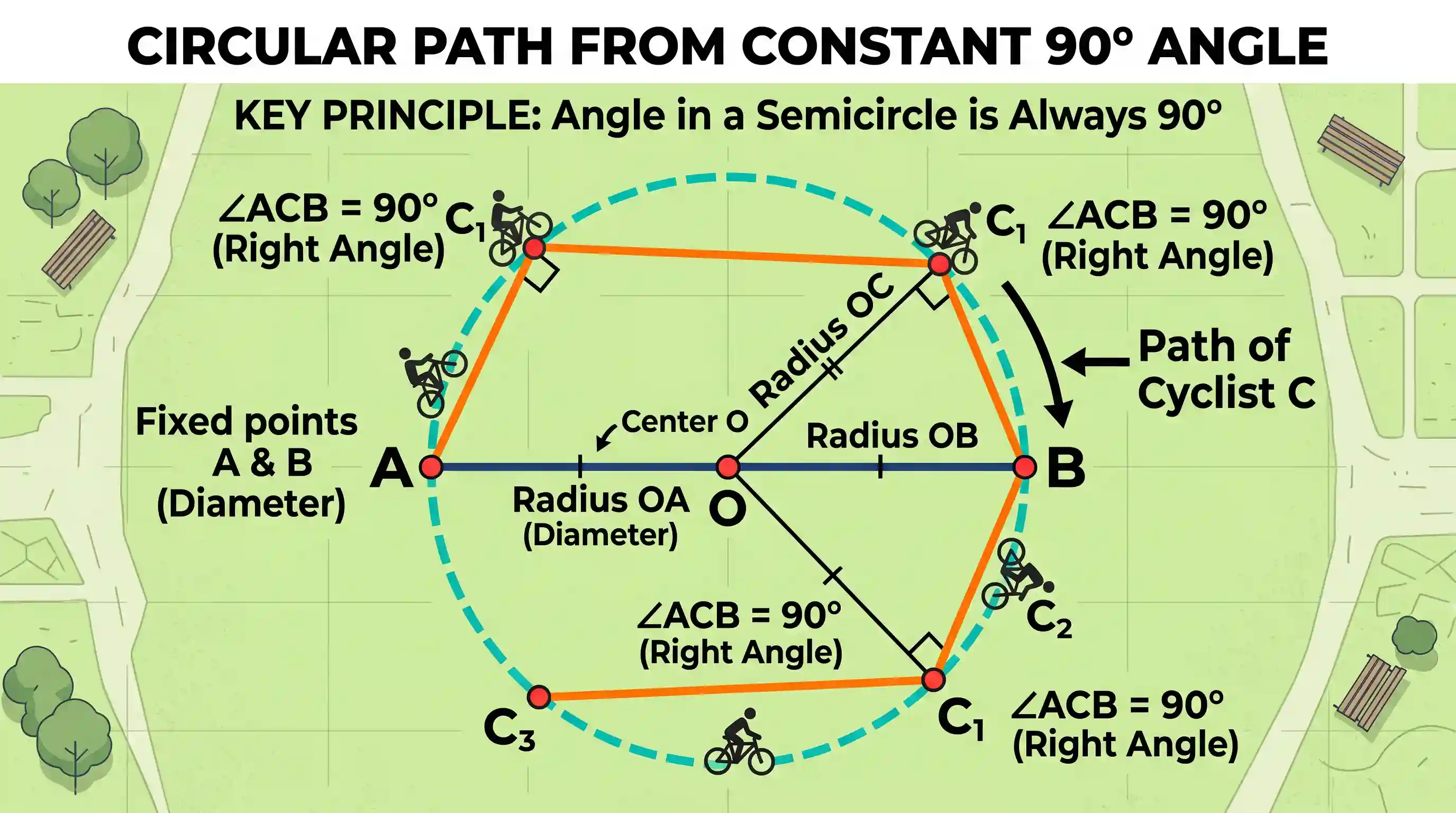
‘A’ and ‘B’ are two fixed points in a field. A cyclist C moves such that ACB is always a right angle. In this context, which one of the following statements is correct?

- AThe path followed by the cyclist is an ellipse
- BThe path followed by the cyclist is a circleCorrect
- CThe path followed by the cyclist is an exponential curve
- DThis type of motion is not possible
Explanation
The correct answer is B because of a fundamental property of circles in geometry. According to the Thales theorem or the property of an angle in a semicircle, the angle subtended by a diameter at any point on the circumference is always a right angle.
In this scenario, A and B are fixed points. If the cyclist C moves such that the angle ACB is always 90 degrees, C must be moving along the boundary of a circle where the line segment AB serves as the diameter. The fixed points A and B act as the endpoints of this diameter, and the path traced by C satisfies the geometric definition of a circle. Therefore, the path followed by the cyclist is a circle.
Related questions
More UPSC Prelims practice from the same subject and topic.
- Prelims 2003GS1geography
An oil tanker is partially filled with oil and moves forward on a level road with uniform acceleration. The free surface of oil then
- Prelims 2003GS1geography
A car travels the first one-third of a certain distance with a speed of 10 km/hr, the next one-third distance with a speed of 20 km/hr and the last one-third distance with a speed of 60 km/hr. The ave…
- Prelims 2003GS1geography
Assertion (A): The weight of a body decreases with the increase of latitude on earth Reason (R): The earth is not perfect sphere
- Prelims 2003GS1geography
Which one of the following countries does NOT border the Caspian Sea?
- Prelims 2003GS1geography
Among the following which planet takes maximum time for one revolution around the Sun?
- Prelims 2003GS1geography
The waterfall ‘Victoria’ is associated with the river