Consider the following statements: India continues to be dependent on imports to meet the requirement of oilseeds in the country because: 1. Farmers prefer to grow food grains with highly remunerative support prices. 2. Most of the cultivation of oilseed crops continues to be dependent on rainfall. 3. Oils from the seeds of tree origin and rice bran have remained unexploited. 4. It is far cheaper to import oilseeds than to cultivate the oilseed crops. Which of the statements given above are correct?

- A1 and 2
- B1, 2 and 3Correct
- C3 and 4
- D1, 2, 3 and 4
Explanation
India's dependence on oilseed imports is a complex issue rooted in several factors related to agricultural policy, cultivation practices, and resource utilization.
Let's analyze each statement:
-
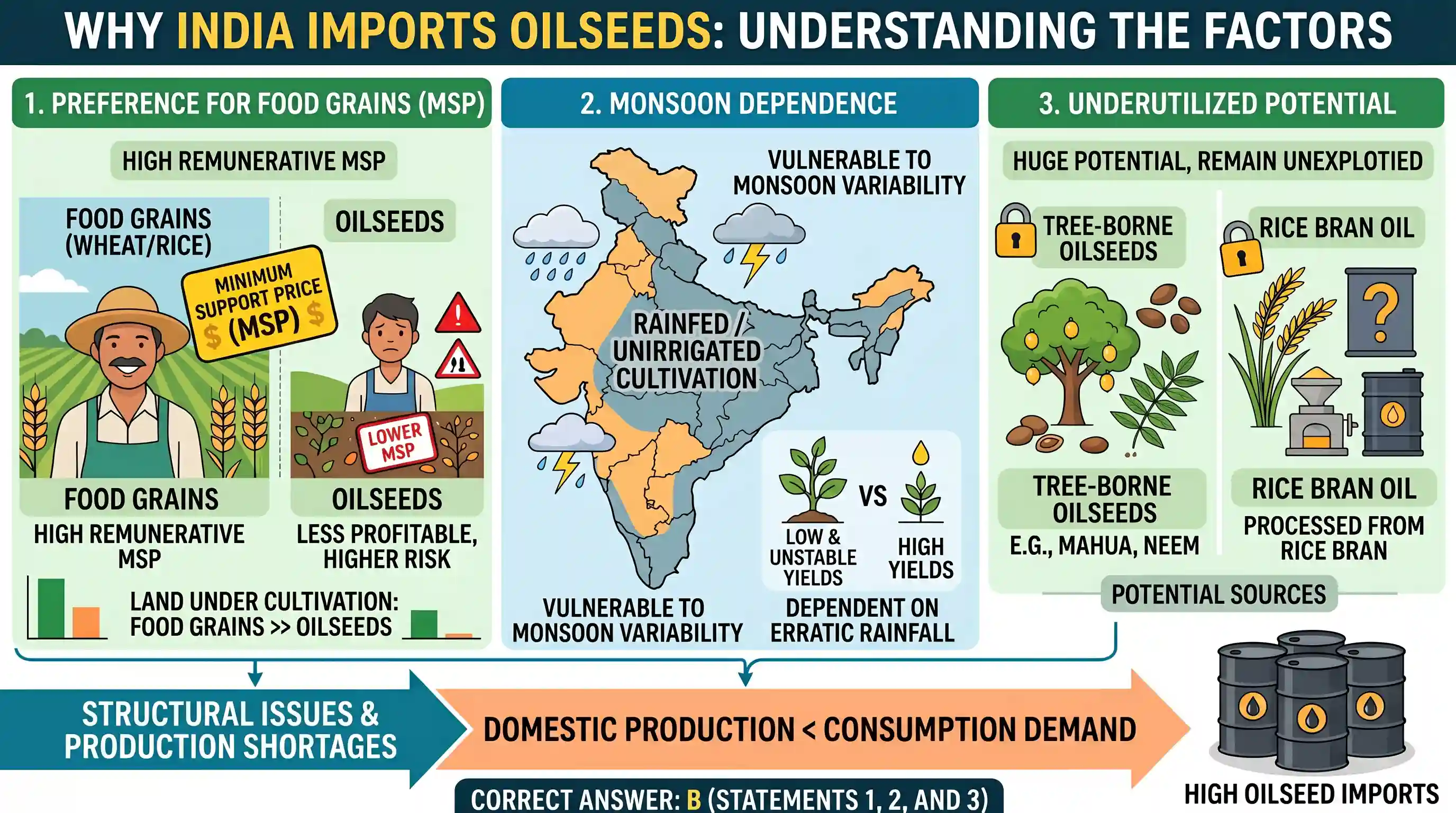
Farmers prefer to grow food grains with highly remunerative support prices. This statement is correct. Government policies, particularly Minimum Support Prices (MSPs) for crops like wheat and rice, often make food grain cultivation more profitable and less risky for farmers compared to oilseeds. This diverts land and resources away from oilseed production, contributing to domestic shortages.
-
Most of the cultivation of oilseed crops continues to be dependent on rainfall. This statement is correct. A significant portion of oilseed cultivation in India occurs in rainfed areas, making it vulnerable to monsoon variability. This leads to unstable yields and lower overall production compared to irrigated crops, thus necessitating imports.
-
Oils from the seeds of tree origin and rice bran have remained unexploited. This statement is correct. India has potential sources of non-conventional oils, such as those derived from tree-borne oilseeds (e.g., Mahua, Neem, Karanj) and rice bran. These resources are largely underutilized. Exploiting them could significantly boost domestic oil availability and reduce import dependence. Their unexploited status is a reason for continued dependency.
-
It is far cheaper to import oilseeds than to cultivate the oilseed crops. While imports can sometimes be cheaper due to global market dynamics, economies of scale in exporting countries, or subsidies in those countries, this statement is not always universally true for all oilseeds or all times. More importantly, it describes a consequence or a reinforcing factor rather than a primary reason for India's initial or structural dependency. The dependency arises from domestic production shortcomings (as explained in statements 1, 2, and 3). If domestic production were sufficient and competitive, the need for imports would diminish regardless of their price. The other three statements point to fundamental issues within India's agricultural sector that lead to insufficient domestic production.
Therefore, statements 1, 2, and 3 are the most accurate and fundamental reasons for India's continued dependence on oilseed imports.
The final answer is B
Related questions
More UPSC Prelims practice from the same subject and topic.
- Prelims 2004GS1economy
Which one of the following was the largest IT software and services exporter in India during the year 2002-03?
- Prelims 2004GS1economy
In the last one decade, which one among the following sectors has attracted the highest Foreign Direct Investment inflows into India?
- Prelims 2004GS1economy
Consider the following statements: 1. National Thermal Power Corporation has diversified into hydropower sector. 2. Power Grid Corporation of India has diversified into telecom sector. Which of the st…
- Prelims 2004GS1economy
Consider the following statements: 1. Damodar Valley Corporation is the first multipurpose river valley project of independent India. 2. Damodar Valley Corporation includes thermal and gas power stati…
- Prelims 2004GS1economy
Assertion (A): India does not export natural rubber. Reason (R): About 97% of India’s demand for natural rubber is met from domestic production.
- Prelims 2004GS1economy
Consider the following statements: 1. Regarding the procurement of food grains, Government of India follows a procurement target rather than an open-ended procurement policy. 2. Government of India an…