Which one of the following is the correct decreasing sequence in terms of the value (in rupees) of the minerals produced in India in the year 2002-03?

- AMetallic minerals—Fuel minerals—Non-metallic minerals
- BFuel minerals—Metallic minerals—Non-metallic minerals
- CMetallic minerals—non-metallic minerals—Fuel minerals
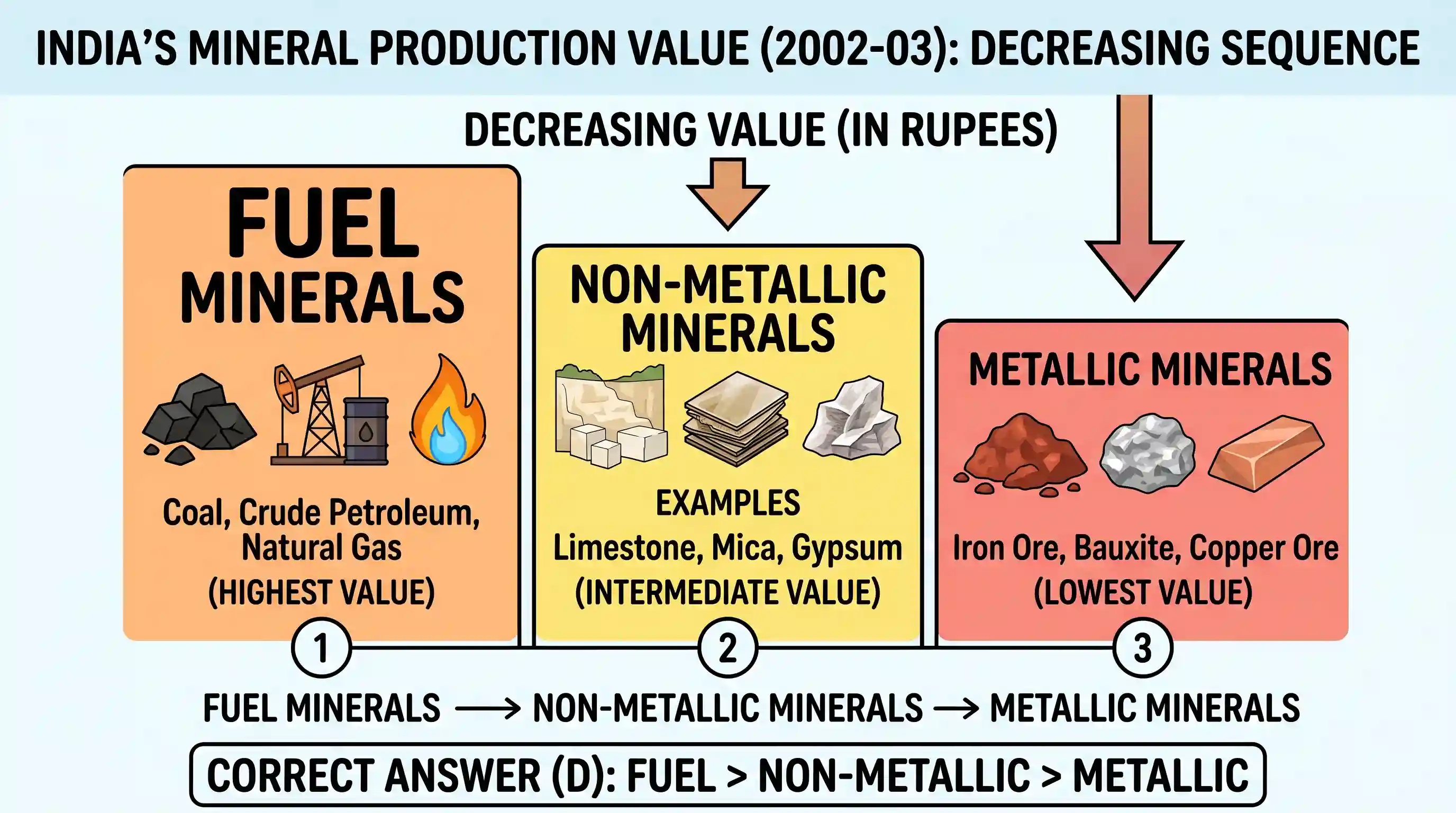
- DFuel minerals—non-metallic minerals—Metallic mineralsCorrect
Explanation
The correct sequence is Fuel minerals—non-metallic minerals—Metallic minerals.
Explanation:
- Fuel minerals (coal, crude petroleum, natural gas) consistently account for the largest share of the value of mineral production in India due to high demand for energy.
- Non-metallic minerals (such as limestone, mica, gypsum, etc.) are produced in large quantities and have diverse industrial applications (e.g., cement, construction), contributing significantly to the overall value, often surpassing metallic minerals.
- Metallic minerals (like iron ore, bauxite, copper, etc.), while crucial, generally have a lower aggregate value compared to fuel minerals and often non-metallic minerals in the Indian context for the specified period.
Therefore, for the year 2002-03, the decreasing order of value was Fuel minerals, followed by Non-metallic minerals, and then Metallic minerals.
Analyzing the options: A) Incorrect. Fuel minerals are the highest in value, not metallic minerals. B) Incorrect. Non-metallic minerals had a higher value than metallic minerals. C) Incorrect. Fuel minerals are the highest in value, not metallic minerals. D) Correct. This sequence accurately reflects the relative values of mineral production categories in India for 2002-03.
Related questions
More UPSC Prelims practice from the same subject and topic.
- Prelims 2004GS1economy
Which one of the following was the largest IT software and services exporter in India during the year 2002-03?
- Prelims 2004GS1economy
In the last one decade, which one among the following sectors has attracted the highest Foreign Direct Investment inflows into India?
- Prelims 2004GS1economy
Consider the following statements: 1. National Thermal Power Corporation has diversified into hydropower sector. 2. Power Grid Corporation of India has diversified into telecom sector. Which of the st…
- Prelims 2004GS1economy
Consider the following statements: 1. Damodar Valley Corporation is the first multipurpose river valley project of independent India. 2. Damodar Valley Corporation includes thermal and gas power stati…
- Prelims 2004GS1economy
Assertion (A): India does not export natural rubber. Reason (R): About 97% of India’s demand for natural rubber is met from domestic production.
- Prelims 2004GS1economy
Consider the following statements: 1. Regarding the procurement of food grains, Government of India follows a procurement target rather than an open-ended procurement policy. 2. Government of India an…