What is the order of magnitude of electric resistance of the human body (dry)?

- A102 ohms
- B104 ohmsCorrect
- C106 ohms
- D108 ohms
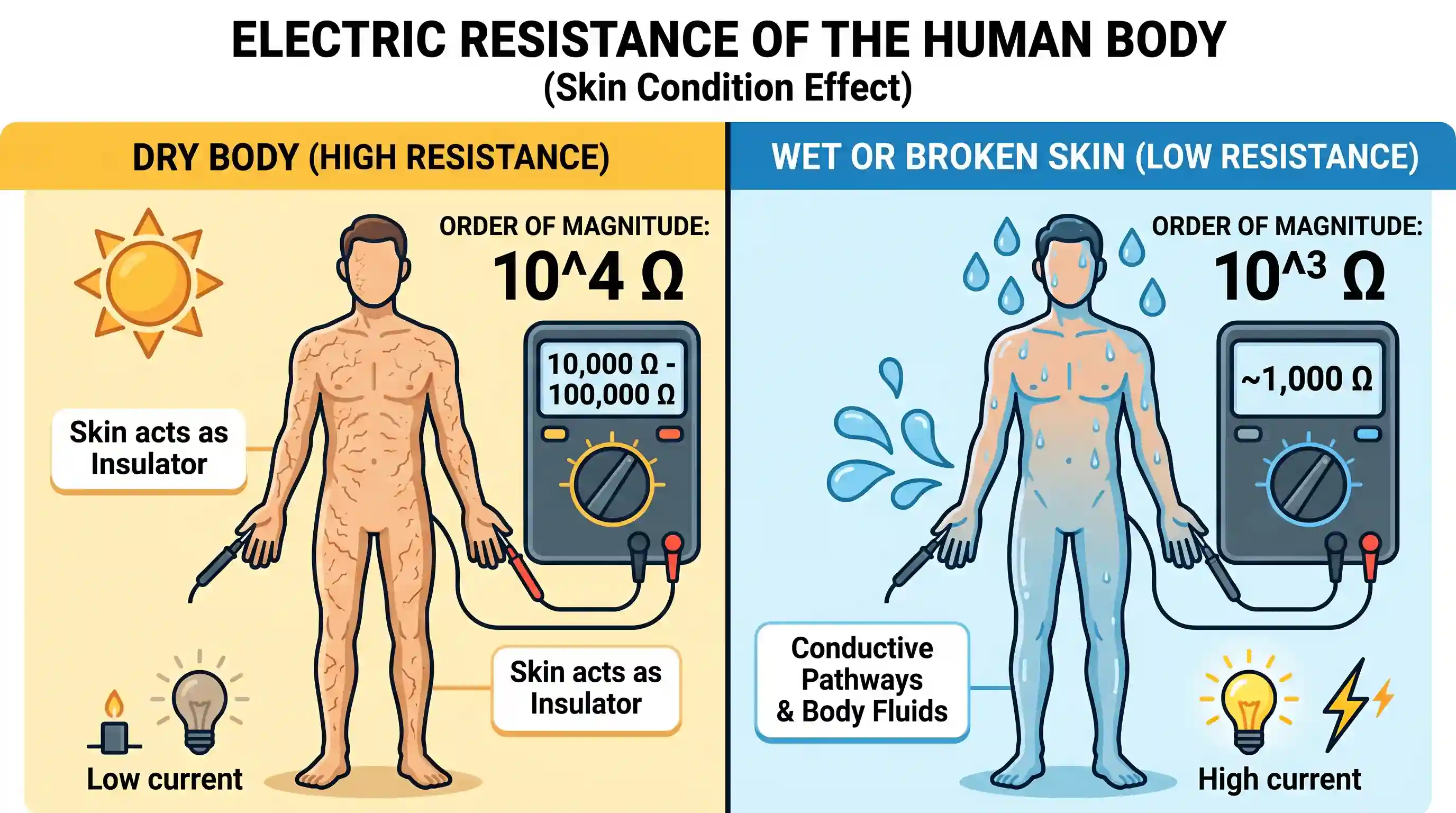
Explanation
The correct answer is B because the electrical resistance of the human body depends primarily on the condition of the skin. When the skin is dry, it acts as a strong insulator, typically offering a resistance ranging from 10,000 ohms to 100,000 ohms. In scientific notation, 10,000 ohms is expressed as 10 to the power of 4, making it the correct order of magnitude. If the skin becomes wet or broken, this resistance drops significantly, often falling to around 1,000 ohms or 10 to the power of 3. Therefore, for a dry human body, 10 to the power of 4 ohms is the standard representative value.
Related questions
More UPSC Prelims practice from the same subject and topic.
- Prelims 2005GS1science-and-technology
Ten identical particles are moving randomly inside a closed box. What is the probability that at any given point of time all the ten particles will be lying in the same half of the box?
- Prelims 2005GS1science-and-technology
Consider the following statements: 1. During the process of osmosis, the solvent travels from the concentrated solution to the dilute solution.
- Prelims 2005GS1science-and-technology
Assertion (A): All the proteins in our food are digested in small intestine only. Reason (R): The Protein digesting enzymes from pancreas are released into small intestine.
- Prelims 2005GS1science-and-technology
Assertion (A): Amoeba is reproduced by fission. Reason (R): All unicellular organisms are reproduced by asexual methods.
- Prelims 2005GS1science-and-technology
Assertion (A): The main constituent of the Liquefied Petroleum Gas is methane. Reason (R): Methane can be used directly for burning in homes and factories where it can be supplied through pipelines.
- Prelims 2005GS1science-and-technology
Assertion (A): The person with diabetes insipidus feels thirsty. Reason (R): A person with diabetes insipidus suffers from excess secretion of vasopressin.