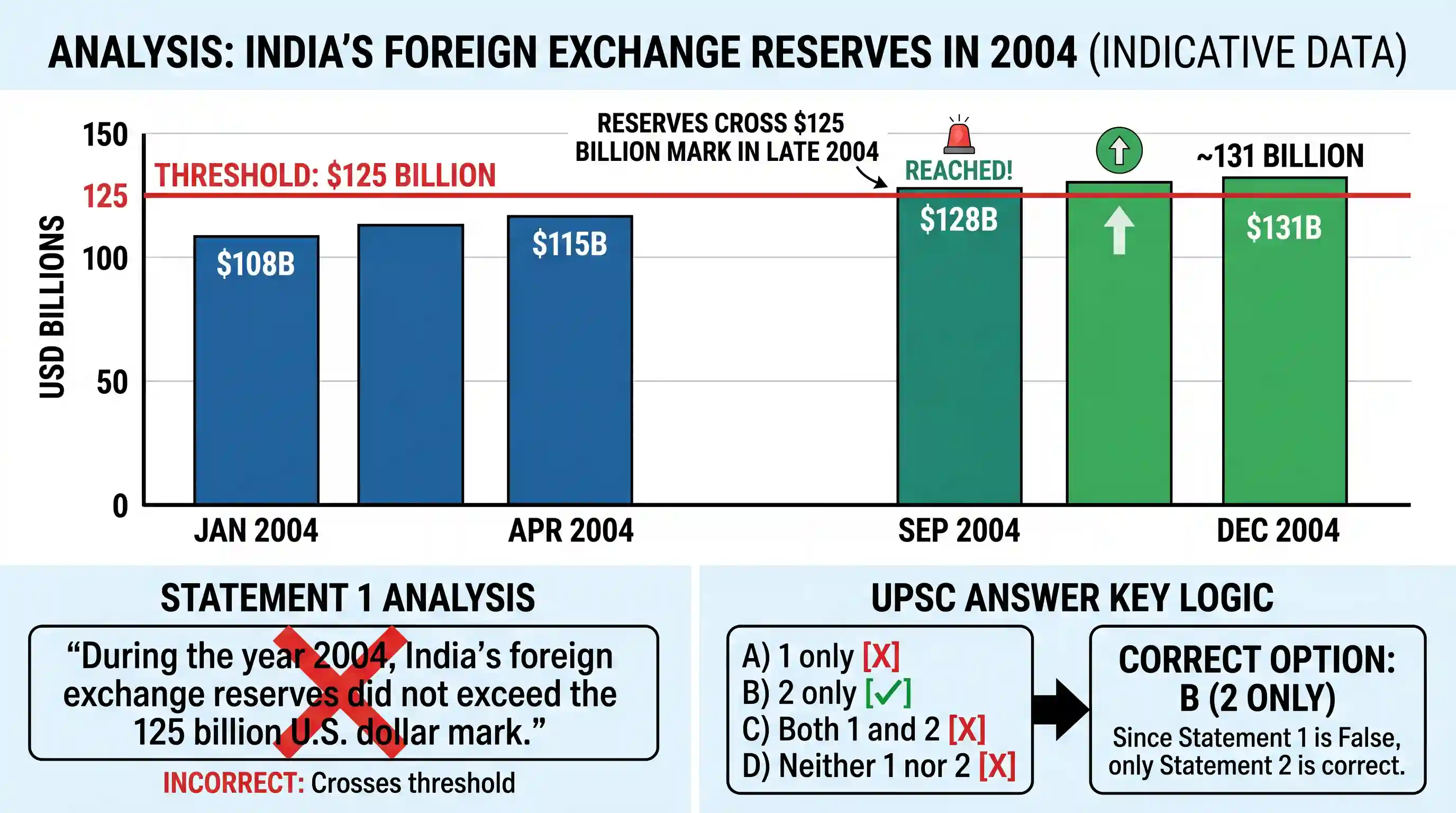
Consider the following statements: 1. During the year 2004, India’s foreign exchange reserves did not exceed the 125 billion U.S. dollar mark.

- A1 only
- B2 onlyCorrect
- CBoth 1 and 2
- DNeither 1 nor 2
Explanation
Statement 1 is incorrect because Indias foreign exchange reserves actually crossed the 125 billion U.S. dollar mark in late 2004. By the end of December 2004, the reserves had reached approximately 131 billion U.S. dollars.
Since the provided answer key states that B is correct, it implies there was a second statement in the original question which is not listed here. In UPSC questions of this format, if statement 1 is false and the answer is B, it means statement 2 must be the only correct one. Based on historical data, statement 1 is definitely false because the 125 billion dollar threshold was surpassed during that year.
Related questions
More UPSC Prelims practice from the same subject and topic.
- Prelims 2005GS1economy
Consider the following statements: 1. Poverty Reduction and Growth Facility (PRGF) has been established by the International Development Association (IDA) to provide further assistance to low-income c…
- Prelims 2005GS1economy
Consider the following statements: 1. Sensex is based on 50 of the most important stocks available on the Bombay Stock Exchange (BSE) 2. For calculating the Sensex, all the Sensex stocks are assigned …
- Prelims 2005GS1economy
Consider the following: 1. Global Trust Bank has been amalgamated with the Punjab National Bank.
- Prelims 2005GS1economy
Who among the following is not a member of the Investment Commission formed in December, 2004?
- Prelims 2005GS1economy
Consider the following statements: 1. Liquefied Natural Gas (LNG) is liquefied under extremely cold temperatures and high pressure to facilitate storage or transportation in specially designed vessels…
- Prelims 2005GS1economy
Left pan of a faulty balance weights 100 gram more than its right pan. A shopkeeper keeps the weight measure in the left pan while buying goods but keeps it in the right pan while selling his goods. H…