Each of the persons A, B, C, D and E possesses Unequal number (<10) of similar items. A, B and C possess 21 items in all, while C, D and E possess 7 items in all. How many items do A and B possess in all?

- A15
- B17
- C18
- DData is insufficientCorrect
Explanation
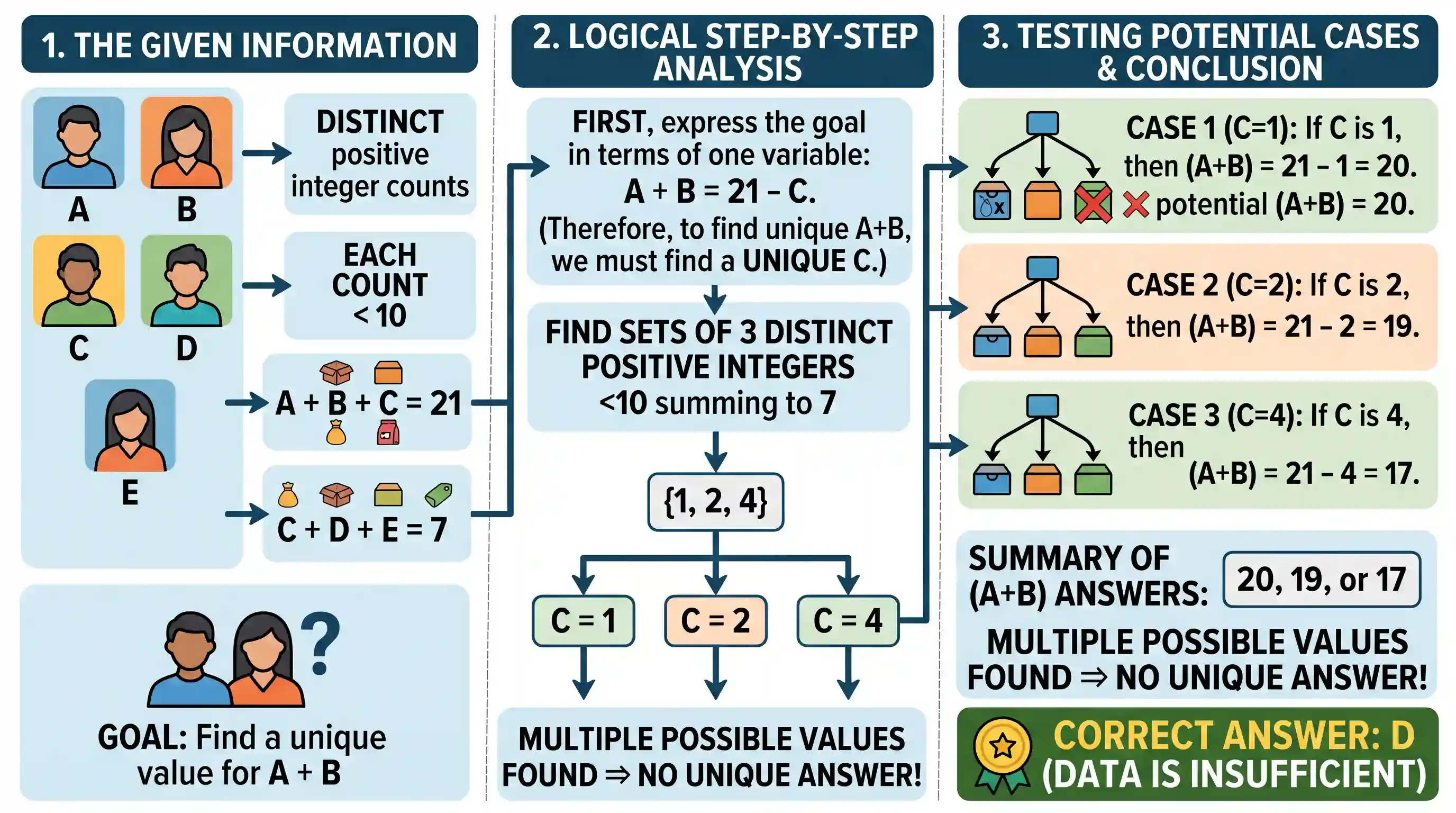
To find the number of items A and B possess in all, we need to determine the value of A + B.
From the first statement, we have: A + B + C = 21 This implies A + B = 21 - C. To find A + B, we need to find the exact value of C.
From the second statement, we have: C + D + E = 7
We are also given that A, B, C, D, E possess unequal numbers of items, and each person possesses less than 10 items. Since C, D, and E must be unequal positive integers and sum to 7, the only possible set of numbers for {C, D, E} is {1, 2, 4}. (For example, 1+2+3=6, so 1+2+4=7 is the next smallest sum of three distinct positive integers.)
This means C can take any of these values: 1, 2, or 4.
Case 1: If C = 1 Then A + B = 21 - 1 = 20. (In this case, D and E would be 2 and 4 in some order, which are unequal and less than 10.)
Case 2: If C = 2 Then A + B = 21 - 2 = 19. (In this case, D and E would be 1 and 4 in some order, which are unequal and less than 10.)
Case 3: If C = 4 Then A + B = 21 - 4 = 17. (In this case, D and E would be 1 and 2 in some order, which are unequal and less than 10.)
Since C can be 1, 2, or 4, there are multiple possible values for A + B (20, 19, or 17). We cannot determine a unique value for A + B.
Therefore, the data provided is insufficient to answer the question.
The final answer is D.
Related questions
More UPSC Prelims practice from the same subject and topic.
- Prelims 2006GS1polity-and-governance
Which one of the following countries is not a member of the Commonwealth of Independence States (CIS)?
- Prelims 2006GS1polity-and-governance
Match List. I with Likst. II and select the correct answer using the code given below the lists: List. I (Author) List I: A. Amartya Sen, B. Bimal Jalan, C. Arundhati Roy, D. Mani Shankar Aiyar List I…
- Prelims 2006GS1polity-and-governance
Consider the following statements: 1. SAFTA came into effect Dec 1, 2005. 2. India, Pakistan, Sri Lanka must decrease duties to 0-5% by 2013. Which of the statements given above is/are correct?
- Prelims 2006GS1polity-and-governance
Which one of the following countries is not a member of ASEAN?
- Prelims 2006GS1polity-and-governance
Which one of the following countries is not a member of ASEAN?
- Prelims 2006GS1polity-and-governance
Which one among the following was the first to legalize euthanasia?