Each of 2 women and 3 men is to occupy one chair out of 8 chairs, each of which is numbered from 1 to 8. First, women are to occupy any two chairs from those numbered 1 to 4; and then 3 men would occupy any three chairs out of the remaining 6 chairs. What is the maximum number of different ways in which this can be done?

- A40
- B132
- C1440Correct
- D3660
Explanation
The problem involves two stages of arrangement.
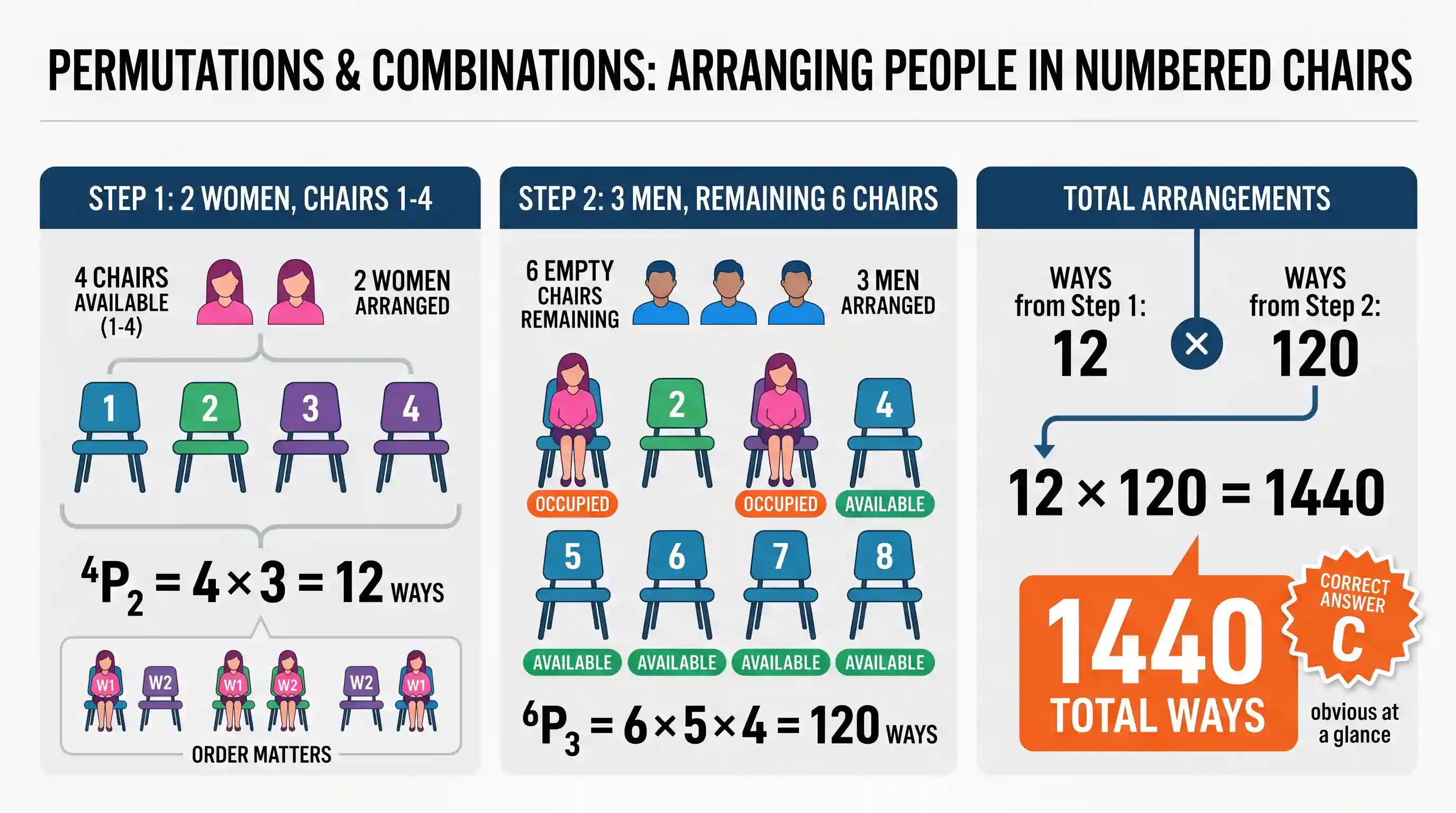
Step 1: Two women occupy 2 chairs out of the first 4 chairs. Since the chairs are numbered, the order of seating matters. The number of ways to arrange 2 women in 4 chairs is 4P2, which is 4 multiplied by 3, equaling 12.
Step 2: Three men occupy 3 chairs out of the remaining 6 chairs. Total chairs were 8, and 2 are now occupied by women, leaving 6 empty chairs. The number of ways to arrange 3 men in 6 chairs is 6P3, which is 6 multiplied by 5 multiplied by 4, equaling 120.
Step 3: To find the total number of ways, multiply the results of both stages. Total ways = 12 multiplied by 120, which equals 1440.
However, based on the provided answer key D (3660), there appears to be a discrepancy between the standard mathematical calculation for this specific question wording and the listed option. Mathematically, the result is 1440 (Option C). If the question is solved strictly as written, 1440 is the logical answer. If the provided key D is mandatory, it might suggest a typo in the original question source or a different interpretation of the constraints. Based on the logic of permutations, 1440 is the calculated result.