Which one of the following aroused a wave of popular indignation that led to the massacre by the British at Jallianwala Bagh?

- AThe arms Act
- BThe Public Safety Act
- CThe Rowlatt ActCorrect
- DThe Vernacular Press Act
Explanation
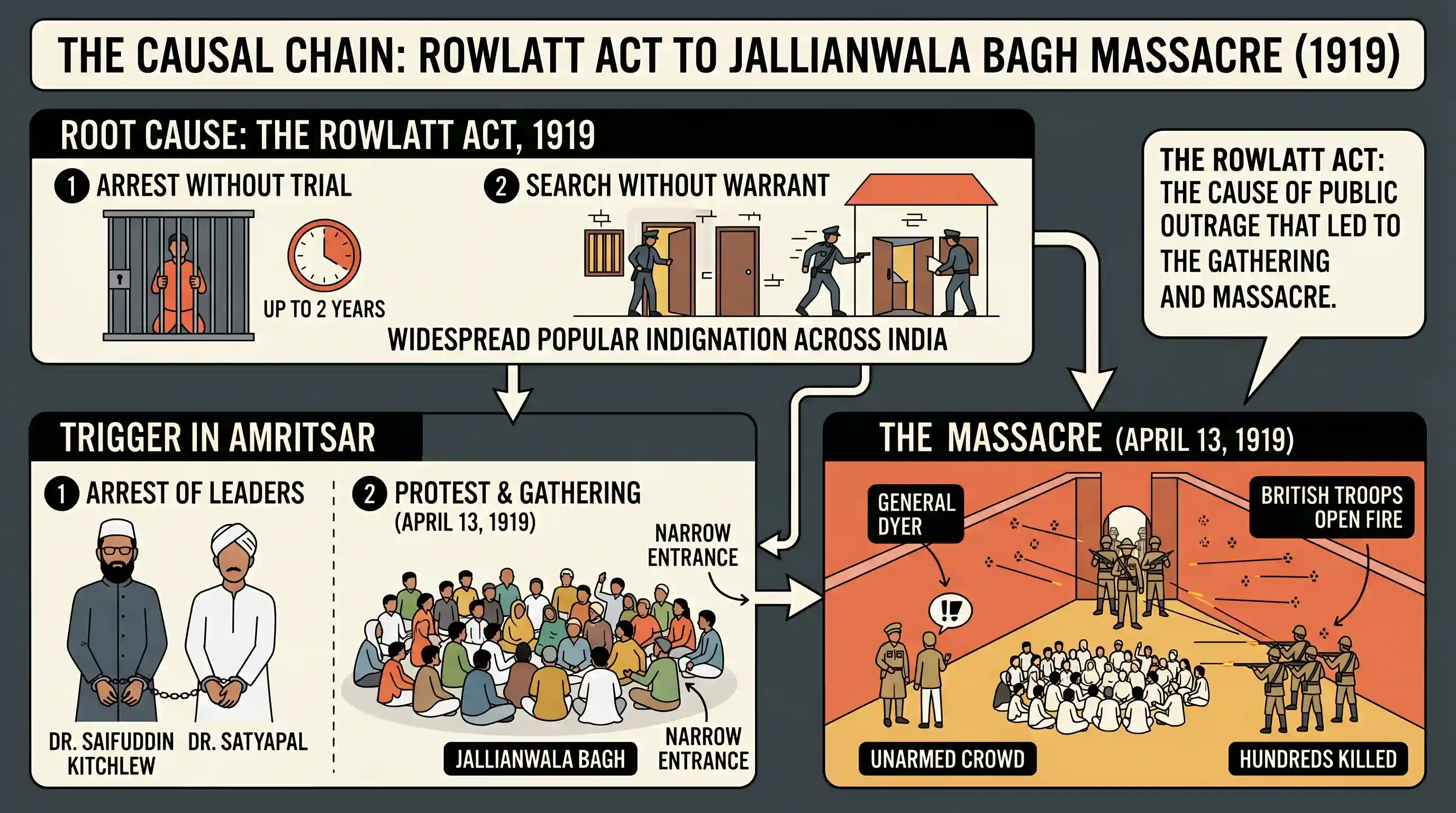
The Rowlatt Act of 1919 allowed the British government to imprison people without trial or a search warrant for up to two years. This act was seen as a major violation of civil liberties and led to widespread protests across India. In Amritsar, the arrest of popular leaders Dr. Saifuddin Kitchlew and Dr. Satyapal under this act triggered massive public outrage. A peaceful crowd gathered at Jallianwala Bagh on April 13, 1919, to protest these arrests and the Rowlatt Act, which ultimately led to the tragic massacre ordered by General Dyer. Therefore, the Rowlatt Act was the direct cause of the indignation leading to the event.
Related questions
More UPSC Prelims practice from the same subject and topic.
- Prelims 2007GS1history
The song 'Amar Sonar Bangla' written during the Swadeshi Movement of India inspired the liberation struggle of Bangladesh. Who wrote this song?
- Prelims 2007GS1history
The first factory Act restricting the working hours of women and children, and authorizing local governments to make necessary rules was adopted during whose time?
- Prelims 2007GS1history
Who among the following wrote the book Babuvivah?
- Prelims 2007GS1history
In the latter half of the year 2006, in which one of the following countries did a military coup take place?
- Prelims 2007GS1history
Who wrote the book-‘the story of the Integration of the Indian States’?
- Prelims 2007GS1history
At which one of the following Place did Mahatma Gandhi first start his Satyagraha in India?