Five balls of different colours are to be placed in three different boxes such that any box contains at least one ball. What is the maximum number of different ways in which this can be done?

- A90
- B120
- C150Correct
- D180
Explanation
To find the number of ways to distribute 5 distinct balls into 3 distinct boxes such that each box has at least one ball, we follow these steps:
-
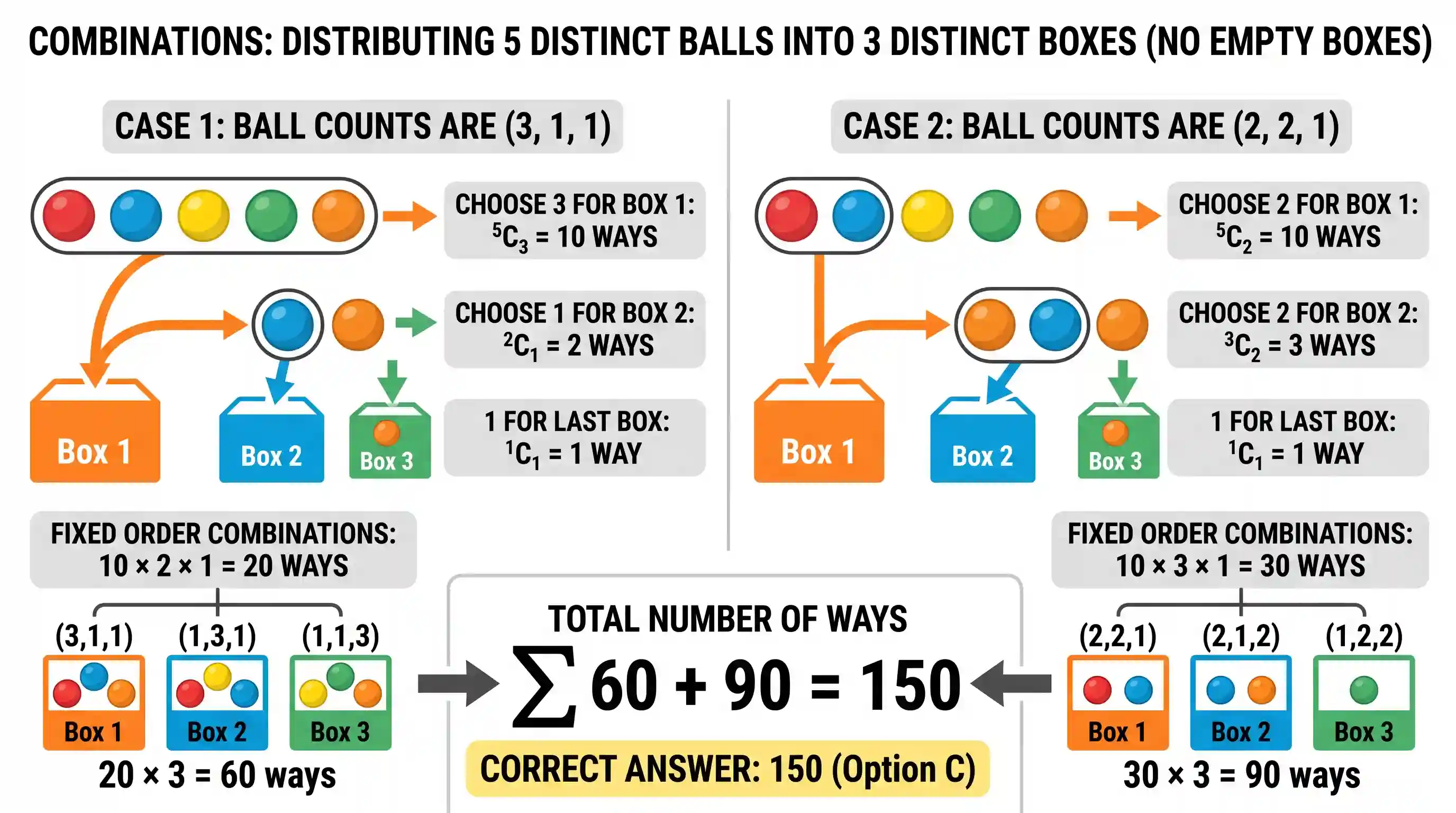
Identify the possible distributions of balls: Since every box must have at least one ball, the two possible distributions are: Case 1: 3 balls in one box, 1 in the second, and 1 in the third (3, 1, 1). Case 2: 2 balls in one box, 2 in the second, and 1 in the third (2, 2, 1).
-
Calculate ways for Case 1 (3, 1, 1): First, choose 3 balls out of 5 for the first box: 5C3 = 10 ways. Then, choose 1 ball out of the remaining 2 for the second box: 2C1 = 2 ways. The last ball goes to the last box: 1C1 = 1 way. Multiply these: 10 x 2 x 1 = 20 ways. Since the 3 balls can be in any of the 3 boxes, multiply by 3: 20 x 3 = 60 ways.
-
Calculate ways for Case 2 (2, 2, 1): First, choose 2 balls out of 5 for the first box: 5C2 = 10 ways. Then, choose 2 balls out of the remaining 3 for the second box: 3C2 = 3 ways. The last ball goes to the last box: 1C1 = 1 way. Multiply these: 10 x 3 x 1 = 30 ways. Since the single ball can be in any of the 3 boxes, multiply by 3: 30 x 3 = 90 ways.
-
Total ways: Add the results from both cases: 60 + 90 = 150 ways.
Thus, the correct option is C.
Related questions
More UPSC Prelims practice from the same subject and topic.
- Prelims 2007GS1science-and-technology
Which of the following types is used by computed tomography employed for visualization of the internal structure of human body?
- Prelims 2007GS1science-and-technology
Which one of the following is the correct sequence in the order of decreasing length of the three structural parts given below of small intestine in the human body?
- Prelims 2007GS1science-and-technology
In human body, which one of the following hormones regulates blood calcium and Phosphate?
- Prelims 2007GS1science-and-technology
How do most insects respire?
- Prelims 2007GS1science-and-technology
In human being, normally in which one of the following parts, does the a sperm fertilize the ovum?
- Prelims 2007GS1science-and-technology
Which one of the following parts of human brain is the regulating centre for swallowing and vomiting?