Consider the following statements: 1. The mode of removal of a Judge of a High Court in India is same as that of removal of a Judge of the Supreme Court. 2. After retirement from the office, a permanent Judge of a High Court cannot plead or act in any court or before any authority in India. Which of the statements given above is/are correct?

- A1 onlyCorrect
- B2 only
- CBoth 1 and 2
- DNeither 1 nor 2
Explanation
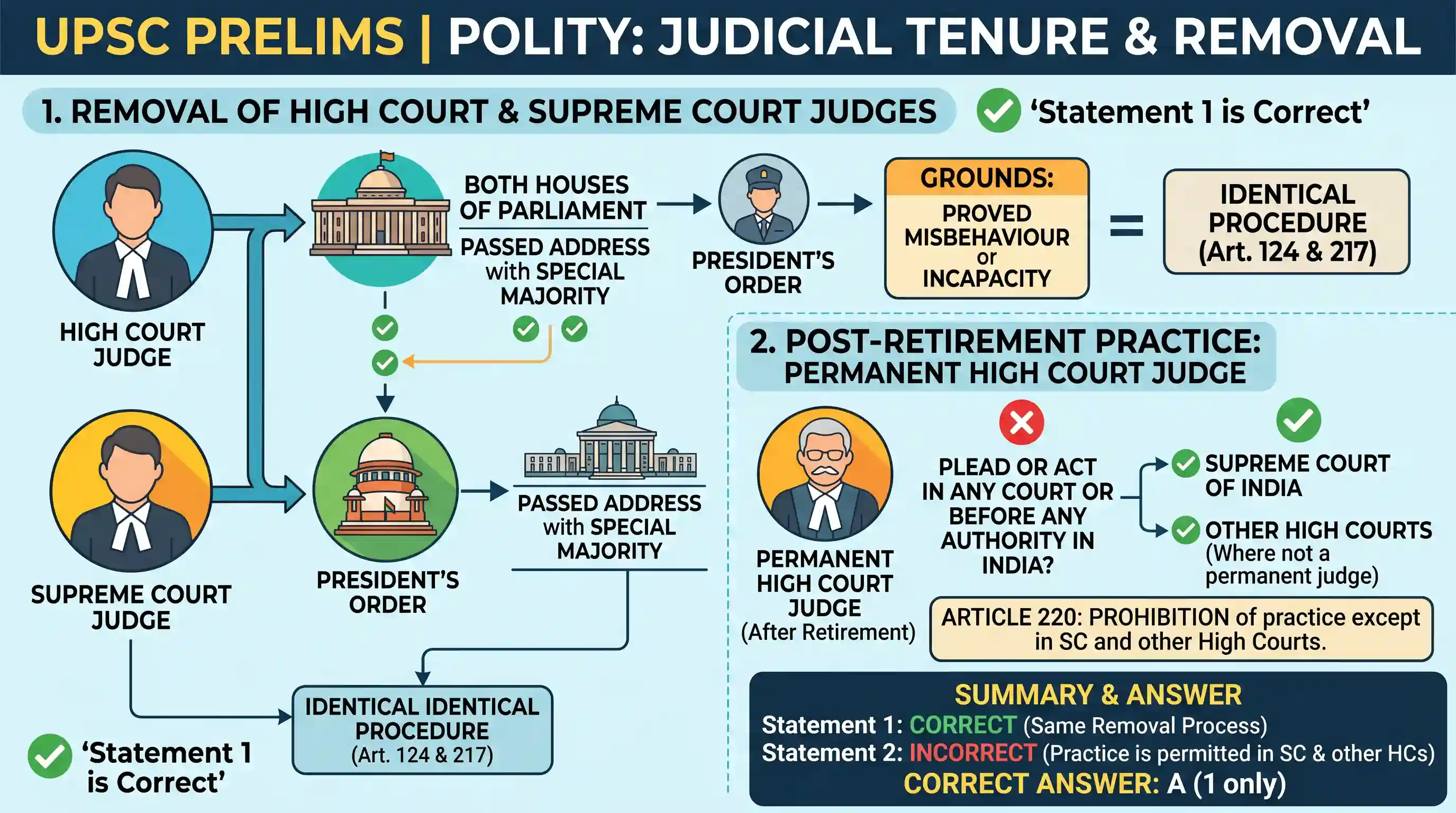
Statement 1 is correct. The procedure for the removal of a High Court Judge is identical to that of a Supreme Court Judge. Both are removed by the President's order, following an address passed by both Houses of Parliament with a special majority on grounds of proved misbehaviour or incapacity.
Statement 2 is incorrect. Article 220 of the Constitution states that a permanent Judge of a High Court, after retirement, is prohibited from pleading or acting in any court or before any authority in India, except the Supreme Court and other High Courts. Therefore, they are not completely barred from pleading or acting in any court in India.
Since only statement 1 is correct, option A is the answer.
Related questions
More UPSC Prelims practice from the same subject and topic.
- Prelims 2007GS1polity-and-governance
Consider the following statements: 1. The series of the International Paper Sizes is based on A0 size Whose area is 0.5 cm2 (approximately). 2. The area of A4 size paper is 1/8th of that of the A0 siz…
- Prelims 2007GS1polity-and-governance
Consider the following statements: 1. The Chairman of the Committee on public Accounts is appointed by the Speaker of the Lok Sabha. 2. The Committee on public Accounts comprises Members of Lok Sabha,…
- Prelims 2007GS1polity-and-governance
Consider the following statements: 1. In India, Red Panda is naturally found in the Western Himalayas only. 2. In India, Slow Loris lives in the dense forests of the North East. Which of the statement…
- Prelims 2007GS1polity-and-governance
Consider the following statements: 1. The annual range of temperature is greater in the Pacific Ocean than that in the Atlantic Ocean. 2. The annual range of temperature is greater in the Northern Hem…
- Prelims 2007GS1polity-and-governance
Which one of the following pairs is not correctly matched?
- Prelims 2007GS1polity-and-governance
Consider the following statements: 1. The repo rate is the rate at which other banks borrow from the Reserve Bank of India. 2. A value of 1 or Gini Coefficient in a country implies that there is perfe…