6 equidistant vertical lines are drawn on a board. 6 equidistant horizontal line are also drawn on the board cutting the 6 vertical lines, and the distance between any two consecutive horizontal lines is equal to that between any two consecutive vertical lines. What is maximum number of squares thus formed?

- A37
- B55Correct
- C44
- D56
Explanation
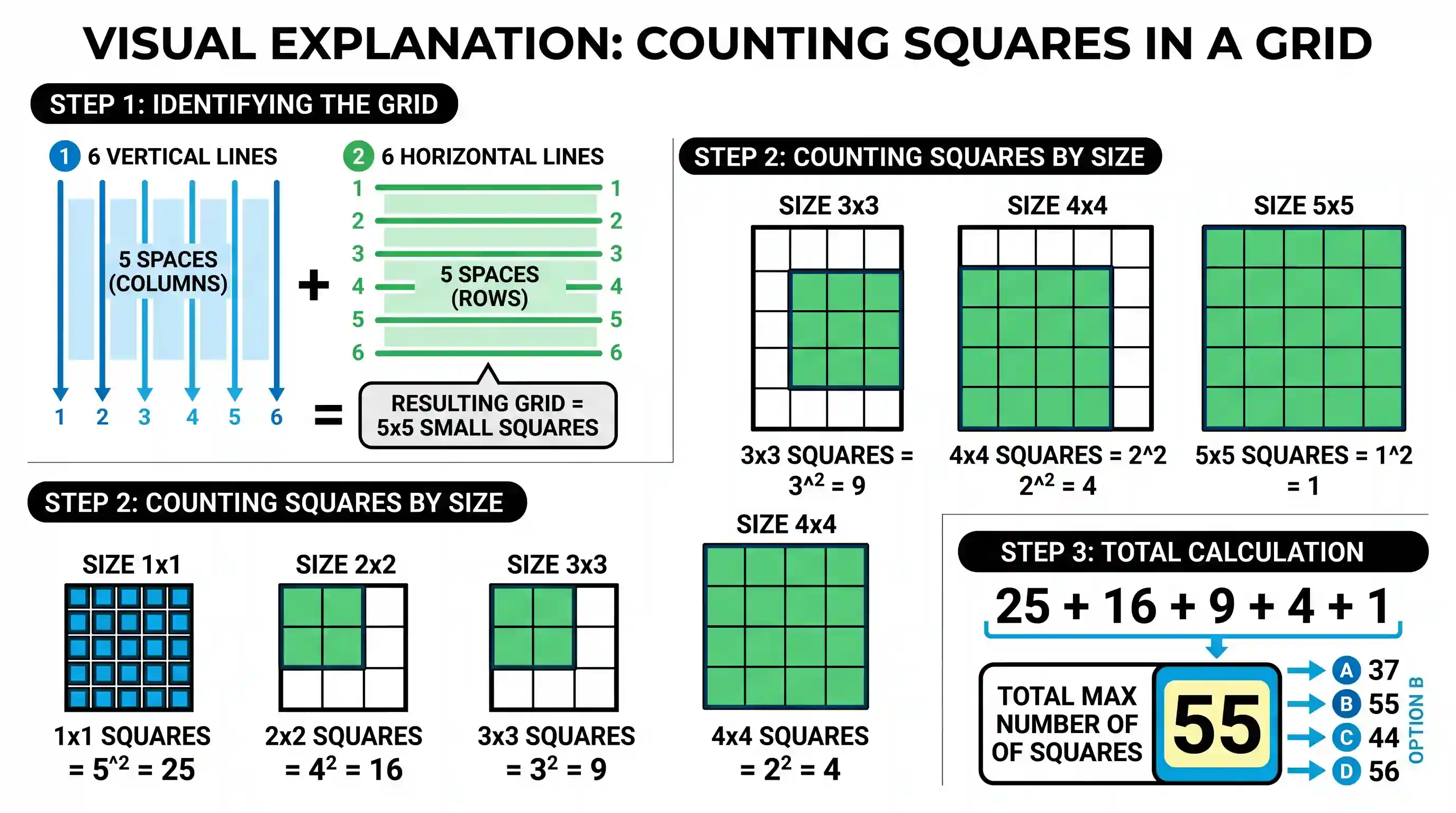
When 6 equidistant vertical lines and 6 equidistant horizontal lines intersect, they create a grid of 5 columns and 5 rows of small individual squares.
To find the total number of squares of all sizes in an n by n grid, we use the formula for the sum of the squares of the first n natural numbers. In this case, since there are 5 spaces between the 6 lines, the grid is 5 by 5.
The calculation is as follows: 5 squared = 25 (size 1 by 1) 4 squared = 16 (size 2 by 2) 3 squared = 9 (size 3 by 3) 2 squared = 4 (size 4 by 4) 1 squared = 1 (size 5 by 5)
Adding these together: 25 + 16 + 9 + 4 + 1 = 55.
Therefore, the maximum number of squares formed is 55. This corresponds to option B.
Related questions
More UPSC Prelims practice from the same subject and topic.
- Prelims 2007GS1science-and-technology
Which of the following types is used by computed tomography employed for visualization of the internal structure of human body?
- Prelims 2007GS1science-and-technology
Which one of the following is the correct sequence in the order of decreasing length of the three structural parts given below of small intestine in the human body?
- Prelims 2007GS1science-and-technology
In human body, which one of the following hormones regulates blood calcium and Phosphate?
- Prelims 2007GS1science-and-technology
How do most insects respire?
- Prelims 2007GS1science-and-technology
In human being, normally in which one of the following parts, does the a sperm fertilize the ovum?
- Prelims 2007GS1science-and-technology
Which one of the following parts of human brain is the regulating centre for swallowing and vomiting?