Six faces of a cube are numbered from 1 to 6, each face carrying one different number. Further, 1. The face 2 is opposite to the face 6. 2. The face 1 is opposite to the face 5. 3. The face 3 is between the face 1 and the face 5. 4. The face 4 is adjacent to the face 2. Which one of the following is correct?

- AThe face 2 is adjacent to the face 3Correct
- BThe face 6 is between the face 2 and the face 4
- CThe face 1 is between the face 5 and the face 6
- DNone of the above
Explanation
Here's a step-by-step analysis:
-
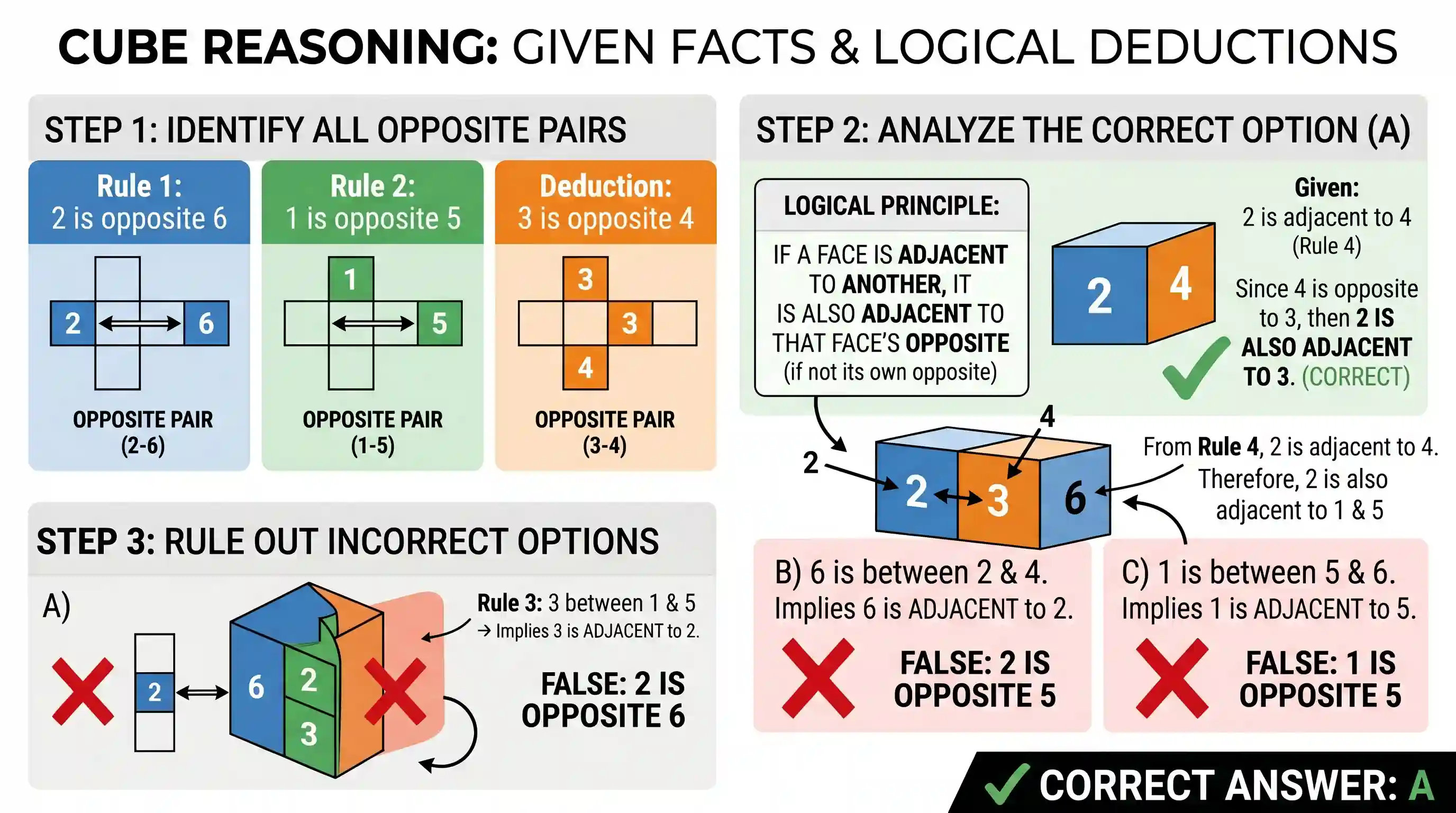
Identify the pairs of opposite faces:
- From statement 1: Face 2 is opposite to face 6. (Pair: 2-6)
- From statement 2: Face 1 is opposite to face 5. (Pair: 1-5)
- Since there are 6 faces, the remaining two faces must also be opposite: Face 3 is opposite to face 4. (Pair: 3-4)
-
Analyze the given positional statements:
- Statement 3: "The face 3 is between the face 1 and the face 5." On a cube, if two faces (1 and 5) are opposite, any other face (like 3) that is not opposite to either of them will be adjacent to both. So, this means face 3 is adjacent to face 1 and face 3 is adjacent to face 5. This is consistent with our opposite pairs (3 is not opposite 1 or 5).
- Statement 4: "The face 4 is adjacent to the face 2." This is a crucial piece of information.
-
Evaluate Option A: "The face 2 is adjacent to the face 3."
- From statement 4, we know that 4 is adjacent to 2.
- We know that 3 is opposite to 4 (from step 1).
- We know that 6 is opposite to 2 (from step 1).
- On a cube, if two faces are adjacent (e.g., 4 and 2), then their opposite faces must also be adjacent. So, if 4 is adjacent to 2, then 3 (opposite 4) must be adjacent to 6 (opposite 2).
- Now we have: 3 is adjacent to 6.
- We also know that 2 is opposite to 6.
- If face A (3) is adjacent to face B (6), and face C (2) is opposite to face B (6), then face A (3) must be adjacent to face C (2). (Imagine 6 is the front face, 2 is the back. If 3 is adjacent to 6, 3 could be top, bottom, left, or right. Any of these positions is also adjacent to the back face 2).
- Therefore, face 2 is adjacent to face 3. This makes option A correct.
-
Evaluate other options to confirm:
- Option B: "The face 6 is between the face 2 and the face 4." This implies face 6 is adjacent to face 2. However, we know from statement 1 that face 6 is opposite to face 2. Opposite faces cannot be adjacent. So, B is incorrect.
- Option C: "The face 1 is between the face 5 and the face 6." This implies face 1 is adjacent to face 5. However, we know from statement 2 that face 1 is opposite to face 5. Opposite faces cannot be adjacent. So, C is incorrect.
Since options B and C are definitively incorrect, and our deduction confirms A, option A is the correct answer.
The final answer is A.
Related questions
More UPSC Prelims practice from the same subject and topic.
- Prelims 2007GS1science-and-technology
Which of the following types is used by computed tomography employed for visualization of the internal structure of human body?
- Prelims 2007GS1science-and-technology
Which one of the following is the correct sequence in the order of decreasing length of the three structural parts given below of small intestine in the human body?
- Prelims 2007GS1science-and-technology
In human body, which one of the following hormones regulates blood calcium and Phosphate?
- Prelims 2007GS1science-and-technology
How do most insects respire?
- Prelims 2007GS1science-and-technology
In human being, normally in which one of the following parts, does the a sperm fertilize the ovum?
- Prelims 2007GS1science-and-technology
Which one of the following parts of human brain is the regulating centre for swallowing and vomiting?