Consider the following statements: 1. a flute of smaller length produces waves of lower frequency. 2. Sound travels in rocks in the form of longitudinal elastic waves only. Which of the statements given above is/are correct?

- A1 only
- B2 only
- CBoth 1 and 2
- DNeither 1 nor 2Correct
Explanation
Explanation:
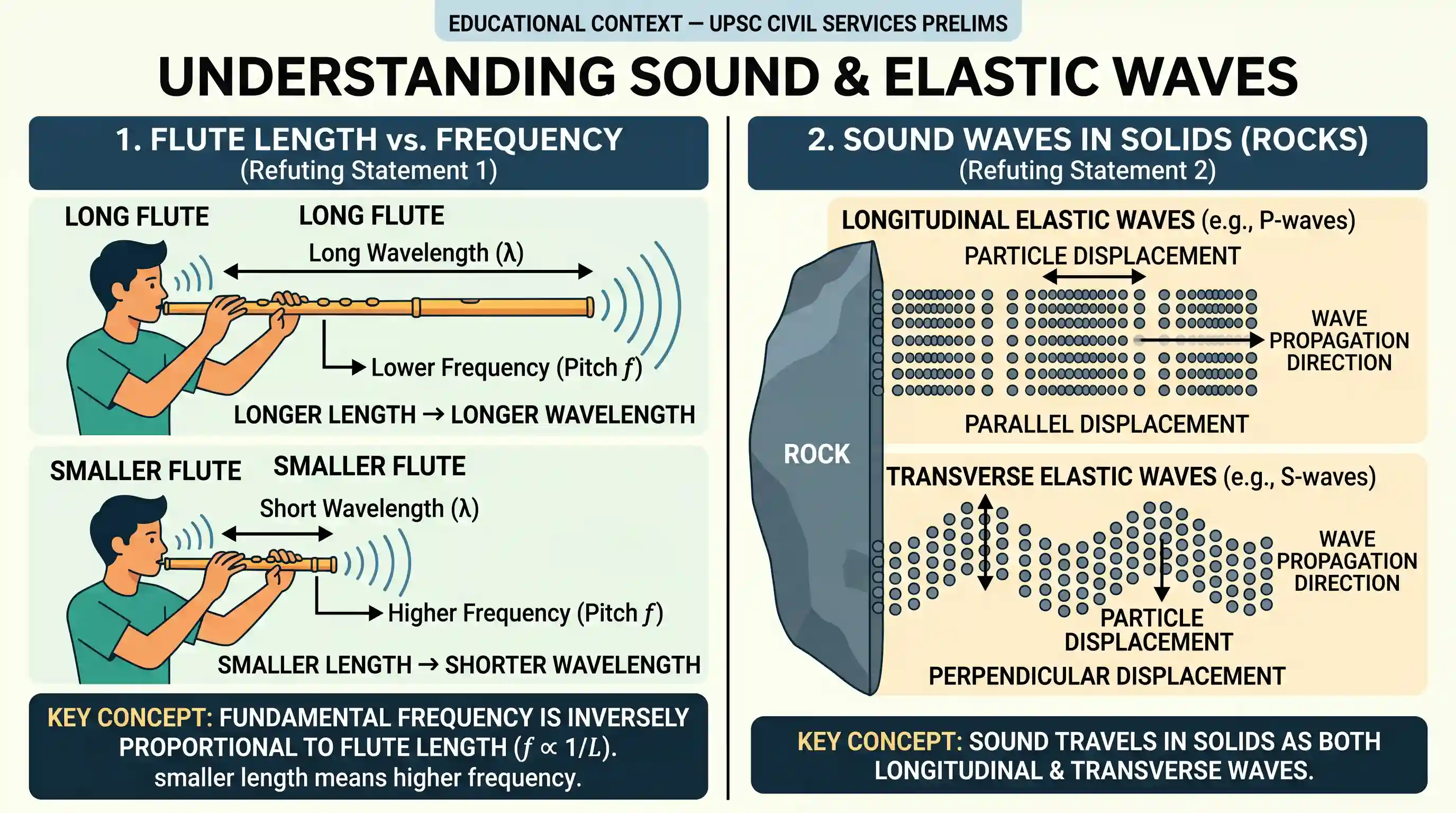
Statement 1 is incorrect. For a flute, which acts as an open pipe, the fundamental frequency (pitch) is inversely proportional to its length. A smaller length means a shorter wavelength and thus a higher frequency (higher pitch), not lower frequency.
Statement 2 is incorrect. Sound, being an elastic wave, can travel through solids (like rocks) in two forms: longitudinal waves (P-waves) and transverse waves (S-waves). Longitudinal waves involve particle displacement parallel to the wave propagation, while transverse waves involve displacement perpendicular to it. Therefore, sound does not travel in rocks as longitudinal waves only.
Since both statements are incorrect, the correct option is D.
Related questions
More UPSC Prelims practice from the same subject and topic.
- Prelims 2007GS1science-and-technology
Which of the following types is used by computed tomography employed for visualization of the internal structure of human body?
- Prelims 2007GS1science-and-technology
Which one of the following is the correct sequence in the order of decreasing length of the three structural parts given below of small intestine in the human body?
- Prelims 2007GS1science-and-technology
In human body, which one of the following hormones regulates blood calcium and Phosphate?
- Prelims 2007GS1science-and-technology
How do most insects respire?
- Prelims 2007GS1science-and-technology
In human being, normally in which one of the following parts, does the a sperm fertilize the ovum?
- Prelims 2007GS1science-and-technology
Which one of the following parts of human brain is the regulating centre for swallowing and vomiting?