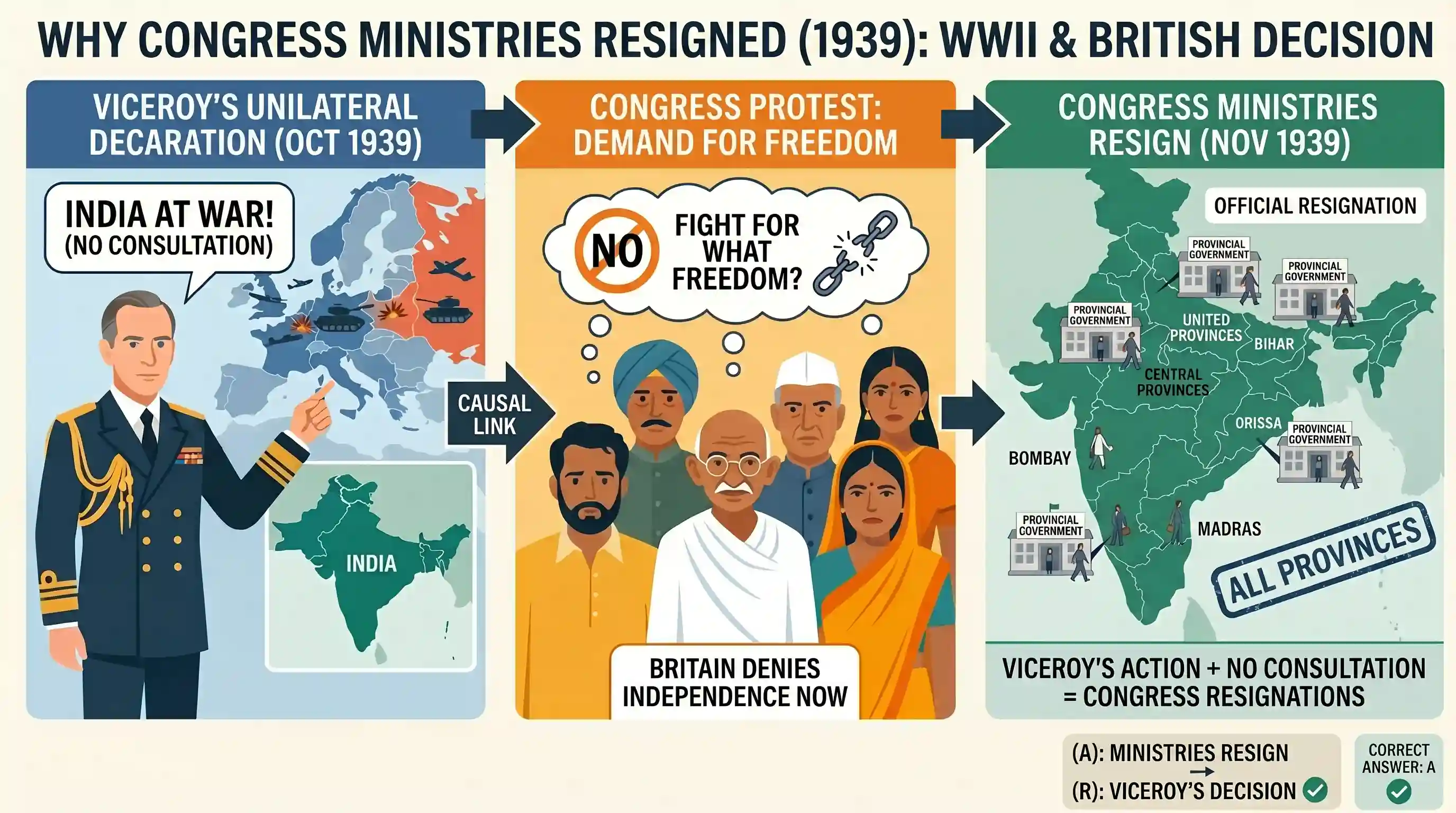
Assertion (A): The Congress Ministries in all the provinces resigned in the year 1939. Reason (R): The Congress did not accept the decision of the Viceroy to declare war against Germany in the context of the Second World War.

- ABoth A and R are individually true and R is the correct explanation of ACorrect
- BBoth A and R are individually true but R is not the correct explanation of A
- CA is true but R is false
- DA is false but R is true
Explanation
The correct answer is A because both the assertion and the reasoning are factually accurate and directly linked.
In 1939, when the Second World War broke out, Lord Linlithgow, the then Viceroy of India, declared India as a party to the war against Germany. This declaration was made unilaterally without consulting the Indian National Congress or the elected provincial ministries.
The Congress objected to this decision, arguing that a democratic nation like Britain could not expect India to fight for freedom abroad while denying it to its own people. As a mark of protest against this decision and the lack of consultation, the Congress Ministries in all provinces resigned in October and November 1939. Therefore, the reason provided perfectly explains the action taken in the assertion.
Related questions
More UPSC Prelims practice from the same subject and topic.
- Prelims 2008GS1history
Which was the Capital of Andhra State when it was made a separate State in the year 1953?
- Prelims 2008GS1history
Yom Kippur War was fought between which sides/countries?
- Prelims 2008GS1history
Who among the following rejected the title of Knighthood and refused to accept a position in the Council of the Secretary of State for India?
- Prelims 2008GS1history
During the Indian Freedom Struggle, who of the following raised an army called ‘Free Indian Legion’?
- Prelims 2008GS1history
Which one of the following suggested the reconstitution of the Viceroy’s Executive Council in which all the portfolios including that of War Members were to be held by the Indian leaders?
- Prelims 2008GS1history
Who among the following gave a systematic critique of the moderate politics of the Indian National Congress in a series of articles entitled *New Lamps for Old*?