A person has 4 coins each of different denomination. What is the number of different sums of money the person can form (using one or more coins at a time)?

- A16
- B15Correct
- C12
- D11
Explanation
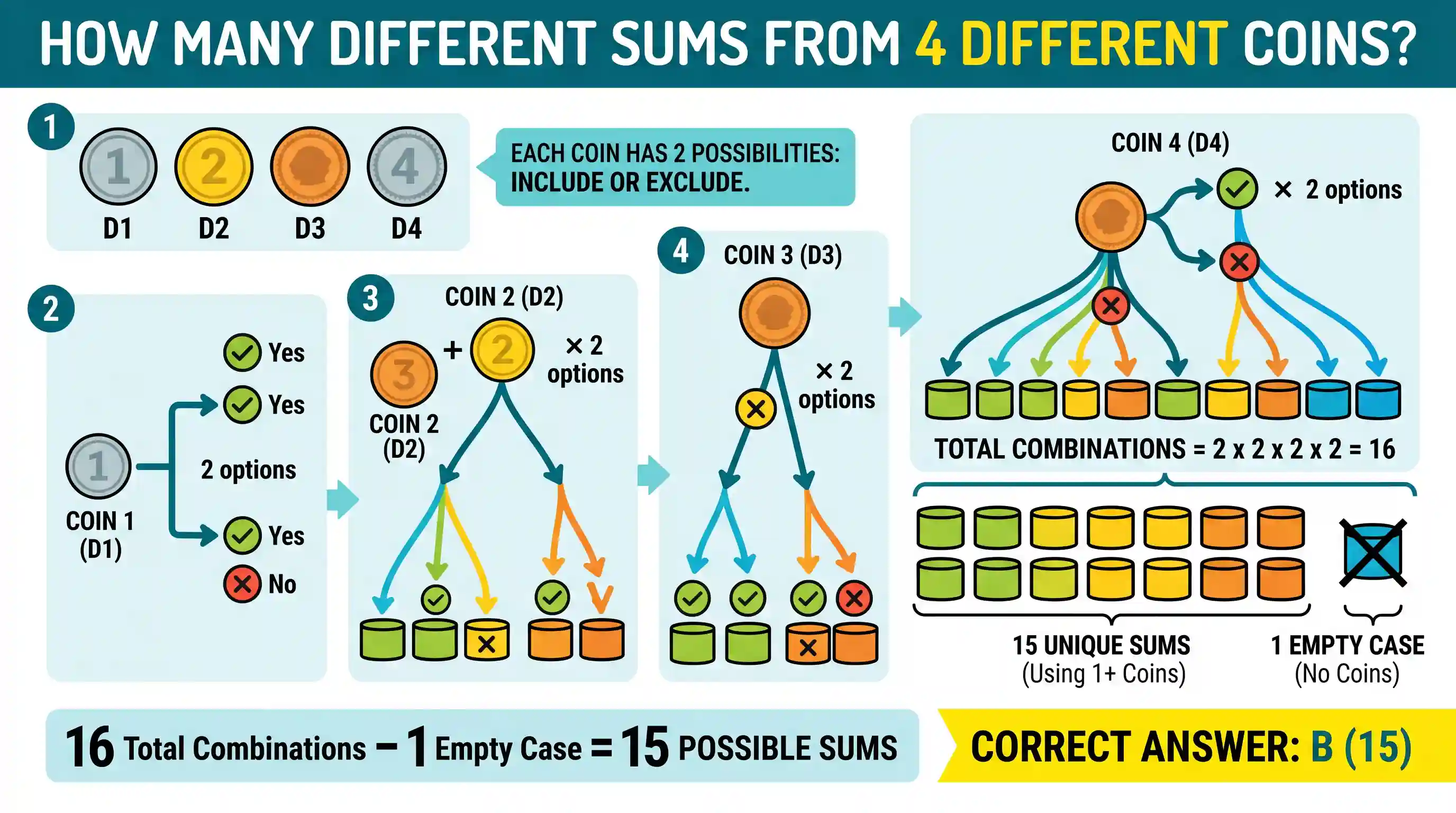
To solve this, consider each of the 4 coins. For every individual coin, there are two possibilities: either the person includes it in the sum or they do not include it.
Since there are 4 coins and each has 2 possibilities, the total number of combinations is 2 multiplied by itself 4 times, which equals 16.
However, these 16 combinations include the single case where none of the coins are selected, resulting in a sum of zero. The question asks for sums formed using one or more coins. Therefore, we must subtract that one empty case.
Calculation: 16 minus 1 equals 15.
Thus, the person can form 15 different sums of money. The correct answer is B.
Related questions
More UPSC Prelims practice from the same subject and topic.
- Prelims 2009GS1economy
Which one of the following pairs is not correctly matched?
- Prelims 2009GS1economy
Among other things, which one of the following was the purpose for which the Deepak Parekh Committee was constituted?
- Prelims 2009GS1economy
Consider the following statements: 1. Infant mortality rate takes into account the death of infants within a month after birth. 2. Infant mortality rate is the number of infant deaths in a particular …
- Prelims 2009GS1economy
In the context of global economy, which one of the following pairs is not correctly matched?
- Prelims 2009GS1economy
Who among the following is the founder of World Economic Forum?
- Prelims 2009GS1economy
Consider the following statements regarding Indian Planning: 1. The Second Five-Year Plan emphasised on the establishment of heavy industries. 2. The Third Five-Year Plan introduced the concept of imp…