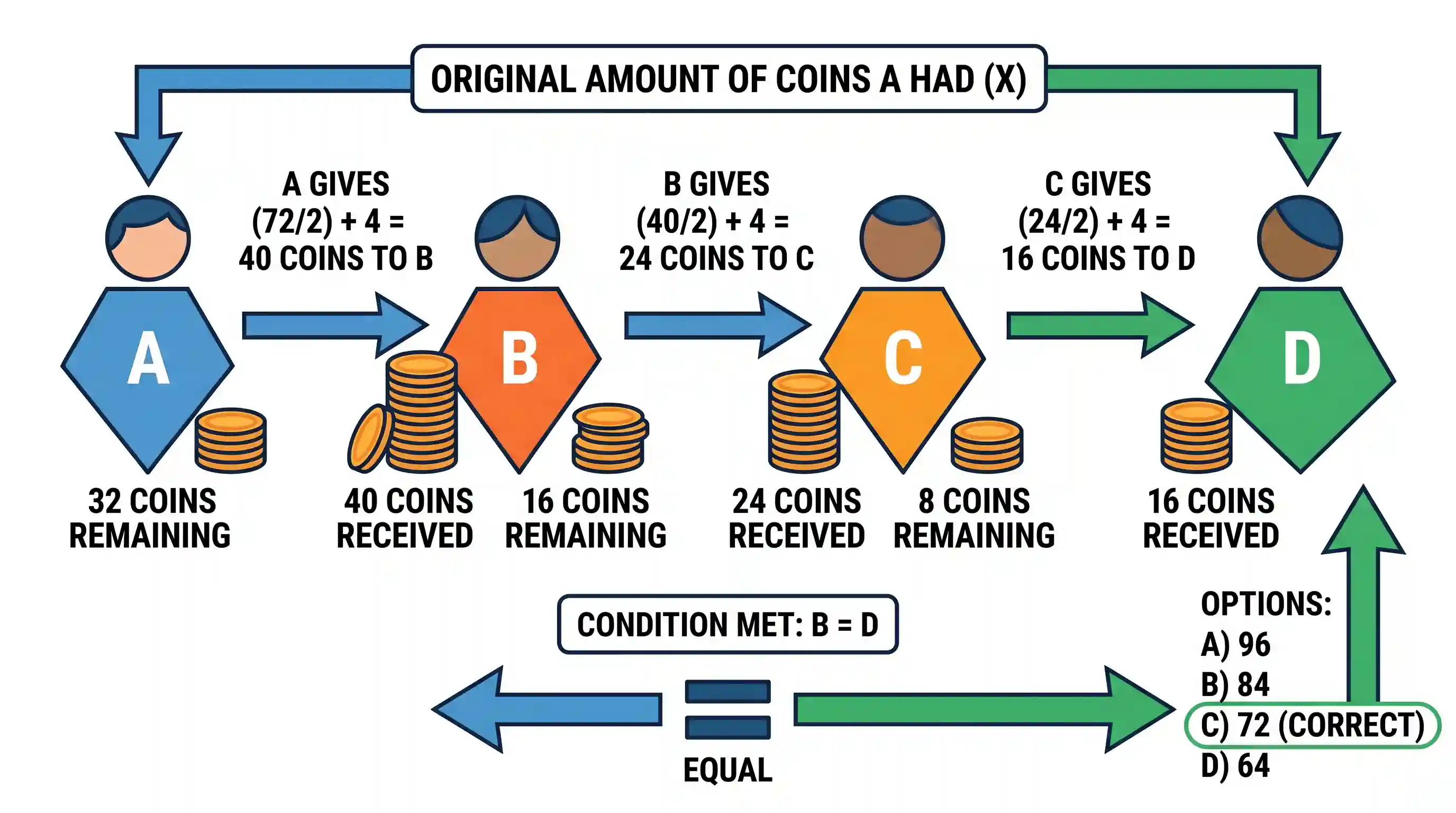
There are four persons A, B, C, D; and A has some coins. A gave half of the coins to B and 4 more besides. B gave half of the coins to C and 4 more besides. C gave half of the coins to D and 4 more besides. Both B and D end up with same number of coins. How many coins did A have originally?

- A96
- B84
- C72Correct
- D64
Explanation
To solve this problem, we work backward or use the options to verify. Let the original number of coins with A be x.
Step 1: A gives half and 4 more to B. A gives x/2 + 4 to B. A is left with x/2 - 4.
Step 2: B gives half of what he received and 4 more to C. B received x/2 + 4. B gives away (x/2 + 4)/2 + 4 to C. B is left with (x/2 + 4)/2 - 4. Simplifying B's remaining coins: x/4 + 2 - 4 = x/4 - 2.
Step 3: C gives half of what he received and 4 more to D. C received (x/4 + 2 + 4) = x/4 + 6. D receives (x/4 + 6)/2 + 4. Simplifying D's coins: x/8 + 3 + 4 = x/8 + 7.
Step 4: Set B's remaining coins equal to D's coins. x/4 - 2 = x/8 + 7. Multiply the entire equation by 8 to clear denominators: 2x - 16 = x + 56. x = 72.
If we check with 72: A has 72. A gives 36 + 4 = 40 to B. B has 40. B gives 20 + 4 = 24 to C. B is left with 40 - 24 = 16. C has 24. C gives 12 + 4 = 16 to D. D ends up with 16. Since B and D both have 16, the answer is 72.
Related questions
More UPSC Prelims practice from the same subject and topic.
- Prelims 2009GS1science-and-technology
In a dry cell (battery), which of the following are used as electrolytes?
- Prelims 2009GS1science-and-technology
Consider the following statements: 1. Sweet orange plant is propagated by grafting technique. 2. Jasmine plant is propagated by layering technique. Which of the statements given above is/are correct?
- Prelims 2009GS1science-and-technology
Which one of the following types of waves are used in a night vision apparatus?
- Prelims 2009GS1science-and-technology
How many numbers lie between 300 and 500 in which 4 comes only one time?
- Prelims 2009GS1science-and-technology
How many letters of the English alphabet (capitals) appear same when looked at in a mirror?
- Prelims 2009GS1science-and-technology
How many three-digit numbers can be generated from 1, 2, 3, 4, 5, 6, 7, 8, 9 such that the digits are in ascending order?