In an examination, there are three subjects A, B and C. A student has to pass in each subject. 20% students failed in A, 22% students failed in B and 16% failed in C. The total number of students passing the whole examination lies between

- A42% and 84%
- B42% and 78%Correct
- C58% and 78%
- D58% and 84%
Explanation
To find the range of students who passed the whole examination, we need to determine the minimum and maximum possible number of students who failed in at least one subject.
-
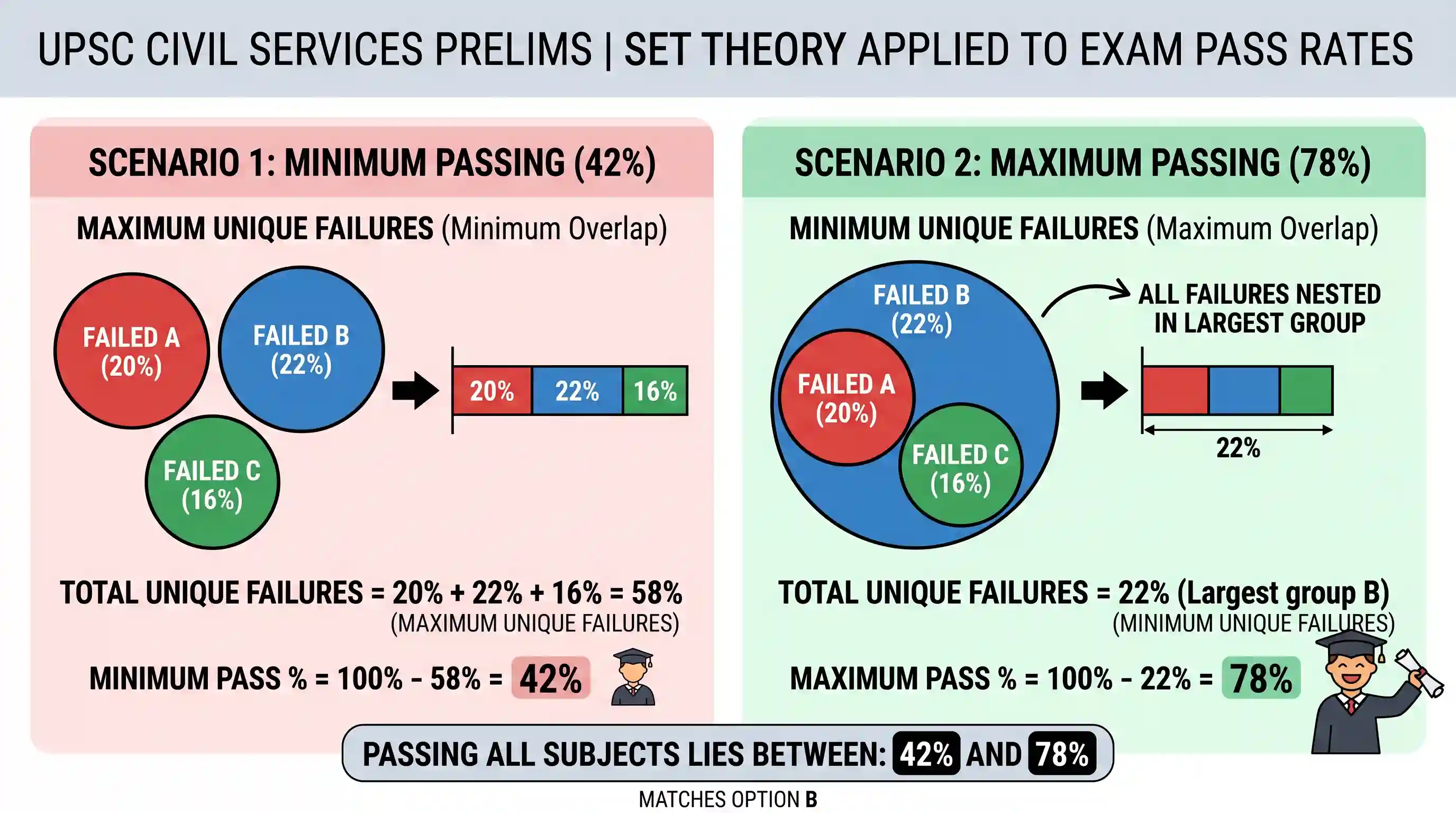
To find the Minimum Pass Percentage: The maximum number of failures occurs when the failures in each subject are entirely different students (no overlap). Total maximum failures = 20 percent (A) + 22 percent (B) + 16 percent (C) = 58 percent. Minimum pass percentage = 100 percent - 58 percent = 42 percent.
-
To find the Maximum Pass Percentage: The minimum number of failures occurs when the failure groups overlap as much as possible. This happens when the smaller failure groups are subsets of the largest failure group. The largest failure group is in subject B (22 percent). If all students who failed in A and C also failed in B, the total failures would just be 22 percent. Maximum pass percentage = 100 percent - 22 percent = 78 percent.
Therefore, the total number of students passing lies between 42 percent and 78 percent. This matches Option B.
Related questions
More UPSC Prelims practice from the same subject and topic.
- Prelims 2009GS1polity-and-governance
There is a family of 6 persons A, B, C, D, E and F. There are two married couples in the family. The family members are lawyer, teacher, salesman, engineer, accountant and doctor. D, the salesman is m…
- Prelims 2009GS1polity-and-governance
NAMA-11 (Nama-11) group of countries frequently appears in the news in the context of the affairs of which one of the following?
- Prelims 2009GS1polity-and-governance
In the latter half of the year 2008, which one of the following countries pulled out of Commonwealth of Independent States?
- Prelims 2009GS1polity-and-governance
Match List I with List II and select the correct answer using the code given below the lists: List I (Persons) A. Luisa Dias Diogo B. Mwai Kibaki C. Rupiah Banda List II (Countries) 1. Kenya 2. Mozamb…
- Prelims 2009GS1polity-and-governance
Among the following Presidents of India, who was also the Secretary General of Non-Aligned Movement for some period?
- Prelims 2009GS1polity-and-governance
To integrate cultural leaders into its meetings, which one of the following gives “Crystal Award”?