There are 240 balls and n number of boxes $B_1, B_2, B_3, ..., B_n$. The balls are to be placed in the boxes such that $B_1$ should contain 4 balls more than $B_2$, $B_2$ should contain 4 balls more than $B_3$, and so on. Which one of the following cannot be the possible value of n?

- A4
- B5
- C6
- D7Correct
Explanation
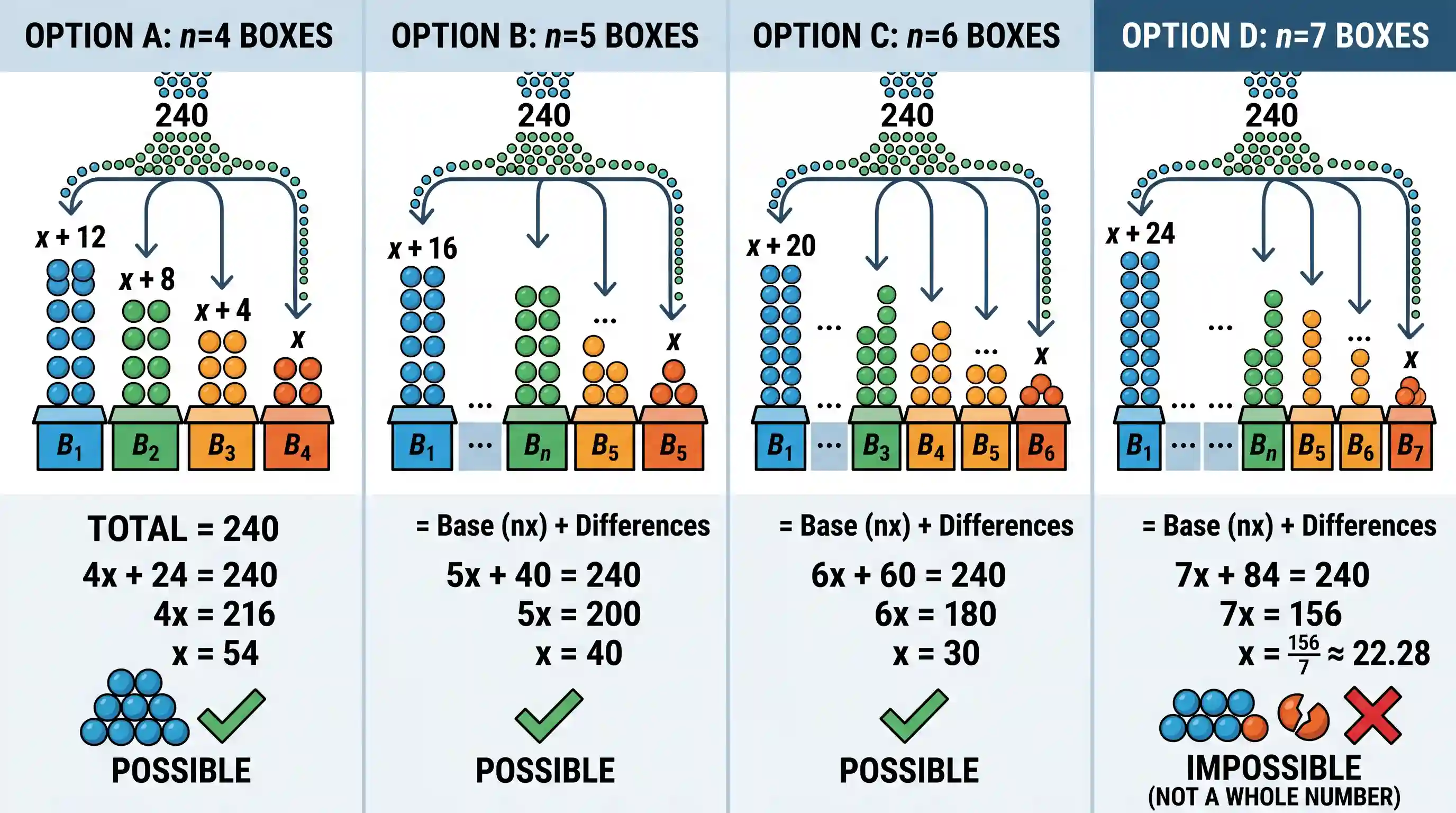
To solve this, we can represent the number of balls in the boxes as an arithmetic progression. Let the number of balls in the last box be x. Since each box has 4 more balls than the next, the number of balls in the boxes are x, x plus 4, x plus 8, and so on.
The sum of an arithmetic progression is calculated by the formula: Sum equals n divided by 2, multiplied by the sum of the first and last terms.
Alternatively, for n boxes with a common difference of 4, the total number of balls is: n times x, plus 4 times the sum of the first n minus 1 integers.
Let us test the options:
For n equals 4: 240 equals 4x plus 24. This gives 4x equals 216, so x equals 54. This is a possible whole number.
For n equals 5: 240 equals 5x plus 40. This gives 5x equals 200, so x equals 40. This is a possible whole number.
For n equals 6: 240 equals 6x plus 60. This gives 6x equals 180, so x equals 30. This is a possible whole number.
For n equals 7: 240 equals 7x plus 84. This gives 7x equals 156. Since 156 is not divisible by 7, x would not be a whole number.
Because the number of balls in a box must be a non negative integer, n cannot be 7. Therefore, option D is the correct answer.
Related questions
More UPSC Prelims practice from the same subject and topic.
- Prelims 2009GS1science-and-technology
In a dry cell (battery), which of the following are used as electrolytes?
- Prelims 2009GS1science-and-technology
Consider the following statements: 1. Sweet orange plant is propagated by grafting technique. 2. Jasmine plant is propagated by layering technique. Which of the statements given above is/are correct?
- Prelims 2009GS1science-and-technology
Which one of the following types of waves are used in a night vision apparatus?
- Prelims 2009GS1science-and-technology
How many numbers lie between 300 and 500 in which 4 comes only one time?
- Prelims 2009GS1science-and-technology
How many letters of the English alphabet (capitals) appear same when looked at in a mirror?
- Prelims 2009GS1science-and-technology
How many three-digit numbers can be generated from 1, 2, 3, 4, 5, 6, 7, 8, 9 such that the digits are in ascending order?