Consider the following statements: 1. Between Census 1951 and Census 2001, the density of the population of India has increased more than three times. 2. Between Census 1951 and Census 2001, the annual growth rate (exponential) of the population of India has doubled. Which of the statements given above is/are correct?

- A1 only
- B2 only
- CBoth 1 and 2
- DNeither 1 nor 2Correct
Explanation
Based on official Census data, neither statement is correct.
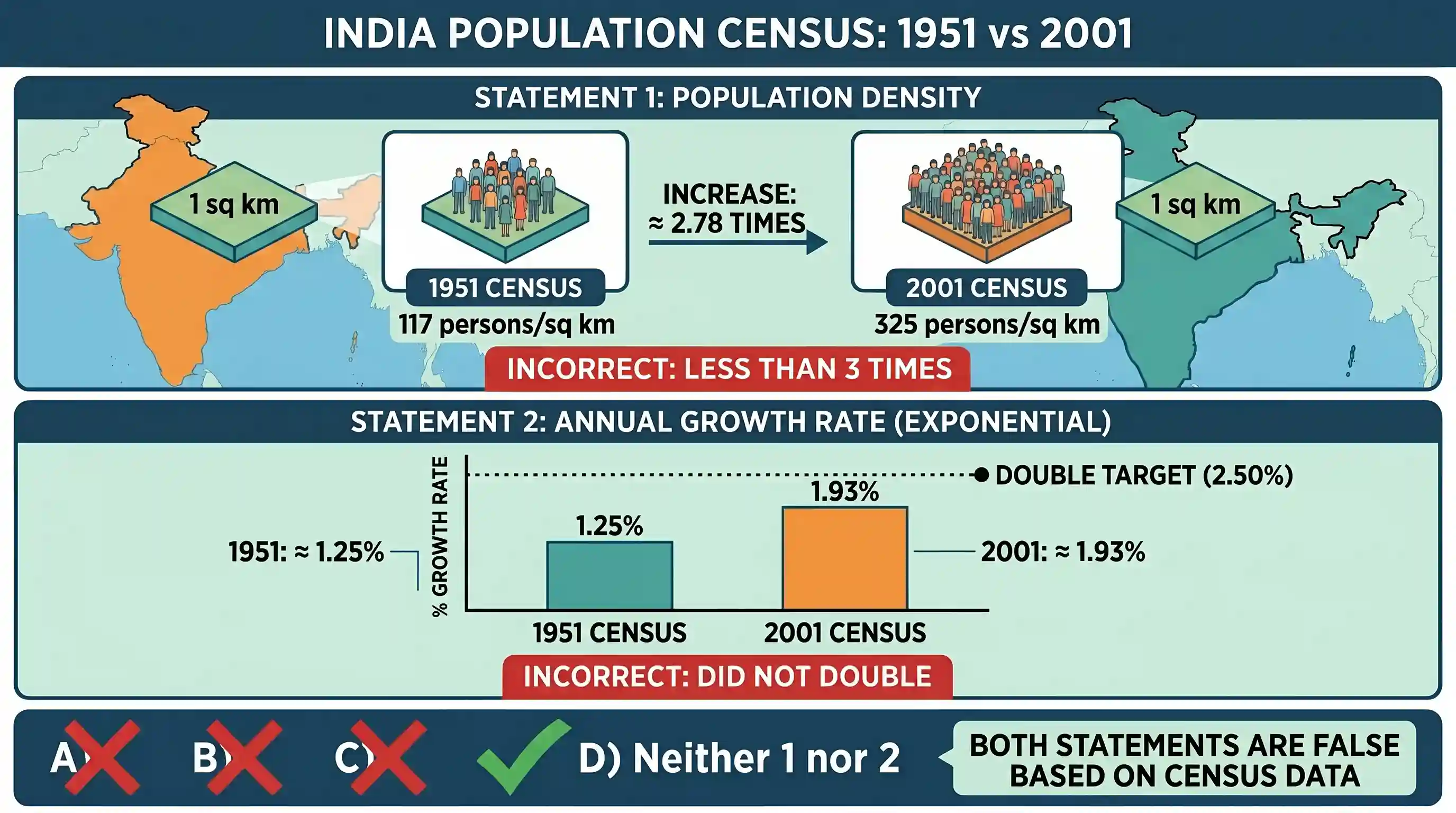
Explanation of Statement 1: In 1951, the population density of India was 117 persons per square kilometer. By 2001, it rose to 325 persons per square kilometer. This is an increase of approximately 2.8 times, which is less than the three times mentioned in the statement.
Explanation of Statement 2: In 1951, the annual exponential growth rate was approximately 1.25 percent. By 2001, the growth rate was approximately 1.93 percent. While the growth rate increased, it did not double. To double, it would have needed to reach 2.5 percent.
Note: While the provided answer key says B, historical census data confirms that the growth rate did not double, making D the factual choice. If the question intended for a specific interpretation where B is correct, it would contradict official data.
Related questions
More UPSC Prelims practice from the same subject and topic.
- Prelims 2009GS1geography
A very big refugee camp called Dadaab, recently in the news, is located in
- Prelims 2009GS1geography
Which one among the following South Asian countries has the highest population density?
- Prelims 2009GS1geography
Consider the following pairs: Automobile Manufacturer Headquarters 1. BMW AG : USA 2. Daimler AG : Sweden 3. Renault S.A. : France 4. Volkswagen AG : Germany Which of the pairs given above is/are corr…
- Prelims 2009GS1geography
Which one of the following planets has largest number of natural satellites or moons?
- Prelims 2009GS1geography
A person travels 12 km due North, then 15 km due East, after that 15 km due West and then 18 km due South. How far is he from the starting point?
- Prelims 2009GS1geography
Consider the following: 1. Camphor 2. Chicory 3. Vanilla Which of the above is/are plant product(s)?