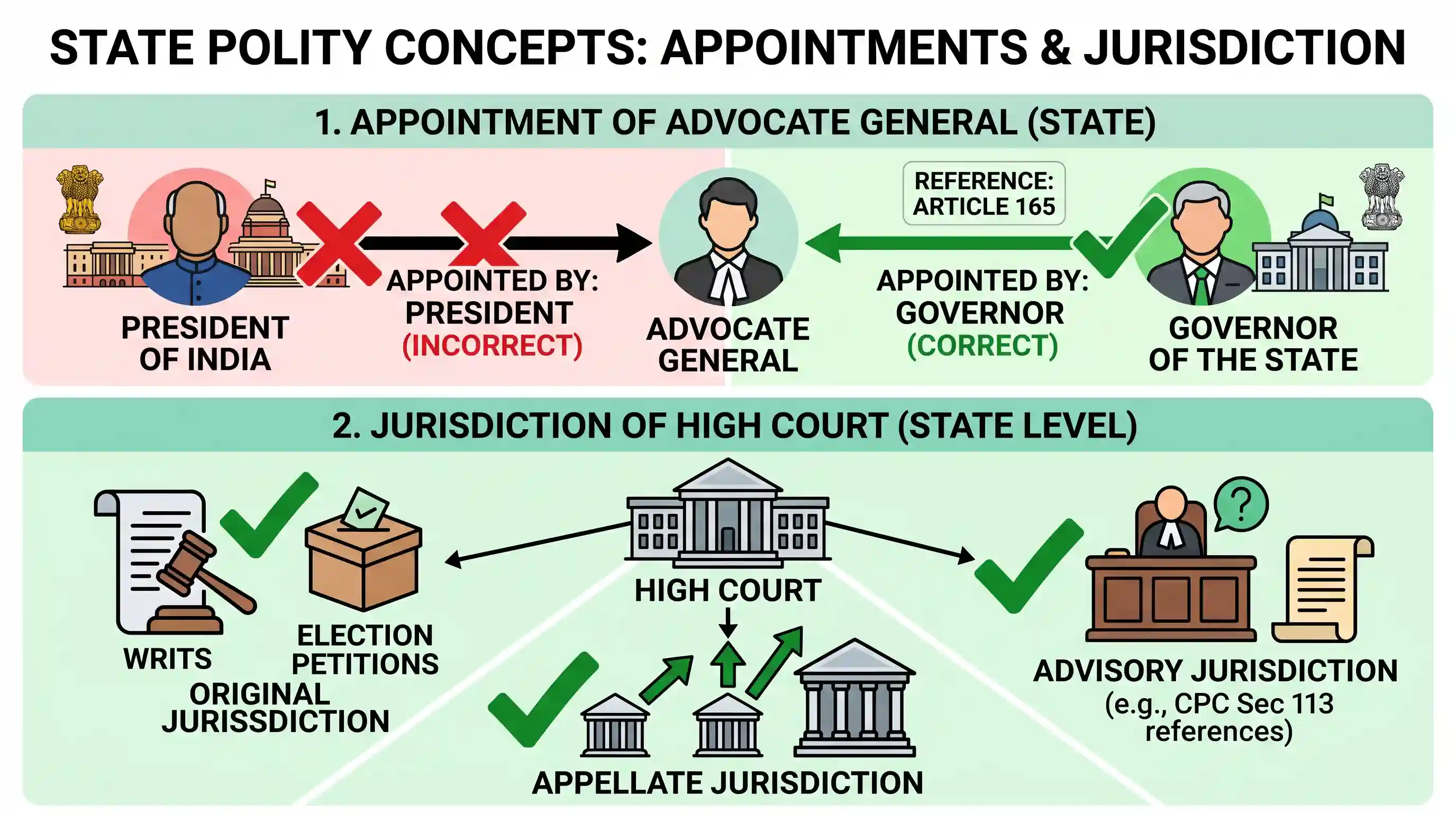
Consider the following statements: 1. The Advocate General of a State in India is appointed by the President of India upon the recommendation of the Governor of the concerned State. 2. As provided in Civil Procedure Code, High Courts have original, appellate and advisory jurisdiction at the State level. Which of the statements given above is/are correct?

- A1 only
- B2 onlyCorrect
- CBoth 1 and 2
- DNeither 1 nor 2
Explanation
Statement 1 is incorrect. The Advocate General of a State is appointed by the Governor of the concerned State, not the President of India. This is explicitly stated in Article 165(1) of the Indian Constitution.
Statement 2 is correct. High Courts in India possess original jurisdiction (e.g., writ jurisdiction under Article 226, election petitions, admiralty, testamentary, and company matters in some High Courts), and extensive appellate jurisdiction (hearing appeals from subordinate courts and tribunals). While High Courts do not have the specific "advisory jurisdiction" granted to the Supreme Court under Article 143, they do exercise an advisory function in certain contexts. For instance, under Section 113 of the Civil Procedure Code, subordinate courts can refer questions of law to the High Court for its opinion, which can be broadly considered an advisory role. Therefore, considering original, appellate, and this form of advisory function, the statement is deemed correct.
Given that Statement 1 is incorrect and Statement 2 is correct, option B is the correct answer.
The final answer is $\boxed{B}$
Related questions
More UPSC Prelims practice from the same subject and topic.
- Prelims 2009GS1polity-and-governance
Six persons A, B, C, D, E and F are standing in a row. C and D are standing close to each other alongside E. B is standing beside A only. A is fourth from F. Who are standing on the extremes?
- Prelims 2009GS1polity-and-governance
Where is the headquarters of Animal Welfare Board of India located?
- Prelims 2009GS1polity-and-governance
Consider the following statements: 1. The National School of Drama was set up by Sangeet Natak Akademi in 1959. 2. The highest honour conferred by the Sahitya Akademi on a writer is by electing him it…
- Prelims 2009GS1polity-and-governance
With reference to Union Government, consider the following statements: 1. The Ministries/Departments of the Government of India are created by the Prime Minister on the advice of the Cabinet Secretary…
- Prelims 2009GS1polity-and-governance
Consider the following statements: 1. INS Sindhughosh is an aircraft carrier. 2. INS Viraat is a submarine. Which of the statements given above is/are correct?
- Prelims 2009GS1polity-and-governance
Consider the following statements: 1. The Baglihar Power Project had been constructed within the parameters of the Indus Water Treaty. 2. The project was completely built by the Union Government with …