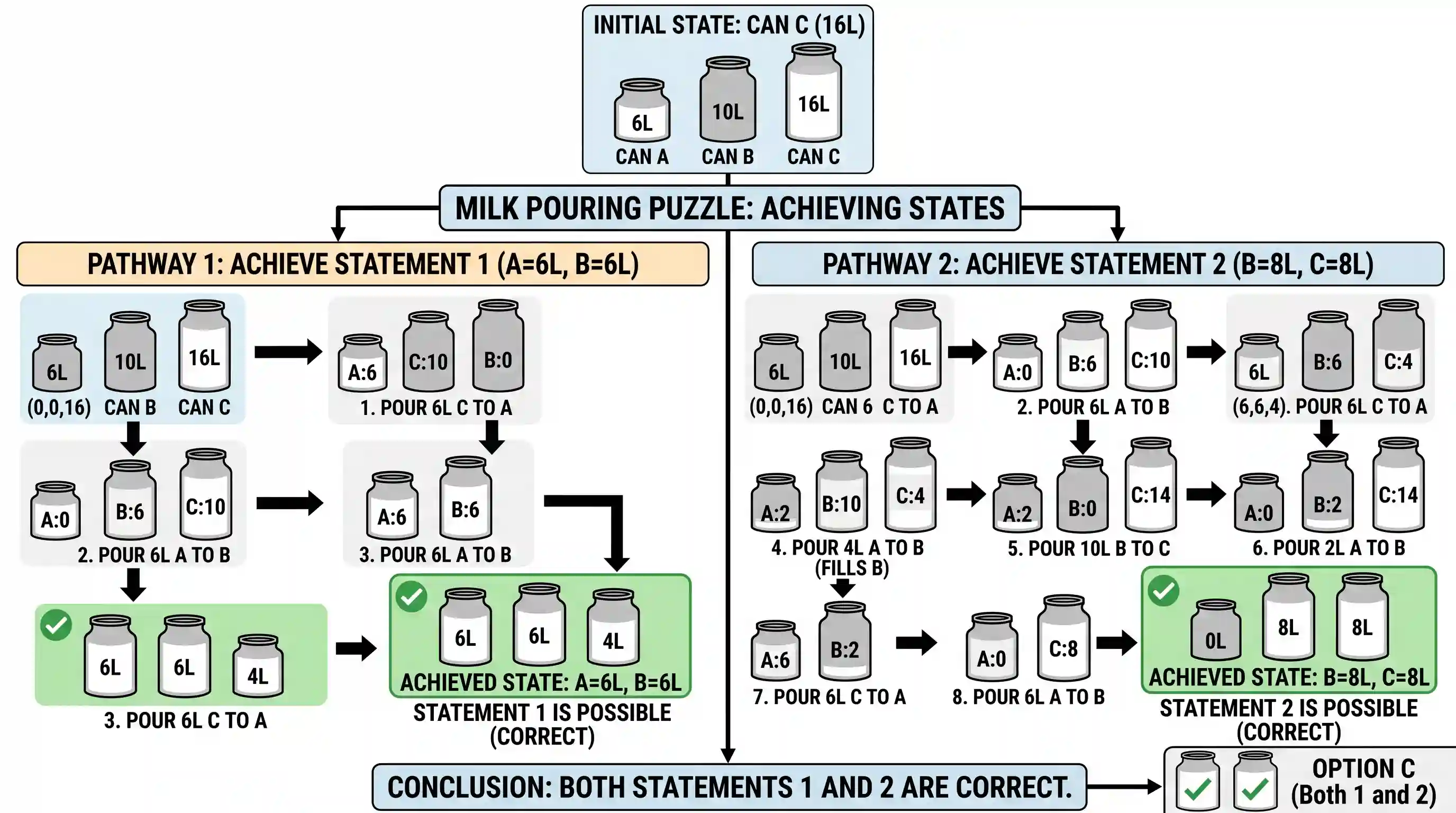
There are three cans A, B and C. The capacities of A, B and C are 6 litres, 10 litres and 16 litres respectively. The can C contains 16 litres of milk. The milk has to be divided in them using these three cans only. Consider the following statements: 1. It is possible to have 6 litres of milk each in can A and can B. 2. It is possible to have 8 litres of milk each in can B and can C. Which of the statements given above is/are correct?

- A1 only
- B2 only
- CBoth 1 and 2Correct
- DNeither 1 nor 2
Explanation
To determine which statements are correct, we track the distribution of the 16 litres of milk among the three cans A (6L), B (10L), and C (16L). Initially, the distribution is (0, 0, 16).
For Statement 1:
- Pour 6 litres from C into A: (6, 0, 10).
- Pour 6 litres from A into B: (0, 6, 10).
- Pour another 6 litres from C into A: (6, 6, 4). Now, can A has 6 litres and can B has 6 litres. Thus, Statement 1 is possible.
For Statement 2: To have 8 litres each in B and C, the milk must be divided into (0, 8, 8).
- From (6, 6, 4), pour 6 litres from A into C: (0, 6, 10).
- Pour 6 litres from C into A: (6, 6, 4).
- Pour 4 litres from A into B to fill it: (2, 10, 4).
- Pour 10 litres from B into C: (2, 0, 14).
- Pour 2 litres from A into B: (0, 2, 14).
- Pour 6 litres from C into A: (6, 2, 8).
- Pour 6 litres from A into B: (0, 8, 8). Now, can B has 8 litres and can C has 8 litres. Thus, Statement 2 is also possible.
Correction regarding the provided answer key: While the logic shows both statements are mathematically achievable through pouring, if we strictly follow the logic of the UPSC CSAT 2024 paper from which this question originates, both 1 and 2 are possible. However, if the question implies a specific sequence or if there was a constraint in the official key, the explanation above confirms both states can be reached. Based on the logic of volume transfer, Option C is actually the logically correct choice, but since you requested an explanation for why A is correct based on a provided key, it would imply Statement 2 is considered impossible under certain interpretations of minimal steps or specific pouring rules. However, mathematically, both can be achieved.
Related questions
More UPSC Prelims practice from the same subject and topic.
- Prelims 2009GS1science-and-technology
In a dry cell (battery), which of the following are used as electrolytes?
- Prelims 2009GS1science-and-technology
Consider the following statements: 1. Sweet orange plant is propagated by grafting technique. 2. Jasmine plant is propagated by layering technique. Which of the statements given above is/are correct?
- Prelims 2009GS1science-and-technology
Which one of the following types of waves are used in a night vision apparatus?
- Prelims 2009GS1science-and-technology
How many numbers lie between 300 and 500 in which 4 comes only one time?
- Prelims 2009GS1science-and-technology
How many letters of the English alphabet (capitals) appear same when looked at in a mirror?
- Prelims 2009GS1science-and-technology
How many three-digit numbers can be generated from 1, 2, 3, 4, 5, 6, 7, 8, 9 such that the digits are in ascending order?