In order to comply with TRIPS Agreement, India enacted the Geographical Indications of Goods (Registration | Protection) Act, 1999. The difference/differences between a “Trade Mark” and a Geographical Indication is/are

- A1 only
- B1 and 2 onlyCorrect
- C2 and 3 only
- D1, 2 and 3
Explanation
The correct answer is B because of the following reasons:
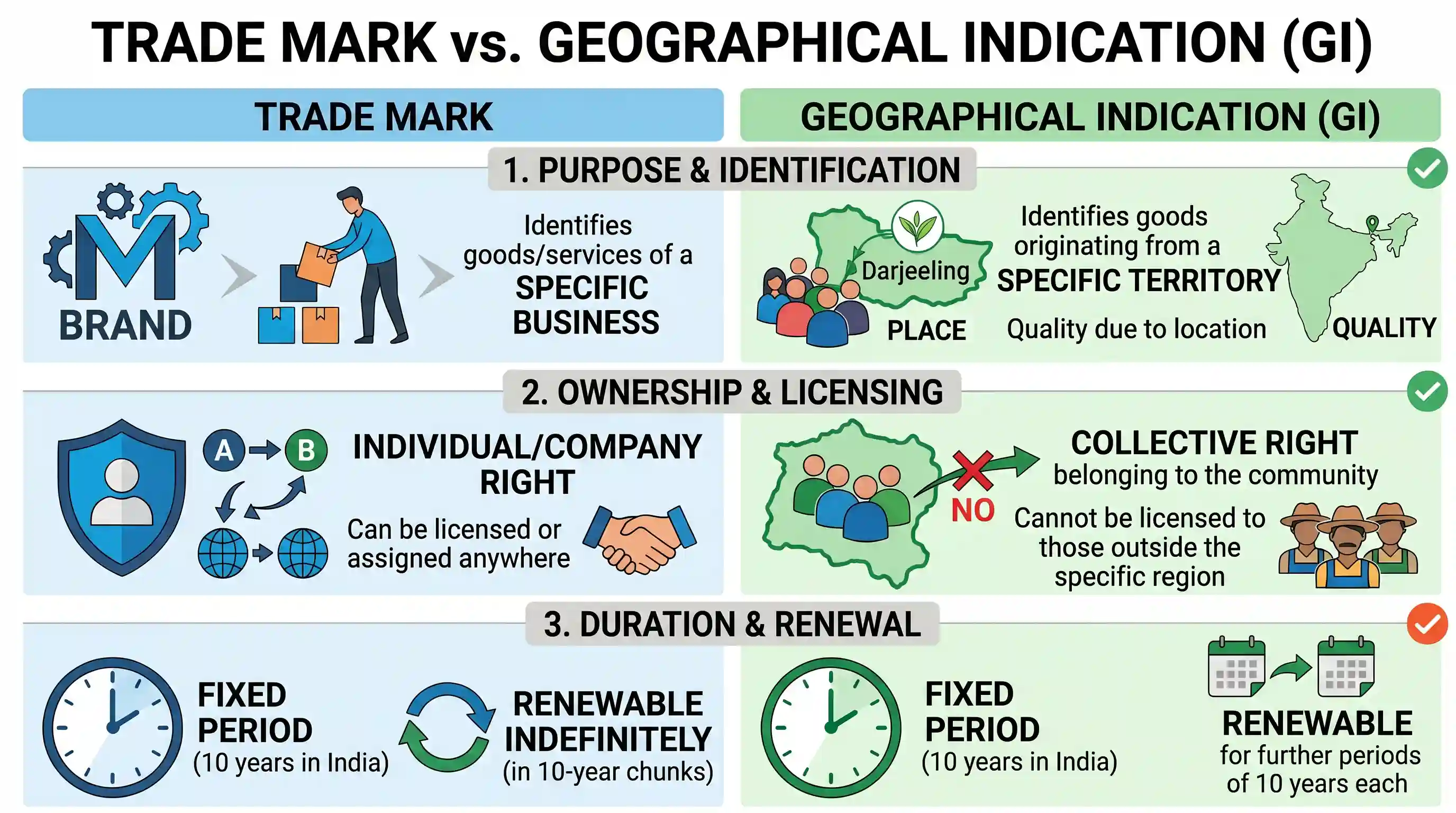
Statement 1 is correct. A Trade Mark is a visual symbol used by a business to distinguish its goods or services from others. It is an individual right owned by a specific person or company. In contrast, a Geographical Indication is used to identify goods as originating from a specific territory or region where a given quality or reputation is attributable to its geographical origin.
Statement 2 is correct. A Trade Mark is a private property right that can be licensed or assigned to anyone, anywhere, regardless of their location. However, a Geographical Indication is a collective right belonging to a community of producers in a specific region. It cannot be licensed to someone outside that region because the quality is tied to the specific location.
Statement 3 is incorrect. Both Trade Marks and Geographical Indications are granted for a fixed period and are renewable. Under Indian law, a Trade Mark is registered for 10 years and can be renewed indefinitely. Similarly, a Geographical Indication is also registered for a period of 10 years and can be renewed for further periods of 10 years each. There is no concept of a GI being granted for infinity without renewal.
Since statements 1 and 2 are correct and statement 3 is false, option B is the right choice.
Related questions
More UPSC Prelims practice from the same subject and topic.
- Prelims 2010GS1polity-and-governance
Which one of the following is not related to United Nations?
- Prelims 2010GS1polity-and-governance
As regards the use of international food safety standards as reference point for the dispute settlements, which one of the following does WTO collaborate with?
- Prelims 2010GS1polity-and-governance
Half of the villagers of a certain village have their own houses. One-fifth of the villagers cultivate paddy. One-third of the villagers are literate. Four-fifth of the villagers are below twenty five…
- Prelims 2010GS1polity-and-governance
With reference to the National Rehabilitation and Resettlement Policy, 2007, consider the following statements: 1. This policy is applicable only to the persons affected by the acquisition of land for…
- Prelims 2010GS1polity-and-governance
In the context of bilateral trade negotiations between India and European Union, what is the difference between European Commission and European Council? 1. European Commission represents the EU in tr…
- Prelims 2010GS1polity-and-governance
Consider the following statements: The Supreme Court of India tenders advice to the President of India on matters of law or fact 1. on its own initiative (on any matter of larger public interest). 2. …