Both Foreign Direct Investment (FDI) and Foreign Institutional Investor (FII) are related to investment in a country. Which one of the following statements best represents an important difference between the two?

- AFII helps bring better management skills and technology, while FDI only brings in capital
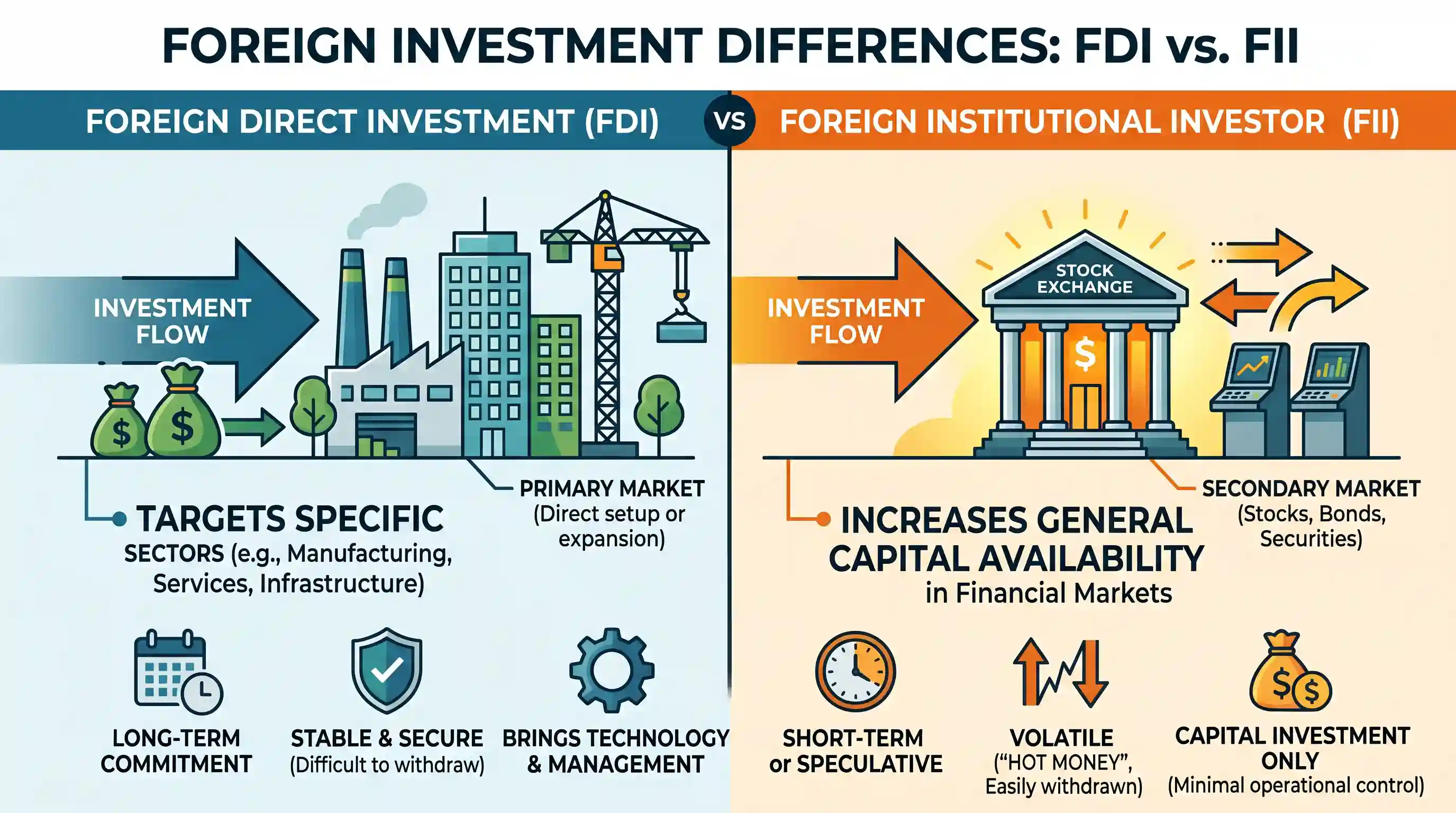
- BFII helps in increasing capital availability in general, while FDI only targets specific sectorsCorrect
- CFDI flows only into the secondary market, while FII targets primary market
- DFII is considered to be more stable than FDI
Explanation
The correct answer is B because it accurately reflects the nature and purpose of these two types of investments.
FDI involves a long term commitment where a foreign entity invests directly in the production or business of a country. This usually targets specific sectors like manufacturing or services to establish a lasting interest and often brings in technology and management expertise.
FII refers to investments made by foreign entities in the financial markets of a country, such as stocks and bonds. These investments increase the overall availability of liquid capital in the economy and are not restricted to specific industrial projects.
The other options are incorrect because FDI, not FII, is associated with management and technology. FDI is generally considered more stable than FII, which is often called hot money due to its volatility. Additionally, FDI typically flows into the primary market through direct setup or expansion, while FII primarily operates in the secondary equity market.
Related questions
More UPSC Prelims practice from the same subject and topic.
- Prelims 2011GS1economy
In terms of economy, the visit by foreign nationals to witness the XIX Common Wealth Games in India amounted to
- Prelims 2011GS1economy
Consider the following actions which the Government can take: 1. Devaluing the domestic currency. 2. Reduction in the export subsidy. 3. Adopting suitable policies which attract greater FDI and more f…
- Prelims 2011GS1economy
Regarding the International Monetary Fund, which one of the following statements is correct?
- Prelims 2011GS1economy
In the Union Budget 2011-12, a full exemption from the basic customs duty was extended to the bio-based asphalt (bioasphalt). What is the importance of this material? Unlike traditional asphalt, bio-a…
- Prelims 2011GS1economy
India has experienced persistent and high food inflation in the recent past. What could be the reasons? 1. Due to a gradual switchover to the cultivation of commercial crops, the area under the cultiv…
- Prelims 2011GS1economy
Which one of the following statements appropriately describes the "fiscal stimulus"?