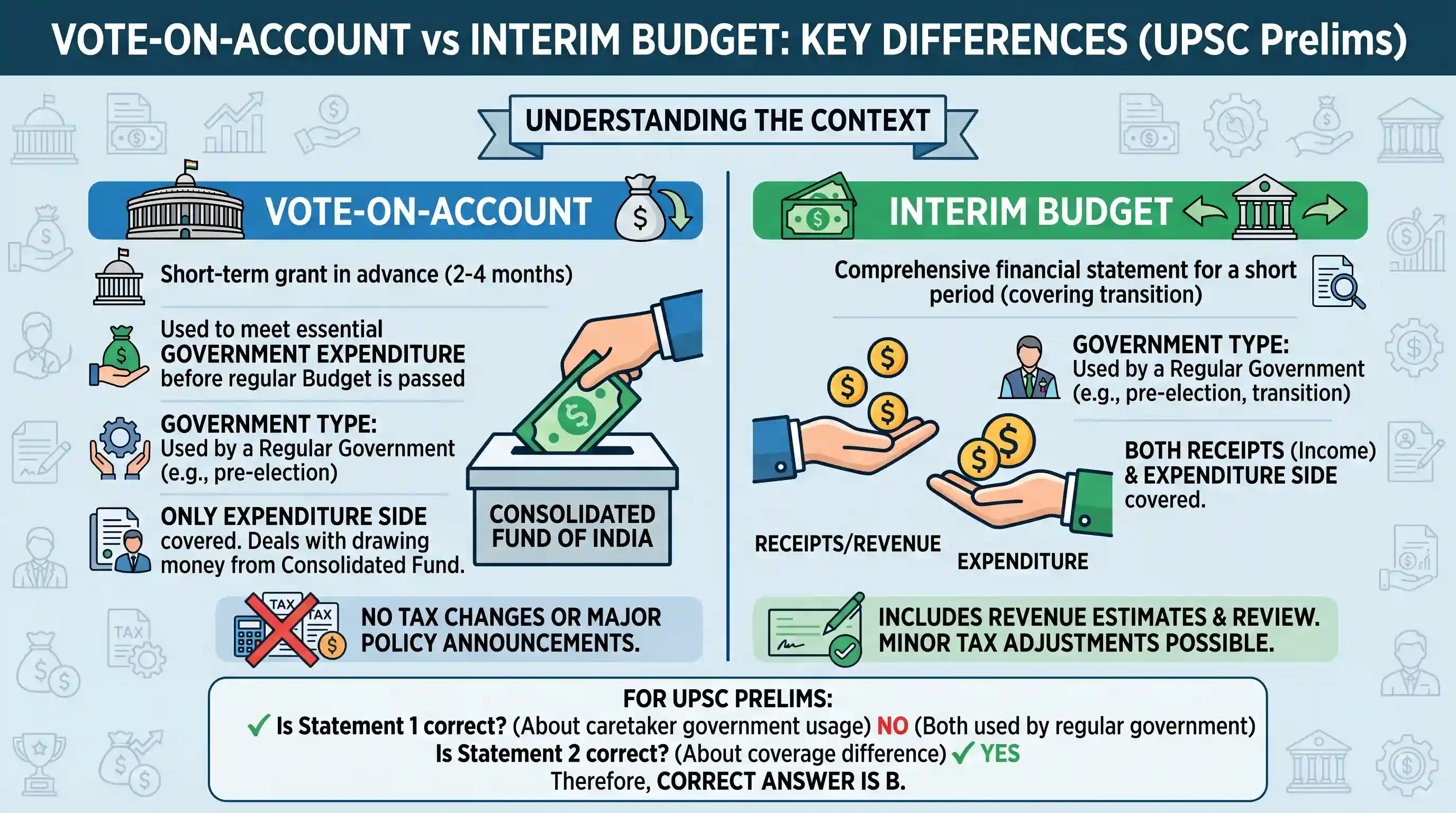
What is the difference between "vote-on-account" and "interim budget"? 1. The provision of a "vote-on-account" is used by a regular Government, while an "interim budget" is a provision used by a caretaker Government. 2. A "vote-on-account" only deals with the expenditure in Government's budget, while an "interim budget" includes both expenditure and receipts. Which of the statements given above is/are correct?

- A1 only
- B2 onlyCorrect
- CBoth 1 and 2
- DNeither 1 nor 2
Explanation
Statement 1 is incorrect. Both a vote-on-account and an interim budget are typically presented by a regular government that is nearing the end of its term and facing general elections, or when there isn't enough time to pass a full budget before the new financial year begins. The term "caretaker government" implies a government that has lost confidence but continues until a new one is formed, which isn't the primary context for these provisions.
Statement 2 is correct. A vote-on-account (Article 116 of the Constitution) is a grant made in advance to the government to draw money from the Consolidated Fund of India to meet essential expenditure for a short period (usually 2-4 months), pending the regular passage of the budget. It deals only with the expenditure side of the government's finances and does not authorize new taxes or changes in existing ones. An interim budget, on the other hand, is a more comprehensive financial statement. It includes both estimated receipts (revenue collection) and expenditure for the upcoming short period, along with a review of the current financial year's performance. It can also propose minor tax adjustments.
Therefore, only statement 2 is correct.