The 2004 Tsunami made people realize that mangroves can serve as a reliable safety hedge against coastal calamities. How do mangroves function as a safety hedge?

- AThe mangrove swamps separate the human settlements from the sea by a wide zone in which people neither live nor venture out
- BThe mangroves provide both food and medicines which people are in need of after any natural disaster
- CThe mangrove trees are tall with dense canopies and serve as an excellent shelter during a cyclone or tsunami
- DThe mangrove trees do not get uprooted by storms and tides because of their extensive rootsCorrect
Explanation
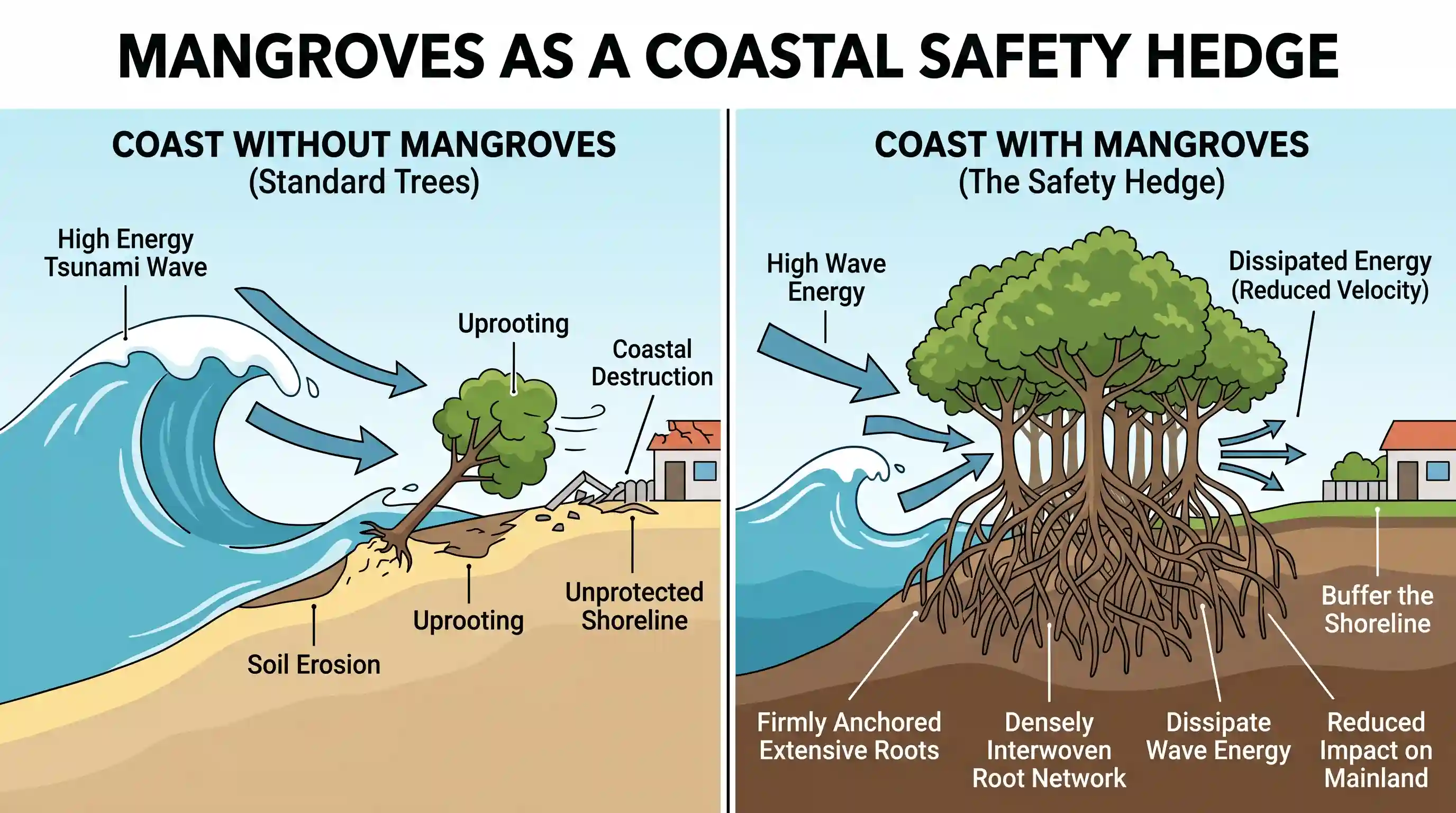
The correct answer is D because the physical structure of mangroves is specifically adapted to survive high energy coastal events. Mangroves possess complex and extensive aerial root systems, such as prop roots and pneumatophores, which anchor them firmly into the soft coastal soil.
These dense root networks act as a physical barrier that dissipates the energy of tidal waves, storm surges, and tsunamis. By absorbing the force of the water and reducing its velocity, mangroves protect the shoreline from erosion and minimize the impact on inland human settlements. Unlike ordinary trees, their unique root architecture prevents them from being easily uprooted by strong currents or high winds.
Related questions
More UPSC Prelims practice from the same subject and topic.
- Prelims 2011GS1geography
The formation of ozone hole in the Antarctic region has been a cause of concern. What could be the reason for the formation of this hole?
- Prelims 2011GS1geography
Regarding “carbon credits”, which one of the following statements is not correct?
- Prelims 2011GS1geography
When the bark of a tree is removed in a circular fashion all around near its base, it gradually dries up and dies because
- Prelims 2011GS1geography
Three of the following criteria have contributed to the recognition of Western Ghats-Sri Lanka and Indo-Burma regions as hotspots of biodiversity: 1. Species richness 2. Vegetation density 3. Endemism…
- Prelims 2011GS1geography
Human activities in the recent past have caused the increased concentration of carbon dioxide in the atmosphere, but a lot of it does not remain in the lower atmosphere because of 1. its escape into t…
- Prelims 2011GS1geography
In the context of ecosystem productivity, marine upwelling zones are important as they increase the marine productivity by bringing the 1. decomposer microorganisms to the surface. 2. nutrients to the…