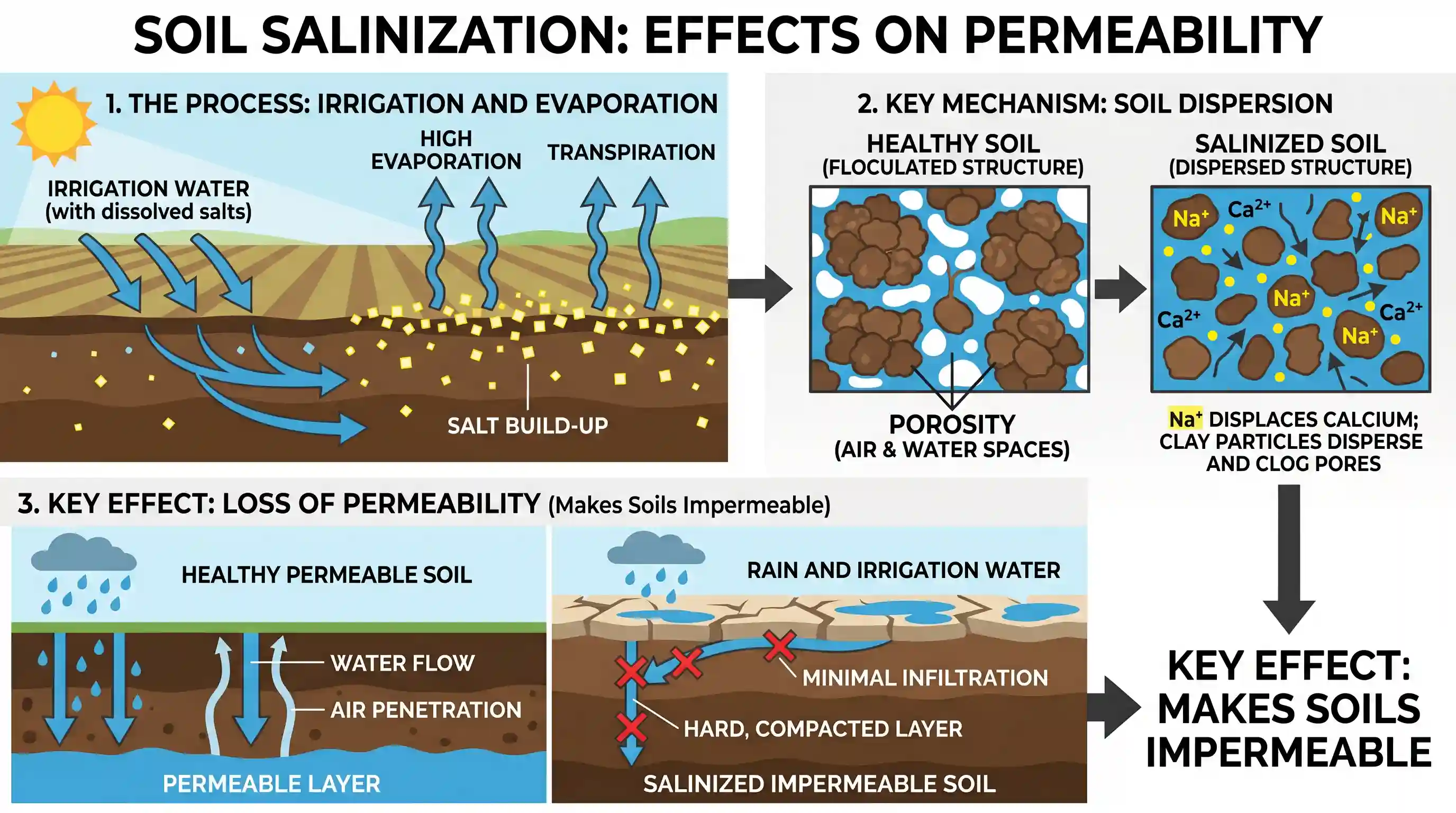
Salinization occurs when the irrigation water accumulated in the soil evaporates, leaving behind salts and minerals. What are the effects of salinization on the irrigated land?

- AIt greatly increases the crop production
- BIt makes some soils impermeableCorrect
- CIt raises the water table
- DIt fills the air spaces in the soil with water
Explanation
Salinization leads to the accumulation of salts like sodium on the soil surface and within its layers. High levels of sodium cause soil particles to disperse, which destroys the soil structure and creates a hard, compacted layer. This process significantly reduces the porosity of the soil, making it increasingly impermeable to water and air. While high water tables can cause salinization, it is the accumulation of salts itself that directly leads to the loss of permeability in the soil. Therefore, option B is the most accurate consequence of salinization on irrigated land.
Related questions
More UPSC Prelims practice from the same subject and topic.
- Prelims 2011GS1geography
The formation of ozone hole in the Antarctic region has been a cause of concern. What could be the reason for the formation of this hole?
- Prelims 2011GS1geography
Regarding “carbon credits”, which one of the following statements is not correct?
- Prelims 2011GS1geography
When the bark of a tree is removed in a circular fashion all around near its base, it gradually dries up and dies because
- Prelims 2011GS1geography
Three of the following criteria have contributed to the recognition of Western Ghats-Sri Lanka and Indo-Burma regions as hotspots of biodiversity: 1. Species richness 2. Vegetation density 3. Endemism…
- Prelims 2011GS1geography
Human activities in the recent past have caused the increased concentration of carbon dioxide in the atmosphere, but a lot of it does not remain in the lower atmosphere because of 1. its escape into t…
- Prelims 2011GS1geography
In the context of ecosystem productivity, marine upwelling zones are important as they increase the marine productivity by bringing the 1. decomposer microorganisms to the surface. 2. nutrients to the…