The lowering of Bank Rate by the Reserve Bank of India leads to

- AMore liquidity in the marketCorrect
- BLess liquidity in the market
- CNo change in the liquidity in the market
- DMobilization of more deposits by commercial banks
Explanation
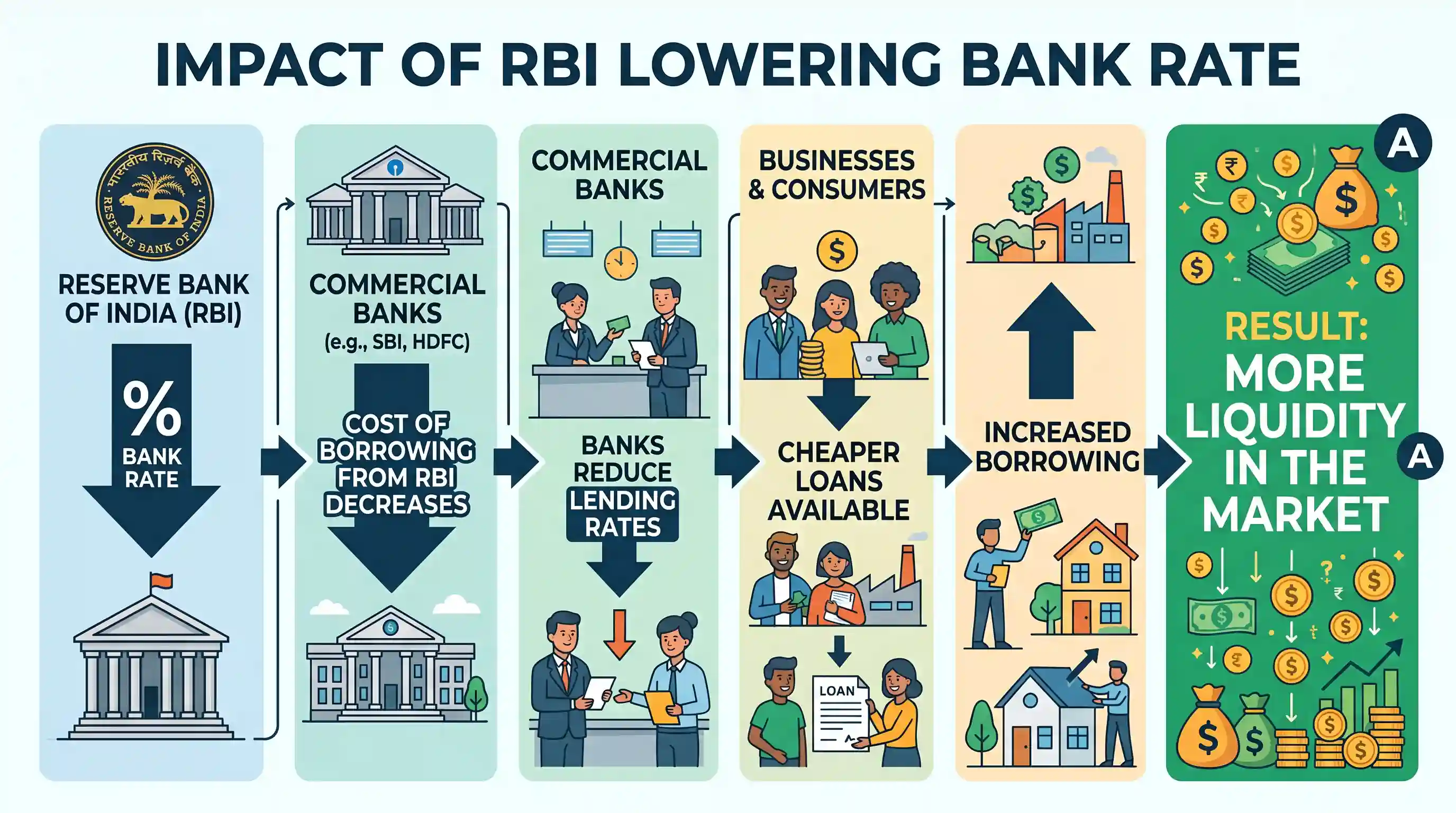
The Bank Rate is the interest rate at which the Reserve Bank of India lends long term funds to commercial banks. When the RBI lowers the Bank Rate, the cost of borrowing for commercial banks decreases. This allows banks to reduce their own lending rates for businesses and consumers. As loans become cheaper, more people and companies borrow money, which increases the money supply circulating in the economy. This process results in more liquidity in the market. Therefore, option A is the correct answer.
Related questions
More UPSC Prelims practice from the same subject and topic.
- Prelims 2011GS1economy
Microfinance is the provision of financial services to people of low-income groups. This includes both the consumers and the self-employed. The service/services rendered under microfinance is/are: 1. …
- Prelims 2011GS1economy
Why is the offering of "teaser loans" by commercial banks a cause of economic concern? 1. The teaser loans are considered to be an aspect of sub-prime lending and banks may be exposed to the risk of d…
- Prelims 2011GS1economy
In the Union Budget 2011-12, a full exemption from the basic customs duty was extended to the bio-based asphalt (bioasphalt). What is the importance of this material? Unlike traditional asphalt, bio-a…
- Prelims 2011GS1economy
India has experienced persistent and high food inflation in the recent past. What could be the reasons? 1. Due to a gradual switchover to the cultivation of commercial crops, the area under the cultiv…
- Prelims 2011GS1economy
In terms of economy, the visit by foreign nationals to witness the XIX Common Wealth Games in India amounted to
- Prelims 2011GS1economy
Which one of the following statements appropriately describes the "fiscal stimulus"?