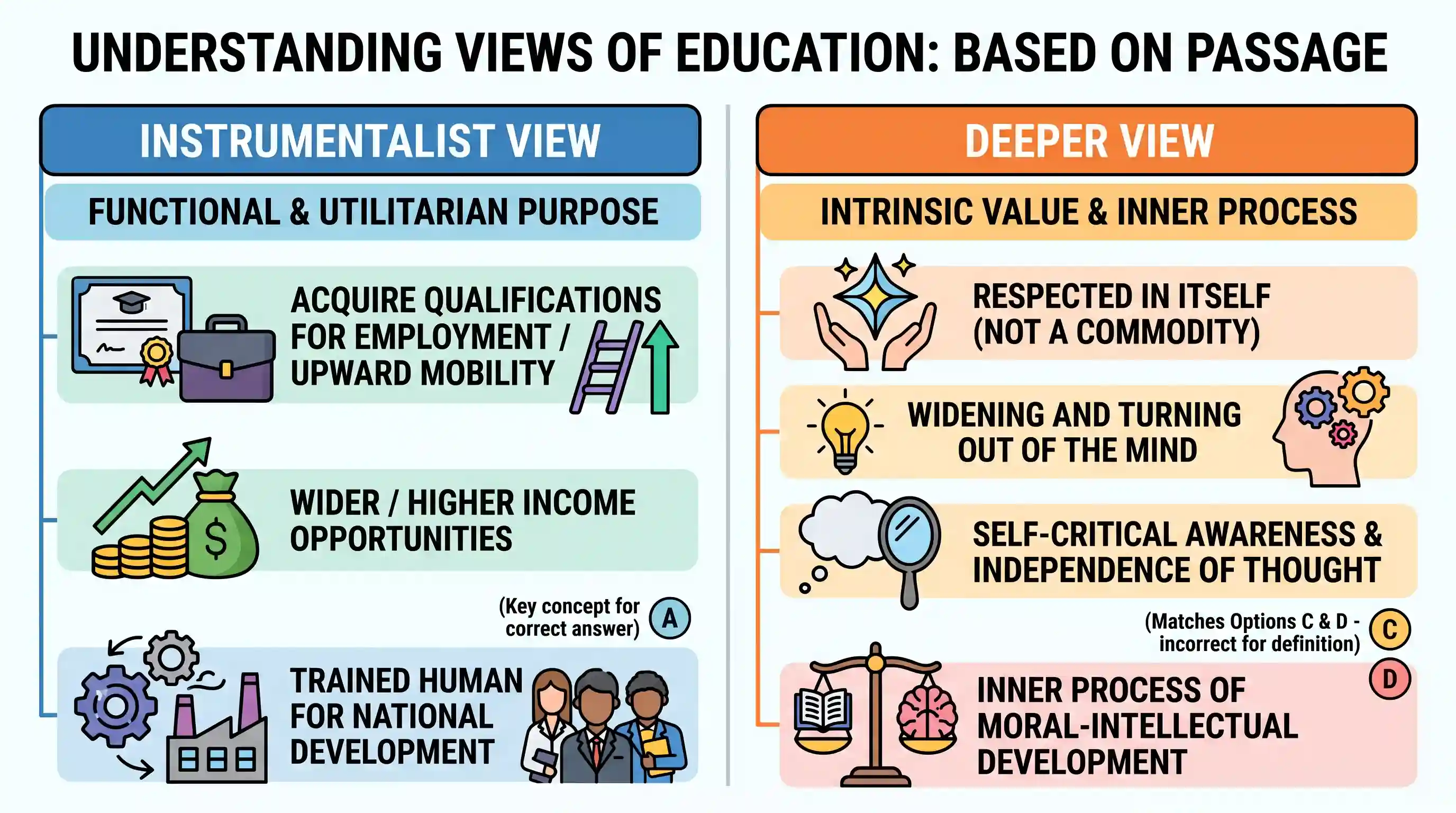
Read the following passages and answer the items that follow passage. Your answer to these items should be based on the passage only. Education, without a doubt, has an important functional, instrumental and utilitarian dimension. This is revealed when one asks question such as what is the purpose of education? The answers, too often, are to acquire qualifications for employment/upward mobility, wider/higher in terms of income opportunities, and to meet the needs for trained human power diverse fields for national development. But in its deepest sense education is not instrumentalist. That is to say, it is not to be justified outside of itself because it leads to the acquisition of formal skills or of certain desired psychological social attributes. It must be respected in itself. Education is thus not a commodity to be acquired or possessed and then used, but a process of inestimable importance to individuals and society, although it can and does have enormous use value. Education then, is a process at expansion and conversion, not in the sense of converting or turning students into doctors or engineers, but the widening and turning out of the mind- the creation, sustenance and development of self- critical awareness independence of thought. It is an inner process of moral- intellectual development. What you understand by the instrumentalist view of education?

- AEducation is functional and utilitarian in its purposesCorrect
- BEducation is meant to fulfil human needs
- CThe purpose of education is to train the human intellect
- DEducation is meant to achieve moral development
Explanation
The correct answer is A because the passage explicitly defines the instrumentalist dimension of education in the opening sentences. It states that education has a functional, instrumental, and utilitarian dimension, which is revealed when looking at its purpose, such as acquiring qualifications for employment, higher income, and meeting national development needs. While the author later argues that education has a deeper intrinsic value, the term instrumentalist specifically refers to the practical, goal oriented use of education as a tool for external outcomes like jobs and utility. Options C and D refer to the deeper, non instrumentalist view of education described later in the text.
Related questions
More UPSC Prelims practice from the same subject and topic.
- Prelims 2012CSATReading Comprehension
Read the following passages and answer the items that follow passage. Your answer to these items should be based on the passage only. Education, without a doubt, has an important functional, instrumen…
- Prelims 2012CSATReading Comprehension
Read the following passages and answer the items that follow passage. Your answer to these items should be based on the passage only. Education, without a doubt, has an important functional, instrumen…
- Prelims 2012CSATReading Comprehension
Read the following passages and answer the items that follow passage. Your answer to these items should be based on the passage only. Chemical pesticides lose their role in sustainable agriculture if …
- Prelims 2012CSATReading Comprehension
Read the following passages and answer the items that follow passage. Your answer to these items should be based on the passage only. Chemical pesticides lose their role in sustainable agriculture if …
- Prelims 2012CSATReading Comprehension
Read the following passages and answer the items that follow passage. Your answer to these items should be based on the passage only. Chemical pesticides lose their role in sustainable agriculture if …
- Prelims 2012CSATReading Comprehension
Read the following passages and answer the items that follow passage. Your answer to these items should be based on the passage only. Chemical pesticides lose their role in sustainable agriculture if …