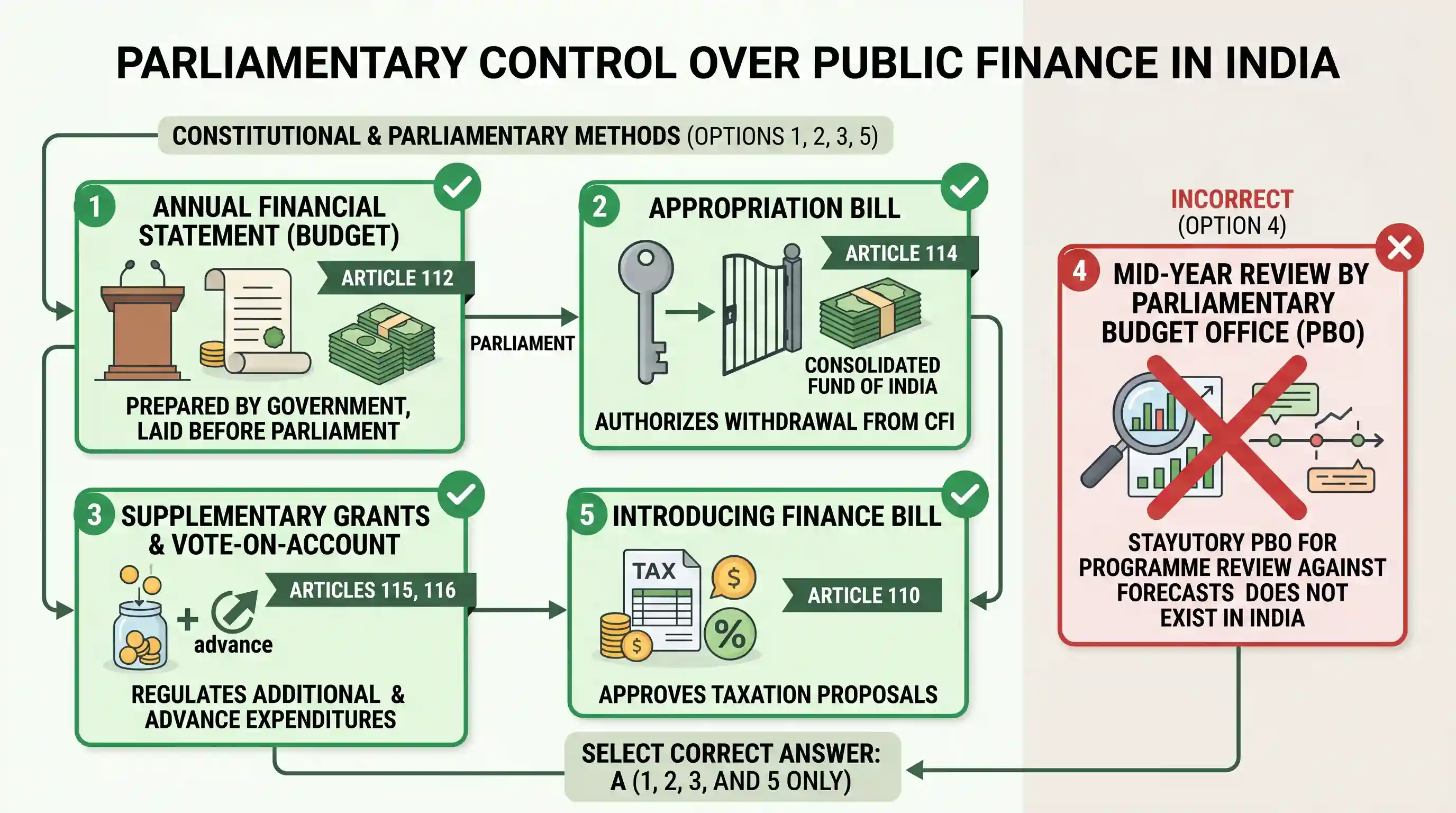
Which of the following are the methods of Parliamentary control over public finance in India? 1. Placing Annual Financial Statement before the Parliament 2. Withdrawal of moneys from Consolidated Fund of India only after passing the Appropriation Bill 3. Provisions of supplementary grants and vote-on-account 4. A periodic or at least a mid-year review of programme of the Government against macroeconomic forecasts and expenditure by a Parliamentary Budget Office 5. Introducing Finance Bill in the Parliament Select the correct answer using the codes given below:

- A1, 2, 3 and 5 onlyCorrect
- B1, 2 and 4 only
- C3, 4 and 5 only
- D1, 2, 3, 4 and 5
Explanation
The correct option is A because statements 1, 2, 3, and 5 represent established constitutional and parliamentary mechanisms for controlling public finance in India.
Statement 1 is correct as Article 112 mandates the President to lay the Annual Financial Statement (Budget) before both Houses of Parliament.
Statement 2 is correct because Article 114 states that no money can be withdrawn from the Consolidated Fund of India except under appropriation made by law.
Statement 3 is correct as supplementary grants (Article 115) and vote on account (Article 116) are constitutional tools that allow Parliament to regulate additional or advance expenditures.
Statement 5 is correct because the Finance Bill, introduced under Article 110, is the instrument through which Parliament approves the governments taxation proposals.
Statement 4 is incorrect because there is no formal Parliamentary Budget Office in India that performs a statutory mid-year review of programs against macroeconomic forecasts. While the Finance Ministry may conduct reviews under the FRBM Act, it is not a direct method of parliamentary control executed by a dedicated Parliamentary Budget Office as described in the statement.