The acidification of oceans is increasing. Why is this phenomenon a cause of concern? 1. The growth and survival of calcareous phytoplankton will be adversely affected. 2. The growth and survival of coral reefs will be adversely affected. 3. The survival of some animals that have phytoplanktonic larvae will be adversely affected. 4. The cloud seeding and formation of clouds will be adversely affected. Which of the statements given above is/are correct?

- A1, 2 and 3 onlyCorrect
- B2 only
- C1 and 3 only
- D1, 2, 3 and 4
Explanation
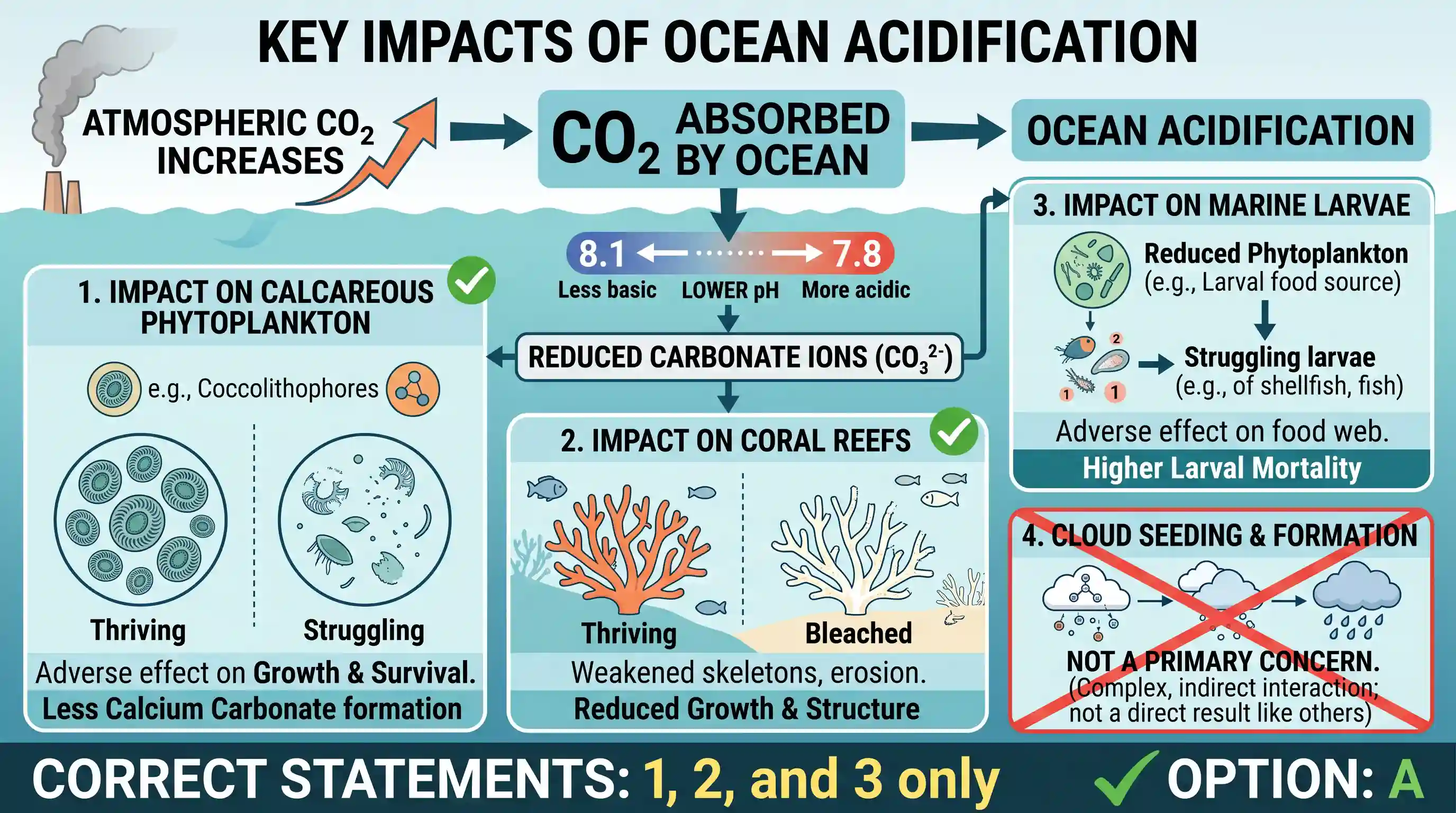
Ocean acidification is primarily caused by the absorption of excess carbon dioxide by the oceans, leading to a decrease in pH. This phenomenon has several critical impacts on marine ecosystems.
-
The growth and survival of calcareous phytoplankton will be adversely affected. Correct. Ocean acidification reduces the availability of carbonate ions, which are essential building blocks for organisms that form shells or skeletons from calcium carbonate (calcification). Calcareous phytoplankton, such as coccolithophores, rely on these ions and will struggle to grow and survive.
-
The growth and survival of coral reefs will be adversely affected. Correct. Coral reefs are built by corals that secrete calcium carbonate skeletons. Reduced carbonate ion availability makes it harder for corals to build and maintain their structures, leading to slower growth, weakened skeletons, and increased vulnerability to erosion.
-
The survival of some animals that have phytoplanktonic larvae will be adversely affected. Correct. If calcareous phytoplankton (a crucial part of the marine food web) are negatively impacted, the food source for many marine larvae that feed on phytoplankton will diminish. This can lead to reduced survival rates for these larval stages, impacting the populations of various marine animals.
-
The cloud seeding and formation of clouds will be adversely affected. Incorrect. While there are complex interactions between ocean biology and atmospheric processes (e.g., some marine organisms produce aerosols that can influence cloud formation), the direct and primary concern of ocean acidification is not the adverse effect on cloud seeding (an artificial process) or natural cloud formation in the same direct and significant way as the biological impacts described in statements 1, 2, and 3. This is not considered a primary or immediate concern of ocean acidification.
Therefore, statements 1, 2, and 3 are correct.
The final answer is A
Related questions
More UPSC Prelims practice from the same subject and topic.
- Prelims 2012GS1geography
If National Water Mission is properly and completely implemented, how will it impact the country? 1. Part of the water needs of urban areas will be met through recycling of wastewater. 2. The water re…
- Prelims 2012GS1geography
Consider the following statements: Chlorofluorocarbons, known as ozone-depleting substances, are used 1. in the production of plastic foams 2. in the production of tubeless tyres 3. in cleaning certai…
- Prelims 2012GS1geography
Electrically charged particles from space travelling at speeds of several hundred km/sec can severely harm living beings if they reach the surface of the Earth. What prevents them from reaching the su…
- Prelims 2012GS1geography
Government of India encourages the cultivation of 'sea buckthorn'. What is the importance of this plant? 1. It helps in controlling soil erosion and in preventing desertification. 2. It is a rich sour…
- Prelims 2012GS1geography
With reference to the wetlands of India, consider the following statements: 1. The country's total geographical area under the category of wetlands is recorded more in Gujarat as compared to other Sta…
- Prelims 2012GS1geography
Consider the following protected areas: 1. Bandipur 2. Bhitarkanika 3. Manas 4. Sunderbans Which of the above are declared Tiger Reserves?