A deadlock between the Lok Sabha and the Rajya Sabha calls for a joint sitting of the Parliament during the passage of 1. Ordinary Legislation 2. Money Bill 3. Constitution Amendment Bill Select the correct answer using the codes given below:

- A1 onlyCorrect
- B2 and 3 only
- C1 and 3 only
- D1, 2 and 3
Explanation
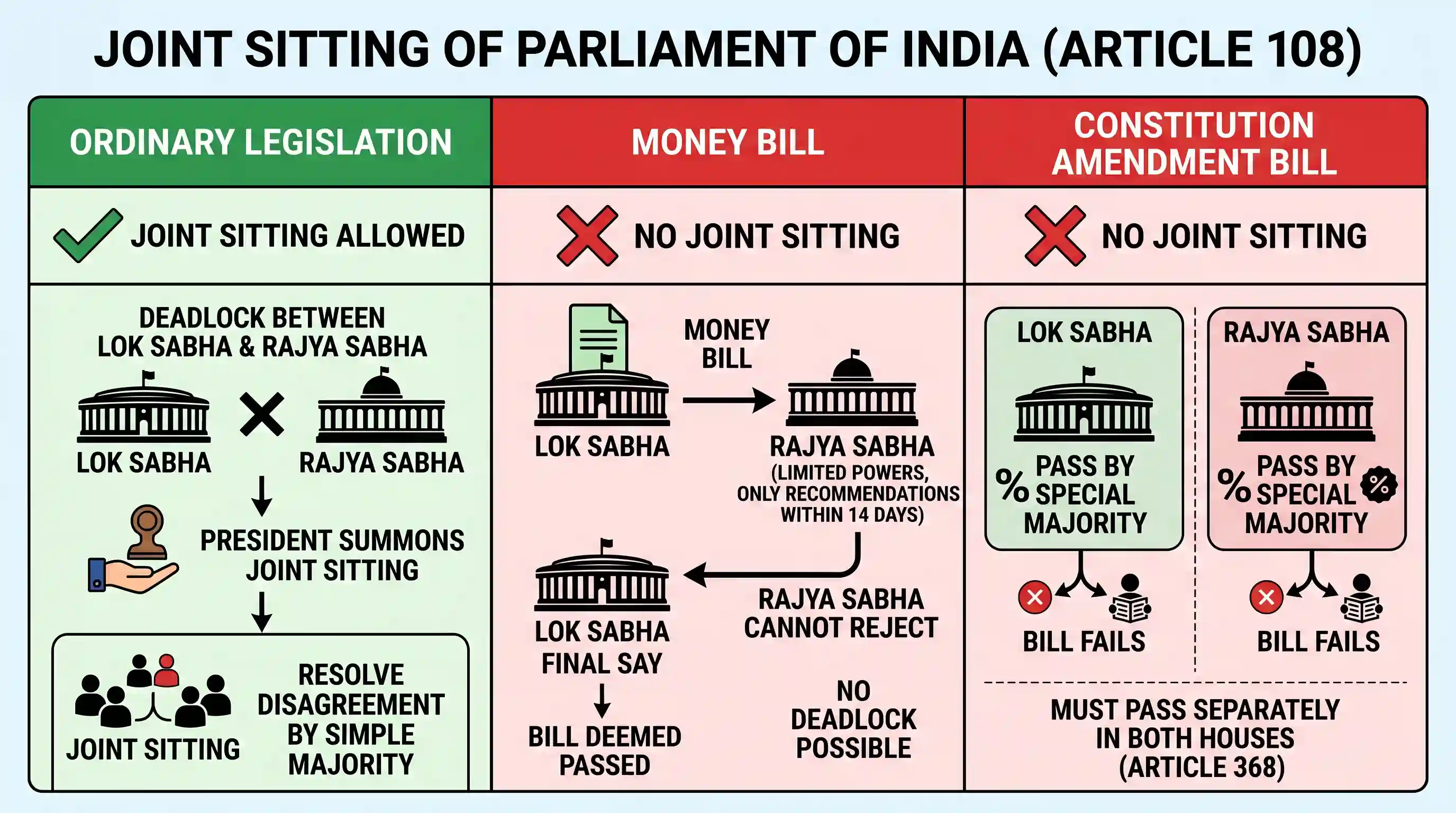
The correct answer is A because the provision for a joint sitting of Parliament under Article 108 applies only to Ordinary Bills and Financial Bills Type I and II. It does not apply to Money Bills or Constitution Amendment Bills for the following reasons:
-
Ordinary Legislation: If a deadlock occurs between the two houses, the President can summon a joint sitting to resolve the disagreement.
-
Money Bill: The Rajya Sabha has very limited powers regarding Money Bills. It can only make recommendations which the Lok Sabha is free to accept or reject. Since the Lok Sabha has the final say, no deadlock can occur, and thus no joint sitting is permitted.
-
Constitution Amendment Bill: Under Article 368, a Constitution Amendment Bill must be passed by each house separately by a special majority. There is no provision for a joint sitting to resolve a disagreement on such bills; if one house rejects the bill, it simply fails.
Related questions
More UPSC Prelims practice from the same subject and topic.
- Prelims 2012GS1polity-and-governance
Consider the following statements: 1. Union Territories are not represented in the Rajya Sabha. 2. It is within the purview of the Chief Election Commissioner to adjudicate the election disputes. 3. A…
- Prelims 2012GS1polity-and-governance
Regarding the office of the Lok Sabha Speaker, consider the following statements: 1. He/She holds the office during the pleasure of the President. 2. He/She need not be a member of the House at the ti…
- Prelims 2012GS1polity-and-governance
The Prime Minister of India, at the time of his/her appointment
- Prelims 2012GS1polity-and-governance
According to the Constitution of India, it is the duty of the President of India to cause to be laid before the Parliament which of the following? 1. The Recommendations of the Union Finance Commissio…
- Prelims 2012GS1polity-and-governance
In the areas covered under the Panchayat (Extension to the Scheduled Areas) Act, 1996, what is the role/power of Gram Sabha? 1. Gram Sabha has the power to prevent alienation of land in the Scheduled …
- Prelims 2012GS1polity-and-governance
In the Parliament of India, the purpose of an adjournment motion is: