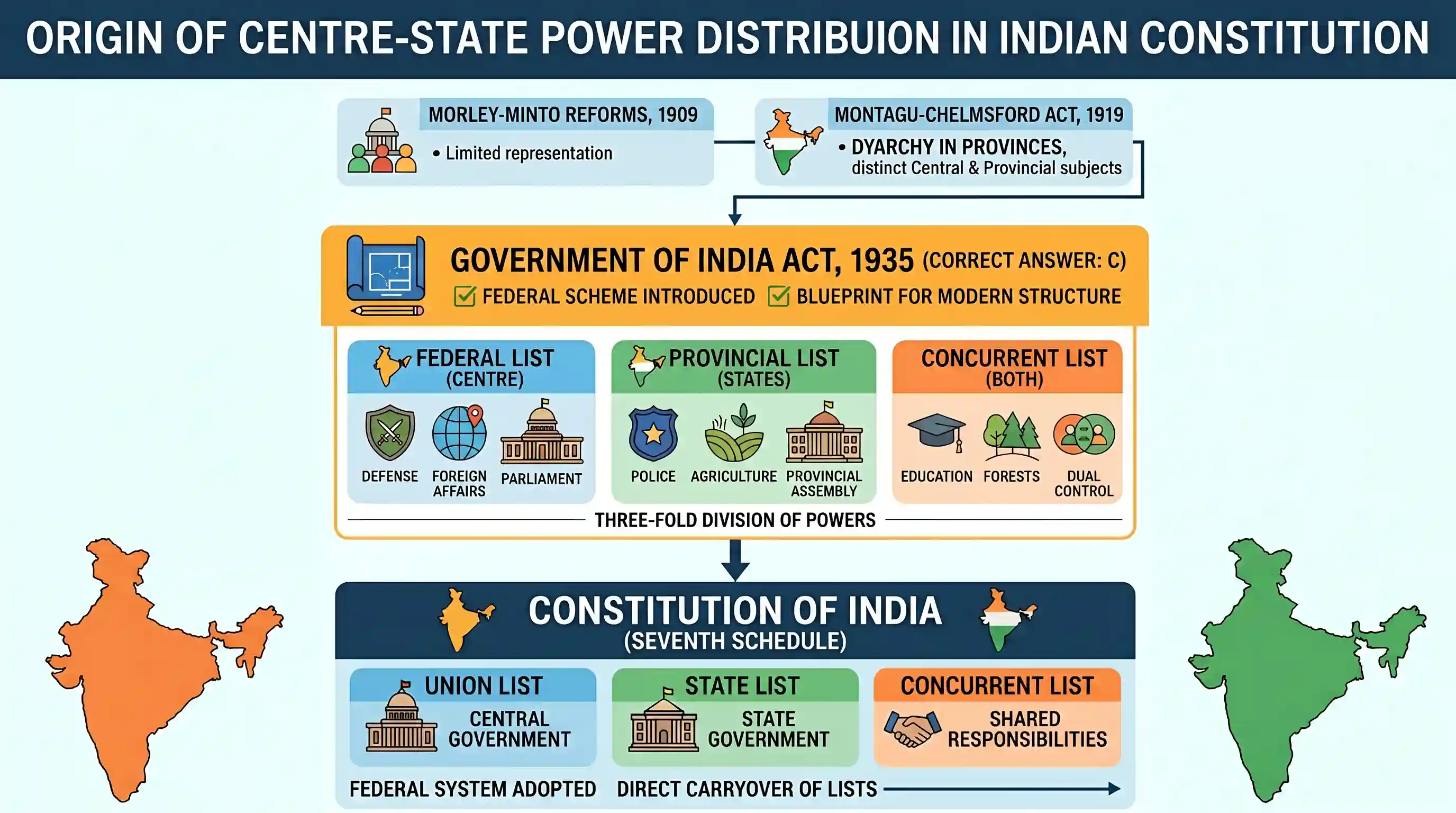
The distribution of powers between the Centre and the States in the Indian Constitution is based on the scheme provided in their:

- AMorley-Minto Reforms, 1909
- BMontagu-Chelmsford Act, 1919
- CGovernment of India Act, 1935Correct
- DIndian Independence Act, 1947
Explanation
The correct answer is C because the Government of India Act of 1935 introduced a federal structure for India. It established a clear division of powers by categorizing legislative subjects into three distinct lists: the Federal List for the Centre, the Provincial List for the provinces, and the Concurrent List for both. The Indian Constitution adopted this tripartite distribution of powers almost entirely, forming the basis of the current Seventh Schedule. While the 1919 Act introduced dyarchy at the provincial level, it was the 1935 Act that provided the comprehensive federal blueprint used in the modern Constitution.
Related questions
More UPSC Prelims practice from the same subject and topic.
- Prelims 2012GS1polity-and-governance
Which of the following special powers have been conferred on the Rajya Sabha by the Constitution of India?
- Prelims 2012GS1polity-and-governance
In the areas covered under the Panchayat (Extension to the Scheduled Areas) Act, 1996, what is the role/power of Gram Sabha? 1. Gram Sabha has the power to prevent alienation of land in the Scheduled …
- Prelims 2012GS1polity-and-governance
In the Parliament of India, the purpose of an adjournment motion is:
- Prelims 2012GS1polity-and-governance
How does National Biodiversity Authority (NBA) help in protecting the Indian agriculture? 1. NBA checks the biopiracy and protects the indigenous and traditional genetic resources. 2. NBA directly mon…
- Prelims 2012GS1polity-and-governance
The National Green Tribunal Act, 2010 was enacted in consonance with which of the following provisions of the Constitution of India? 1. Right to healthy environment, construed as a part of Right to li…
- Prelims 2012GS1polity-and-governance
Consider the following provisions under the Directive Principles of State Policy as enshrined in the Constitution of India: 1. Securing for citizens of India a uniform civil code 2. Organizing village…