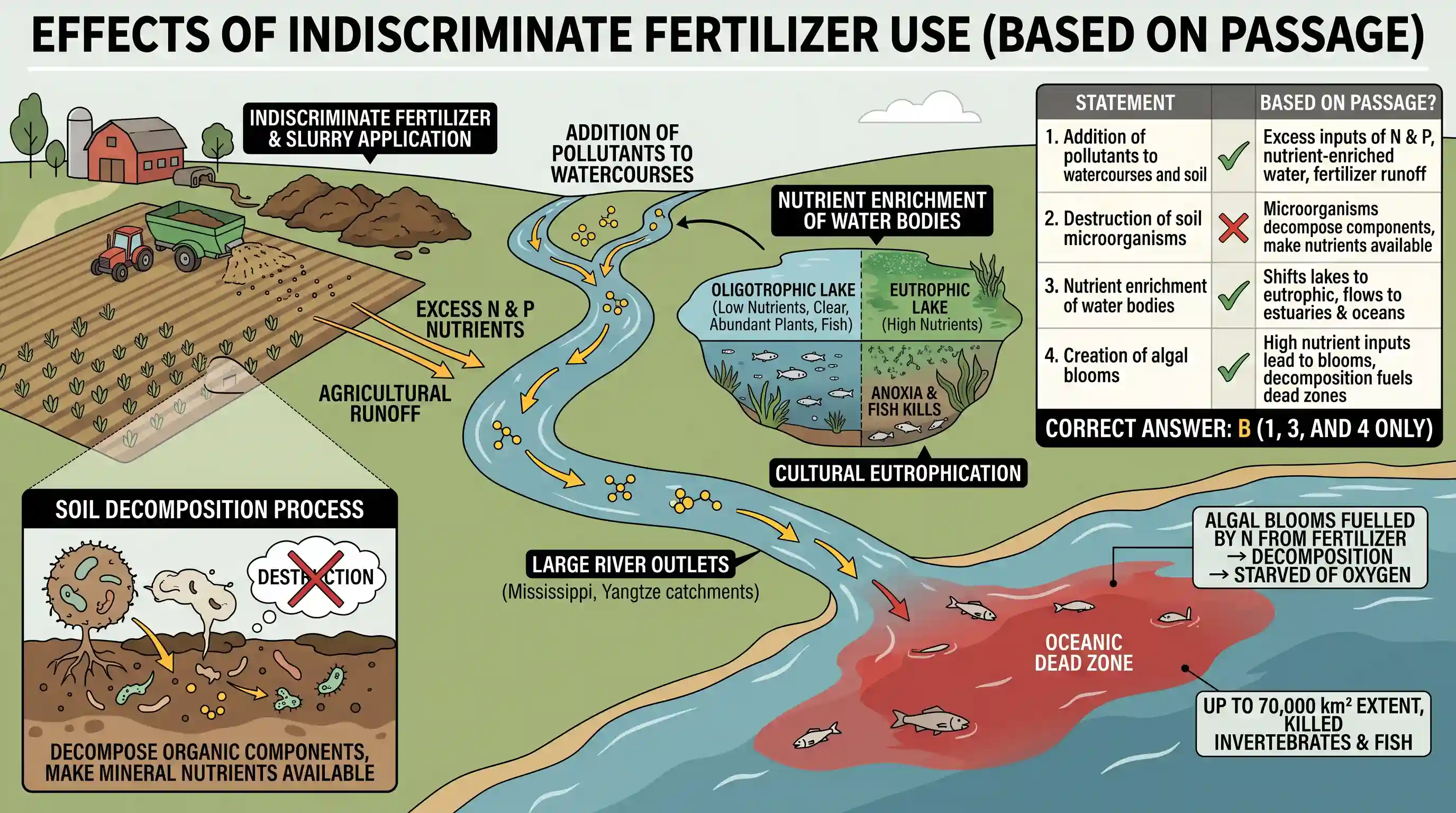
Read the following passages and answer the items that follow passage. Your answers to these items should be based on the passages only The law in many parts of the world increasingly restricts the discharge of agricultural slurry into watercourses. The simplest and often the most economically sound practice returns the material to the land as semisolid manure or as sprayed slurry. This dilutes its concentration in the environment to what might have occurred Ill a more primitive and sustainable type of agriculture and converts pollutant into fertilizer. Soil microorganisms decompose the organic components of sewage and slurry and most of the mineral nutrients become available to be absorbed again by the vegetation. The excess input of nutrients, both nitrogen and phosphorus - based, from agricultural runoff (and human sewage) has caused many 'healthy' oligotrophic lakes (low nutrient concentrations, low plant productivity with abundant water weeds, and clear water) to change to eutrophic condition where high nutrient inputs lead to high phytoplankton productivity (sometimes dominated by bloom- forming toxic species). This makes the water turbid, eliminates large plants and, in the worst situations, leads to anoxia and fish kills; so called cultural eutrophication. Thus, important ecosystem services arc lost, including the provisioning service of wild- caught fish and the cultural services associated with recreation. The process of cultural eutrophication of lakes has been understood for some time. But only recently did scientists notice huge 'dead zones' in the oceans near river outlets, particularly those draining large catchment areas such as the Mississippi in North America and the Yangtze in China. The nutrient- enriched water flows through streams, rivers and lakes, and eventually to the estuary and ocean where the ecological impact may be huge, killing virtually all invertebrates and fish in areas up to 70,000 km2 in extent. More than 150 sea areas worldwide are now regularly starved of oxygen as a result of decomposition of algal blooms, fuelled particularly by nitrogen from agricultural runoff of fertilizers and sewage from large cities. Oceanic dead zones are typically associated with industrialized nations and usually lie off- 'countries that subsidize their agriculture, encouraging farmers to increase productivity and use more fertilizer. According to the passage, what are the effects of indiscriminate use of fertilizers? 1. Addition of pollutants to the soil and water. 2. Destruction decomposer of microorganisms in soil. 3. Nutrient enrichment of water bodies. 4. Creation of algal blooms. Select the correct answer from the codes given below:

- A1, 2 and 3 only
- B1, 3 and 4 onlyCorrect
- C2 and 4 only
- D1, 2, 3 and 4
Explanation
The question must be answered from the passage alone. Statement 1 is supported: the passage discusses laws restricting discharge of agricultural waste into watercourses, excess nitrogen- and phosphorus-based inputs from agricultural runoff (and sewage) harming lakes and seas, and nitrogen from agricultural runoff of fertilizers fuelling oxygen loss—i.e. harmful nutrient/pollutant loads reaching water (and the land–water pathway from fertilizer use). Statement 2 is not supported: the passage says soil microorganisms decompose organic matter in sewage and slurry and make mineral nutrients available again; it does not say indiscriminate fertilizer use destroys decomposer microorganisms. Statement 3 is supported: nutrient-enriched water flows through streams, rivers and lakes to estuaries and oceans, and excess nutrient input from runoff shifts lakes from oligotrophic to eutrophic. Statement 4 is supported: high nutrient inputs lead to high phytoplankton productivity including bloom-forming toxic species, and dead zones follow decomposition of algal blooms fuelled by nitrogen from agricultural runoff of fertilizers. Therefore statements 1, 3 and 4 follow from the passage; 2 does not. The correct code is B.
Related questions
More UPSC Prelims practice from the same subject and topic.
- Prelims 2013CSATReading Comprehension
Read the following passage and answer the two items that follow. Your answers to these items should be based on the passage only. Passage Ecological - research over the last quarter of the century has…
- Prelims 2013CSATReading Comprehension
What is the purpose of maintaining the continuity of forested landscapes and corridors? 1. Preservation of biodiversity. 2. Management of mineral resources. 3. Grant of forest lands for human activiti…
- Prelims 2013CSATReading Comprehension
Read the following passages and answer the items that follow passage. Your answers to these items should be based on the passages only The law in many parts of the world increasingly restricts the dis…
- Prelims 2013CSATReading Comprehension
Read the following passages and answer the items that follow passage. Your answers to these items should be based on the passages only The law in many parts of the world increasingly restricts the dis…
- Prelims 2013CSATReading Comprehension
Read the following passages and answer the items that follow passage. Your answers to these items should be based on the passages only . The law in many parts of the world increasingly restricts the d…
- Prelims 2013CSATReading Comprehension
Read the following passages and answer the items that follow passage. Your answers to these items should be based on the passages only . The law in many parts of the world increasingly restricts the d…