Five people A, B, C, D and E are, seated about a round table, Every chair is spaced equidistant from adjacent chairs, I. C is seated next to A. II. A is seated two seats from D. III. B is not seated next to A. Which of the following must be true? I. D is seated next to B. II. E is seated next to A. Select the correct answer from the codes given below:

- AI only
- BII only
- CBoth I and IICorrect
- DNeither I nor II
Explanation
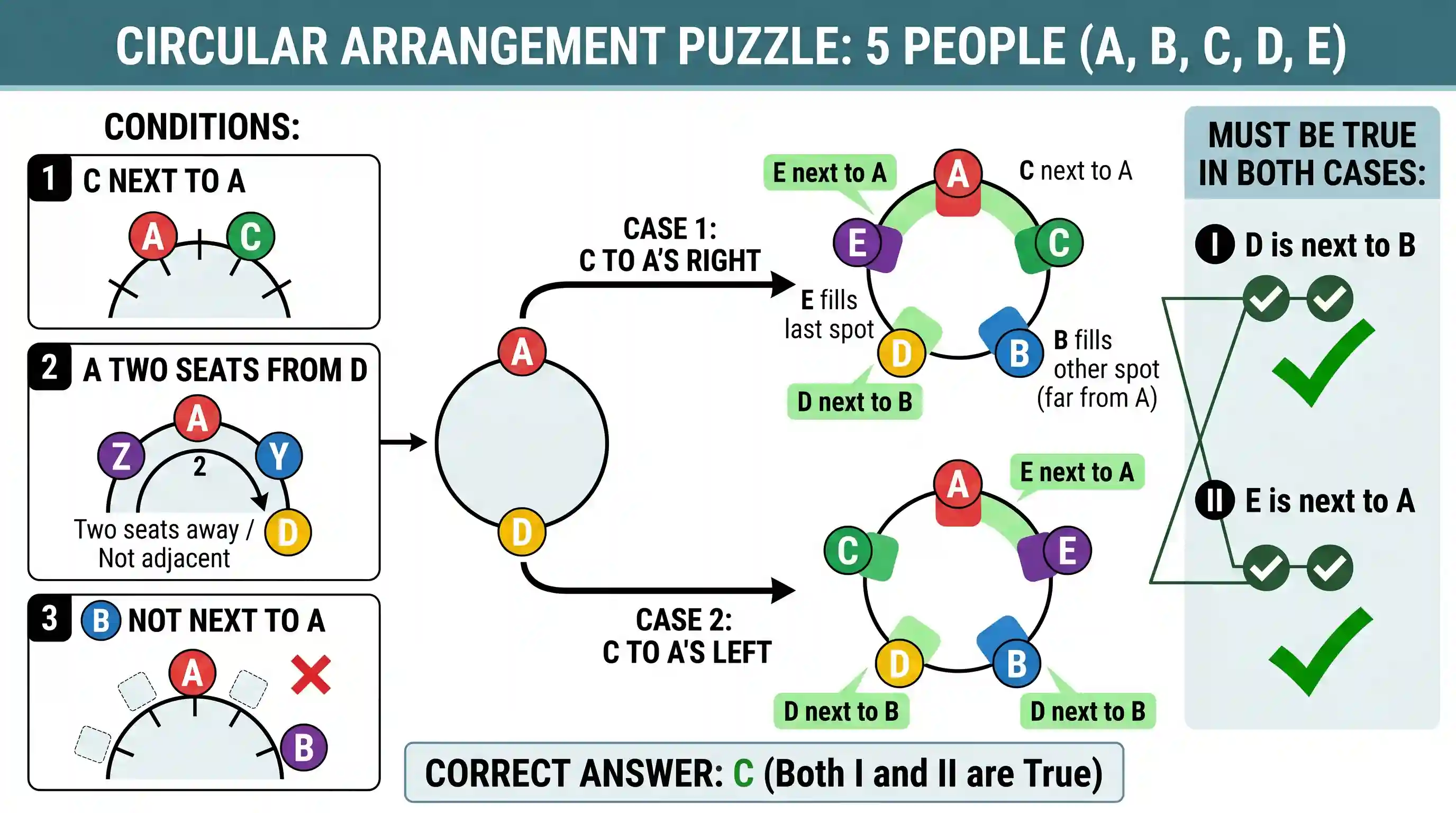
The problem involves arranging five people (A, B, C, D, E) around a round table based on three conditions. The key to solving this is correctly interpreting "A is seated two seats from D". In a circular arrangement of 5 people, "two seats from D" means there are exactly two people between A and D in one direction (e.g., clockwise), and consequently, one person between them in the other direction (counter-clockwise). This implies A and D are not adjacent.
Let's deduce the possible arrangements:
Conditions:
- C is seated next to A.
- A is seated two seats from D (meaning two people between them in one direction, one in the other).
- B is not seated next to A.
Let's place A and D first based on condition 2. If we place A, then D must be two seats away in one direction. Assume A is at position 1. Then D is at position 4 (with positions 2 and 3 between them clockwise). So, the structure is A _ _ D _. The remaining person is at position 5.
Now, apply condition 1: C is next to A. Case 1: C is to A's right (at position 2). Arrangement: A C _ D _ The empty slots are position 3 (between C and D) and position 5 (between D and A). These must be filled by B and E. So, A C (X) D (Y), where X and Y are B and E.
Apply condition 3: B is not seated next to A. A's neighbors are C (at position 2) and Y (at position 5). Therefore, B cannot be Y. This means B must be X (at position 3). So, the arrangement becomes A C B D Y. The remaining person Y must be E. Arrangement 1 (clockwise): A C B D E.
Let's verify Arrangement 1 (A C B D E):
- C is next to A: Yes (C is to A's right).
- A is two seats from D: Yes (C and B are between A and D clockwise).
- B is not next to A: Yes (B is next to C and D, not A). This arrangement is valid.
Case 2: C is to A's left (at position 5). Arrangement: A _ _ D C The empty slots are position 2 (between A and D) and position 3 (between the person at 2 and D). These must be filled by B and E. So, A (X) (Y) D C, where X and Y are B and E.
Apply condition 3: B is not seated next to A. A's neighbors are X (at position 2) and C (at position 5). Therefore, B cannot be X. This means B must be Y (at position 3). So, the arrangement becomes A X B D C. The remaining person X must be E. Arrangement 2 (clockwise): A E B D C.
Let's verify Arrangement 2 (A E B D C):
- C is next to A: Yes (C is to A's left).
- A is two seats from D: Yes (E and B are between A and D clockwise).
- B is not next to A: Yes (B is next to E and D, not A). This arrangement is valid.
These two arrangements (A C B D E and A E B D C) are reflections of each other and are the only possible configurations.
Now, let's check the given statements against both valid arrangements:
Statement I: D is seated next to B.
- In Arrangement 1 (A C B D E): D is next to B. (True)
- In Arrangement 2 (A E B D C): D is next to B. (True) Since D is next to B in both possible arrangements, Statement I must be true.
Statement II: E is seated next to A.
- In Arrangement 1 (A C B D E): E is next to A (E is to A's left). (True)
- In Arrangement 2 (A E B D C): E is next to A (E is to A's right). (True) Since E is next to A in both possible arrangements, Statement II must be true.
Both Statement I and Statement II must be true.
The final answer is C) Both I and II.
Related questions
More UPSC Prelims practice from the same subject and topic.
- Prelims 2013CSATLogical Reasoning
Five cities P, Q, R, S and T are connected by different modes of transport as follows: P and Q are connected by boat as well as rail. Sand R are connected by bus and boat. Q and T are connected by air…
- Prelims 2013CSATLogical Reasoning
Five cities P, Q, R, S and T are connected by different modes of transport as follows: P and Q are connected by boat as well as rail. Sand R are connected by bus and boat. Q and T are connected by air…
- Prelims 2013CSATLogical Reasoning
Five cities P, Q, R, S and T are connected by different modes of transport as follows: P and Q are connected by boat as well as rail. Sand R are connected by bus and boat. Q and T are connected by air…
- Prelims 2013CSATLogical Reasoning
Five cities P, Q, R, S and T are connected by different modes of transport as follows: P and Q are connected by boat as well as rail. Sand R are connected by bus and boat. Q and T are connected by air…
- Prelims 2013CSATLogical Reasoning
A tennis coach is trying to put together a team of four players for the forthcoming tournament. For this 7 players are available: males A, Band C; and females W, X, Y and Z. All players have equal cap…
- Prelims 2013CSATLogical Reasoning
A tennis coach is trying to put together a team of four players for the forthcoming tournament. For this 7 players are available: males A, Band C; and females W, X, Y and Z. All players have equal cap…